WÜRZBURG, GERMANY
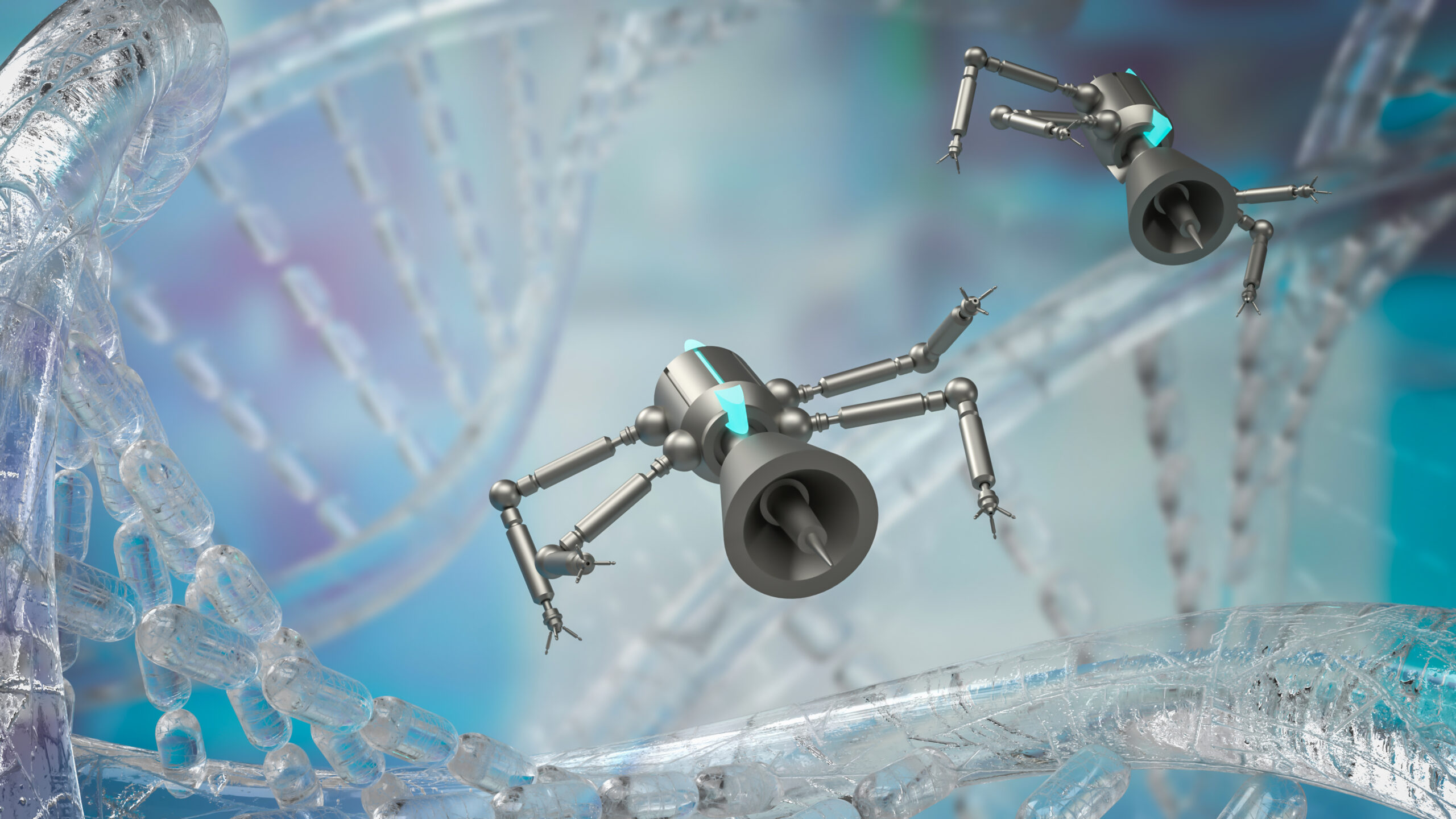
Somewhere in a physics lab at the Julius-Maximilians-Universität Würzburg, in a puddle of liquid too small to see without a microscope, tiny robots the size of a fraction of a bacterium are chasing down living microbes, grabbing them, carrying them across the sample, and dropping them off exactly where a human operator wants — all without a single moving part you'd recognize as a motor, wheel, or propeller.
There is no battery. There is no wireless signal. There is no tiny onboard computer plotting a course. The entire propulsion system is light itself — laser light, striking a nanoscale antenna, and physically pushing the machine forward through the simple, elegant physics of photon recoil, the same principle that lets sunlight nudge a solar sail through the vacuum of space, just shrunk down to a scale roughly 50 times smaller than the width of a human hair.
The research, led by physicist Bert Hecht and lead experimental scientist Jin Qin, was published this month in Nature Communications, and it represents one of the most concrete steps yet toward a decades-old dream in nanotechnology: building machines small enough to work directly inside the microscopic world, manipulating individual bacteria and cells the way a person might use a pair of tweezers — except the tweezers are made of light, and the hand holding them never has to touch anything at all.
How Do You Steer Something You Can't Touch?
The central problem facing anyone trying to build a robot at this scale is almost comically basic: how do you steer something too small to have a rudder, too small to have wheels, and too small to carry any kind of onboard guidance electronics?
Hecht's team solved it by leaning into a property of physics rather than fighting it. Their nanorobots are built with up to four plasmonic nanoantennas — tiny wire-like structures engineered to interact with light in a very specific way. These antennas absorb incoming laser light and then re-emit it in a directional beam, and the recoil from that emission — Newton's third law, acting out at the nanoscale — pushes the robot forward, the same way a rocket is pushed forward by exhaust shooting out the back.
The breakthrough that makes the whole system controllable wasn't inventing new propulsion — it was realizing they didn't need a complicated onboard steering mechanism at all. The nanoantenna wires embedded in each robot naturally want to align themselves with the polarization direction of the incoming light. By simply rotating the polarization of the laser from outside the sample — no signal sent to the robot, no antenna receiving commands — researchers can spin the orientation of the entire machine and steer it wherever they want, while the propulsion from photon recoil keeps pushing it forward the whole time.
"This is a striking example of how light can be used not only to observe the microscopic world, but also to actively shape it," Hecht said of the work.
The result is a machine that can execute genuinely startling maneuvers for something this small: rapid 90-degree turns on command, fast enough and precise enough to let it scan broad areas of a liquid sample in a systematic, organized pattern rather than drifting randomly, the way most passive microscopic particles do under Brownian motion. In practical testing, the robots reached speeds of up to 50 micrometers per second — which sounds minuscule until you remember the entire machine itself is only a few hundred nanometers across, meaning it's covering the equivalent of many times its own body length every single second, an athletic feat that would make Unitree's sprinting humanoid robots blush by comparison, pound for pound.
From Chasing to Catching
Speed and steering alone would already be a notable achievement in the nanorobotics field, where most previous "swimmers" and "walkers" have struggled to do much more than wiggle in a chosen direction. But Hecht's team pushed the demonstration further, showing that their light-driven machines could actually perform useful microscale labor: selectively capturing individual living bacteria, transporting them across a sample, and releasing them at a chosen destination.
In practice, that means the robots can act as microscopic delivery drivers, picking up a specific bacterium out of a crowded, chaotic liquid environment and moving it — intact and apparently unharmed — to wherever a researcher wants it deposited. Multiply that one-at-a-time process across many robots working in parallel, and you get something the paper's authors describe as a genuine tool for reorganizing microscopic environments under laboratory conditions: sorting bacteria by type, clearing them from a specific region of a sample, or concentrating them somewhere a researcher wants to study them more closely.
Earlier versions of similar plasmonic microrobots, described in related work published by Optica in the spring, were already being referred to informally as "nanoscale robotic cleaners" for their ability to hunt down and physically remove unwanted particles from a liquid environment — and this new work builds directly on that foundation, adding the precision steering and selective-capture capabilities that turn a promising physics demonstration into something closer to a working tool.
Why Doctors and Chemists Are Paying Attention
The applications researchers are most excited about sit squarely at the intersection of nanotechnology and medicine. Chief among them: targeted drug delivery, the long-sought goal of getting therapeutic payloads to precisely the right cell, in precisely the right location, without flooding the rest of the body with medication the way conventional pills and injections do. A robot that can be steered from outside the body — or at least outside the sample — using nothing but polarized light, with no wires, no batteries, and no onboard electronics to fail or degrade, is close to an ideal delivery vehicle in theory, even if enormous engineering challenges remain before anything like this could operate inside a living organism rather than a lab dish.
Beyond drug delivery, the team points to single-cell manipulation — the ability to isolate, move, and study one individual cell at a time rather than working with bulk populations, which could matter enormously for research into cancer biology, immunology, and microbiome science, fields where the differences between individual cells often matter as much as the averages. Researchers also see potential for the technology to serve as a kind of nanoscale sensing platform, using the same plasmonic antennas that provide propulsion to simultaneously gather information about the local chemical or biological environment as the robot moves through it.
And there's a more immediate, less glamorous application hiding in plain sight: cleanup. The ability to selectively hunt down and physically remove unwanted bacteria from a liquid sample has obvious relevance to fields like water purification, laboratory decontamination, and infection control, where being able to selectively target and physically extract a pathogen — rather than relying purely on chemical treatments that affect everything in the sample indiscriminately — could open entirely new approaches.
The Long Road From Lab Dish to Human Body
It's worth being clear-eyed about how far this technology still has to travel. Everything described in the new paper happened in a controlled laboratory sample under a microscope, with an external laser doing the steering and a research team watching in real time. Getting from "capturing bacteria in a lab dish" to "delivering medicine inside a living human being" involves an enormous number of additional engineering and biological hurdles: getting light to penetrate deep enough into living tissue to steer the robots, ensuring the materials used are biocompatible and don't trigger immune reactions, scaling up from single robots to swarms capable of meaningful therapeutic effect, and proving the whole system is safe across the kind of rigorous trials medical regulators require.
None of that is trivial, and researchers in the field have historically been cautious about overpromising timelines for nanomedicine — a field that has produced plenty of dazzling lab demonstrations over the past two decades without yet delivering many machines that make it into an actual doctor's toolkit. Still, the specific combination this team achieved — battery-free propulsion, external steering with no onboard electronics, and demonstrated selective capture of a real biological target — represents a meaningfully more complete package than most prior nanorobot demonstrations, which tended to nail one or two of those properties while falling short on the others.
What This Means for You
You won't be getting a light-powered nanorobot injection at your next doctor's visit — this technology remains firmly in the research phase, likely years if not decades from any clinical application. But if you or someone you love has ever dealt with a stubborn bacterial infection resistant to standard antibiotics, or a cancer treatment that damaged healthy tissue along with the tumor because there was no way to target the medicine more precisely, this is exactly the kind of foundational physics breakthrough that eventually makes those more precise treatments possible. Every major advance in targeted medicine — from the first chemotherapy drugs designed to target dividing cells to today's antibody-drug conjugates — started with someone in a lab figuring out a fundamentally new way to control something too small to touch. This is that moment, for light-powered robotics.
It's also a reminder that not every major scientific headline needs to come with a flashy demo video or a billion-dollar valuation attached. While the tech world spent this week marveling at a sprinting humanoid robot and a record-breaking stock market debut, a much quieter team of German physicists was making arguably the more consequential kind of progress: not a machine that mimics human athleticism for show, but one that does something no human, and no larger robot, could ever physically do — reach into the microscopic world and rearrange it, one bacterium at a time.
The Bottom Line
Hecht and Qin's light-driven nanorobots won't be curing diseases next year. But they represent a genuine and well-documented leap in humanity's ability to control the microscopic world using nothing but beams of light, building directly on physics first described by Einstein and Planck a century ago and pointing toward a future where medicine, water treatment, and microbiology research could all be reshaped by machines too small to ever see with the naked eye.
Published By | Tech Wiz