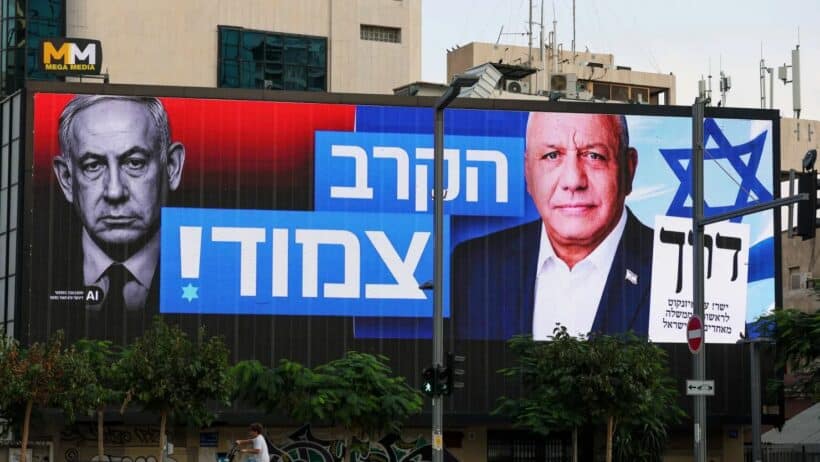
As ballots are tallied after a record-turnout election, the exit-poll picture of an opposition edge has given way to a narrow lead for the incumbent camp, with the decisive soldiers' and absentee ballots still to come.
World Politics
Introduction
A day after Israelis voted in what many commentators framed as a referendum on Benjamin Netanyahu's leadership, the country still does not know who will govern it. The exit polls broadcast on Tuesday night suggested a dead heat, with some projections giving Gadi Eisenkot's opposition bloc a slight edge. As actual ballots have been counted on Wednesday, the picture has shifted: Netanyahu's right-wing and religious bloc has pulled ahead, with Likud confirmed as the largest single party, but neither camp is anywhere near the 61 seats needed for a majority in the 120-seat Knesset.
What looked on election night like an opposition triumph has become something more ambiguous and more dangerous for political stability. Both leaders have claimed the mandate of the voters. Netanyahu says the right bloc holds a majority and has called for a national right-wing government. Eisenkot, a former army chief of staff who now leads the party Yashar, declared that the public chose change and that the prime minister is now a caretaker. The final arithmetic will not be known for days, and the outcome may ultimately turn on tens of thousands of ballots from soldiers, hospital patients and diplomats that have not yet been verified.
Background: A Referendum on a Long Tenure
The campaign was fought against the backdrop of the October 7, 2023 Hamas-led attacks, the long war in Gaza, escalating violence in the occupied West Bank and a tense confrontation with Iran. Netanyahu, who has dominated Israeli politics for most of the past three decades, sought to persuade voters that only he could manage the security threats Israel faces. Eisenkot, supported by an array of centrist and left-leaning parties, argued that the country needed a new era and a government that could rebuild public trust.
Nine days before the vote, President Donald Trump publicly endorsed Netanyahu, a move that was widely reported and that Netanyahu's allies embraced. After the first projections came in, Trump shared a social media post crediting his endorsement for shifting momentum toward the prime minister. That claim has not been independently verified, and it is too early to tell how much influence, if any, the endorsement had on the result.
Turnout was extraordinary by Israeli standards. According to the Central Elections Committee, 77.7 percent of eligible voters took part, the highest since 1999 and 7.1 percentage points above the 2022 election. Military turnout was reported at close to 80 percent, and more than 60,000 Israelis returned from abroad to vote. High turnout complicates simple narratives, since it appears to have mobilized both the right-wing base and Arab citizens, whose parties are on course for one of their strongest showings.

Key Developments: The Numbers Move
The most reliable figures available come from partial counts reported by Israeli outlets on Wednesday, and they should be treated as provisional. With roughly half of the vote counted, Ynet reported Netanyahu's bloc at 55 seats, Eisenkot's bloc at 49, and the Arab parties at 16. Likud was projected at 27 seats, Eisenkot's Yashar at 21, the Joint List at 12, Naftali Bennett's Beyachad at 11, the Democrats at 9, United Torah Judaism at 9, Yisrael Beytenu at 8, Shas at 7, Otzma Yehudit at 6, Religious Zionism-Zehut at 6 and Ra'am at 4. The Netanyahu bloc was six seats short of a majority at that point.
Other outlets and the television exit polls produced somewhat different ranges, which illustrates how fluid the picture remains. Tuesday's exit polls put the Netanyahu bloc at 51 to 52 seats and the opposition at 49 to 51. By Wednesday morning, the television projections had the opposition falling to 47 and Netanyahu's bloc rising to between 53 and 57. Combined Arab representation was projected at 16 to 19 seats. Sources also differ on how to classify some parties, so bloc totals vary by outlet. The only safe conclusion is that Netanyahu's camp is ahead but short, and the opposition is behind but not out.
The reason the final result is so uncertain is the so-called double-envelope ballots. These are votes cast by soldiers, reservists, diplomats, hospital patients and displaced Israelis, estimated at between 600,000 and 650,000, and they require separate verification that could run into Friday. Historically these ballots have tended to favor Zionist parties, which could help Netanyahu's bloc, though the effect on individual parties is hard to predict. Several large communities, including Arab towns such as Rahat, Sakhnin and Kafr Qasim, had also not reported a single polling station in the partial tally. Official results are formally due to be published on November 4. Financial markets reacted nervously, with the shekel weakening sharply as the preliminary results arrived.
Reactions: Two Claims of Victory
Eisenkot spoke on election night as though the opposition had won. He said the public had voted for change, called on Netanyahu to step down, and warned him not to use security matters for political purposes. Yair Golan, leader of the Democrats, said voters had fired the Netanyahu government and described a historic opportunity to build a government of change. Yair Lapid said Netanyahu's bloc had suffered a crushing defeat, a characterization that reflected the exit polls and sits uneasily with the later counts.
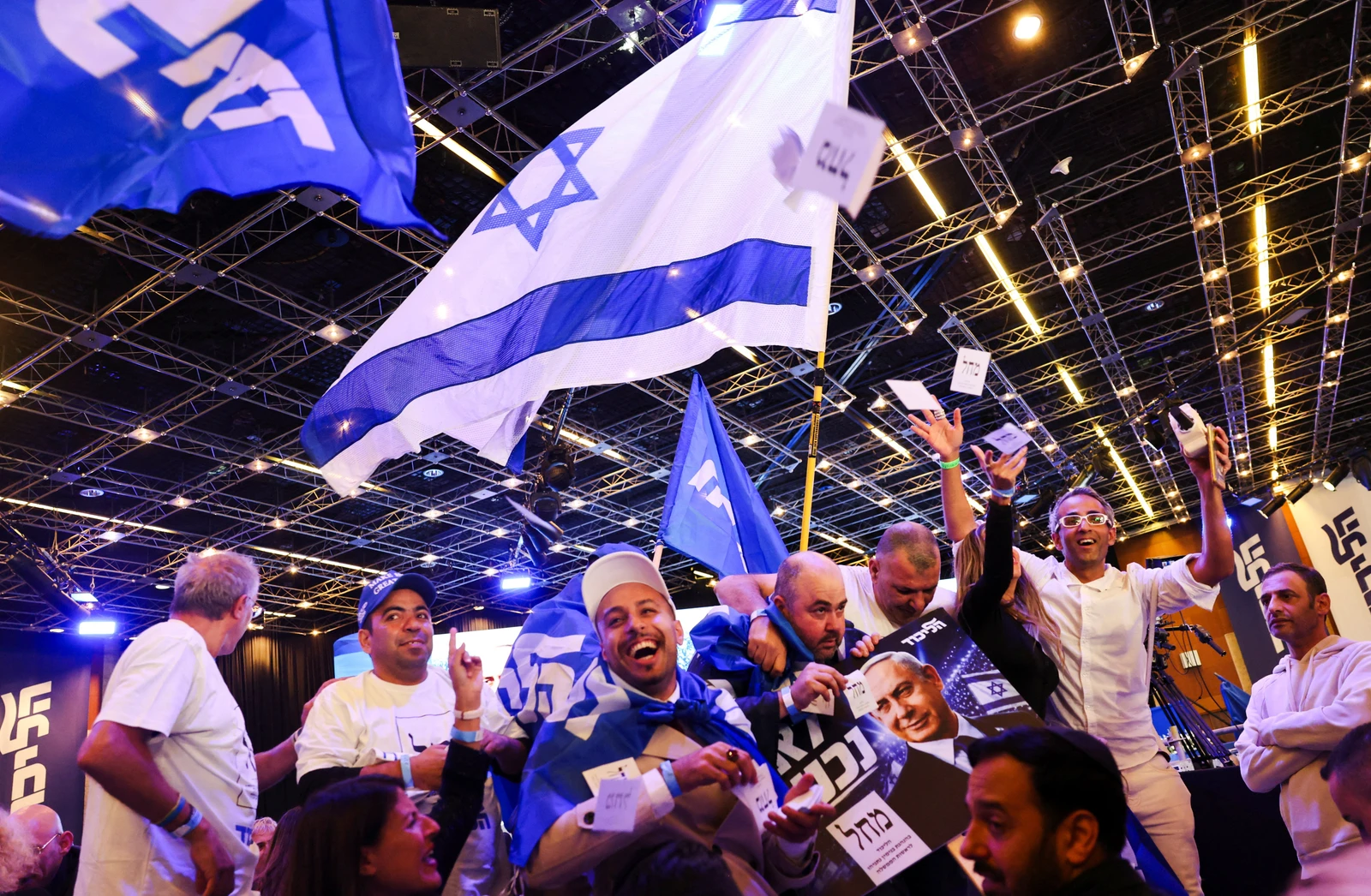
Netanyahu's response was to claim the arithmetic in his favor. He said Likud was the largest party and that the right bloc had a majority, urged Zionist forces to unite, and called for a national right-wing government. He also alleged that the television channels had projected stronger results for the opposition in order to discourage his supporters. Itamar Ben-Gvir praised his party's performance and warned against any unity government with Eisenkot, while Bezalel Smotrich vowed to continue expanding Jewish settlements in the West Bank.
The campaign's final days were marked by bitter exchanges over Arab voters. Arab party leaders, including Mansour Abbas of Ra'am and Yousef Jabareen, accused Netanyahu of inciting hatred against Palestinian citizens of Israel. They pointed to his post on X describing Arab voters as Muslim Brotherhood supporters accused of raiding polling stations, and his appeal to right-wing voters to back Likud as a matter of life and death. Abbas expressed hope that the final results would give the opposition and his party the numbers needed to govern.
The Coalition Puzzle
Even if the counting ends with Netanyahu's bloc at 55 to 57 seats, it would still need to find four to six more mandates, and few obvious partners exist. The opposition parties have said they will not join a Netanyahu-led government, and Eisenkot has specifically rejected serving under Netanyahu, including in a rotation arrangement in which the two would alternate as prime minister. A broad unity government therefore looks unlikely on present positions, though Israeli politics has a long history of reversals.
The opposition faces its own arithmetic problem. Without the Arab parties, Eisenkot's bloc cannot reach 61, yet several opposition figures are reluctant to depend on Arab-led factions for a majority. Golan is the only opposition leader described as open to relying on them. A minority government that survives on outside support is a theoretical option for either side, but it would be fragile. There is also an unresolved question about who would lead the opposition camp, since Eisenkot wants the head of its largest party to be its prime ministerial candidate and no agreement has been announced.
If neither side can assemble a majority, Israel faces the prospect of yet another election, extending an era of repeated polls that voters had hoped was over. In that scenario Netanyahu and his current cabinet would remain in office as a caretaker government, a status that would give him continued control of the machinery of state through a period in which decisions about Iran, Gaza and the West Bank remain pending.
What Happens Next
The formal process is laid out in law. Once the final count is complete, President Isaac Herzog will consult the leaders of the newly elected factions and ask which candidate they recommend for prime minister. He then nominates the person he believes is best placed to form a government. That nominee has up to 42 days to do so, with the possibility of extensions under Israeli procedure. Israeli commentators have already asked whether Herzog faces an impossible choice between Netanyahu and Eisenkot, particularly if each can claim the recommendations of roughly equal numbers of Knesset members.
The coming days will test several assumptions. Observers will watch whether the double-envelope ballots move Netanyahu's bloc closer to a majority or leave it stranded, whether any party such as Bennett's Beyachad or Yisrael Beytenu signals willingness to cross bloc lines, and whether the ultra-Orthodox parties maintain their alignment with Netanyahu. They will also watch whether the tone of the campaign hardens into a dispute over the legitimacy of the results; Netanyahu's complaint about television projections could be an early sign.
Outside Israel, Washington, which backed Netanyahu so openly, and Gulf and European capitals will be watching closely. The coalition outcome will shape the future of the stalled Gaza peace framework, Israel's posture toward Iran and the prospects of normalization with Arab states. For now, the only certainty is uncertainty: a deeply divided electorate has produced a Knesset in which neither camp can govern alone, and the political bargaining that follows may last weeks.
Published By | News Editor