Background
The Falkland Islands — Las Malvinas to Argentines — are a self-governing British overseas territory roughly 13,000 kilometres from the United Kingdom and a few hundred from the Argentine coast. Britain has administered them since 1833. Argentina argues it inherited Spanish sovereignty over the archipelago in the nineteenth century and has never accepted British possession. Britain points to the length of its administration and, more insistently in the modern era, to the wishes of the islanders themselves: in a 2013 referendum, 1,513 of 1,517 voters backed remaining a British overseas territory. Around 4,000 people live there.
The dispute became a war in 1982, when Argentina's military junta seized the islands and Margaret Thatcher's government despatched a task force to retake them. Seventy-four days of fighting left 649 Argentine and 255 British service members dead. The war ended the junta and hardened British policy: since 1982, no British government of any party has entertained sovereignty negotiations, and self-determination has been the doctrine's load-bearing wall.
Washington's position has been more delicate. The United States has historically recognised Britain's de facto administration of the islands without formally endorsing either side's sovereignty claim — a studied ambiguity that has, in practice, worked heavily in London's favour, because Britain has always been able to count on being the closer of the two capitals to Washington. That assumption is what Argentina's president is now testing.

Key Developments
The opening came from Trump. In an interview this week with the British broadcaster GB News, the president appeared to suggest he might not come to Britain's aid if conflict erupted with Argentina over the islands, linking the question explicitly to London's refusal to join the American campaign against Iran. The UK "was not there to help me" with the war, he said. "We didn't need help, but I did ask NATO, and I asked your former leader, 'Why didn't you send a couple of ships?'" Asked separately by the BBC whether the longstanding US position on the Falklands was under review, Trump replied: "I always review every position. That's just one of many."
The remarks did not emerge from nowhere. They followed reports that US defence officials had considered using Washington's Falklands position as leverage to press London on military spending, up to and including opposing British sovereignty. A leaked Pentagon email in April had proposed reviewing US support for the British position precisely as pressure over the UK's refusal to back American action against Iran.
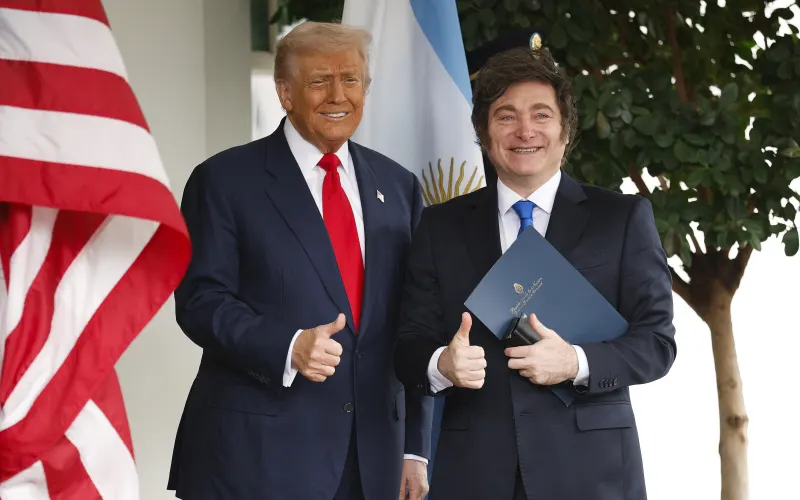
President Javier Milei seized the moment. In a nationally televised address on Thursday night he declared that the "winds of change blowing around the world" now favoured Argentina's claim. "The United States is considering this change in position because it knows that Argentina has a reliable partner, aligned with Western values, in a strategically important position that can be a valuable ally in the decades to come," he said.
He paired the rhetoric with concrete measures. Milei announced he would sign a decree that same night to accelerate sanctions procedures against companies involved in oil extraction in what he called Argentine territory under British occupation. The penalties would extend beyond the operators themselves to their shareholders, directors and suppliers, effectively barring any firm with a direct or indirect connection to the project from doing business on Argentine soil. He also announced new funding for a naval base in Tierra del Fuego, Argentina's southernmost province, to strengthen the military presence near the islands. "Argentina will not stand idly by," he said. "Any further advance on the Malvinas Islands will be considered a violation of our national security." And, in a line aimed squarely at domestic critics: "We can argue about my style. We can disagree over fiscal or exchange-rate policy. But there are causes that rise above any political difference. The Malvinas is one of them."
The target is the Sea Lion field, roughly 220 kilometres north of the archipelago in the North Falkland Basin, in about 450 metres of water. Israel's Navitas Petroleum operates the project with a 65 percent stake; Britain's Rockhopper Exploration holds 35 percent. The partners took a final investment decision in December 2025 worth $1.8 billion for the first phase, against estimated reserves of about 1.7 billion barrels. In August, Navitas exercised a $125 million purchase option on the vessel OSX-1, intended to serve as a second floating production, storage and offloading unit alongside the Aoka Mizu.
There is a factual discrepancy worth flagging. Milei said in his address that the project "has a date to begin offshore oil production sometime in the coming months." The consortium's published schedule places drilling in early 2027 and first oil in 2028. Neither claim has been independently reconciled, and the gap matters: it is the difference between an imminent fait accompli and a project still years from producing a barrel.

Reactions
Markets moved first. Rockhopper shares fell more than 10 percent on the London Stock Exchange on Friday, to 69 pence, before recovering to around 72.9 pence, some 6.5 percent below the previous close. Navitas fell about 2.3 percent in Tel Aviv. Borders & Southern Petroleum, an AIM-listed company holding licences in the South Falkland Basin around the Darwin discovery, also fell despite having no stake in Sea Lion at all — a sign that investors are pricing a jurisdiction, not a single project.
The operators pushed back the same day. In a joint statement issued to London's Regulatory News Service under the title "Sea Lion Operator Update following Media Reports," the partnership said it "operates pursuant to valid petroleum licences lawfully granted to it by the government of the Falkland Islands, a self-governing UK Overseas Territory, and with the full and ongoing support of the UK Government," and that it did not expect recent developments to have a material effect on development activities or the timetable.
British officials rebuffed Milei firmly. A spokesman for Prime Minister Andy Burnham, Tom Wells, called the government's position "long-standing and unwavering," adding that sovereignty rests with the UK and that the islanders' right to self-determination is paramount, citing the 2013 referendum. Wes Streeting wrote on X that "Milei's statement overnight tells us more about domestic politics in Argentina than it does about the Falkland Islands" — Al Jazeera identified him as defence secretary, and a separate line of reporting attributed a similar "unwavering" statement to Foreign Secretary Ed Miliband; outlets have not been consistent on which minister said what, and readers should treat the attributions with care even though the substance of the British position is not in dispute.
The row acquired an unusual outside voice when Yair Netanyahu, son of the Israeli prime minister, wrote in Spanish on X that "the Falkland Islands belong to Argentina," accusing Britain of hypocrisy and angering parts of the British right.
Analysts were markedly cooler than the rhetoric. Christoph Bluth of the University of Bradford noted that Trump has not endorsed Argentina's sovereignty claim at all — only said the US position is under review — and that the idea appears to have originated inside the Pentagon as leverage over British defence spending rather than from any reassessment of the dispute itself. Klaus Dodds of Royal Holloway, University of London, said abandoning neutrality would break a fundamental tenet of post-1982 US policy and could be read as Trump rewarding Milei while punishing Britain, and that Milei would take advantage wherever he could. Tilmann Altenberg of Cardiff University called Trump's comments "first and foremost a reflection on the relationship between the US and the UK, rather than a deliberate shift in US policy," while conceding they might give Milei a "window of opportunity" ahead of Argentina's 2027 election. Matthew Benwell, a specialist on the islands' geopolitics, said the remarks would cause unease in both London and Stanley but cautioned against reading them as policy change. Andrés Malamud, of the Institute of Social Sciences in Lisbon, was blunter still, forecasting that the same thing would happen as with Greenland: nothing.
What's Next
The practical ceiling on Argentine action is low and well understood in Buenos Aires. Argentina cannot physically stop production at Sea Lion. What it can do is raise the cost and the risk — through sanctions on suppliers and insurers, through litigation, and through the chilling effect on financing. That regime already exists in embryonic form: Resolution 133/2012 of Argentina's Energy Secretariat declared Rockhopper's activity clandestine, and in December 2025 the Foreign Ministry formally warned individuals, companies, financial institutions, suppliers and insurers about the consequences of participating in unauthorised operations. This week, environmental lawyers and 1982 war veterans filed a lawsuit in Argentina challenging the legality of the permits and the project's potential environmental impact. Milei's decree is an intensification of an existing campaign, not the opening of a new one.
Three things are worth watching. The first is the decree's actual text and scope — specifically whether the extension to shareholders, directors and suppliers is drafted broadly enough to touch the international service and insurance firms a deepwater development depends on. The second is whether the drilling timetable slips; the operators say it will not, and their statement to the market is a legally consequential commitment. The third is whether Washington does anything at all. A formal change in the US sovereignty position would be historically significant, but analysts on both sides of the Atlantic doubt it is coming, and even if it did, it would not oblige Britain to negotiate.
The deeper story may be the one Milei is telling at home. Argentina votes for president in 2027, and the Malvinas remain one of the few causes that unite an otherwise fractured electorate — a point Milei made explicitly. He has spent his term positioning Argentina as Washington's closest ideological partner in Latin America: a $20 billion American financial lifeline last year tied to his party's legislative performance, additional beef export access after La Libertad Avanza won, appearances at pro-Trump events, attendance at Trump's second inauguration, a handshake at the Board of Peace signing in Davos in January. He has been called Trump's "favourite president." Whether that alignment can be converted into anything on the Falklands is doubtful. Whether it can be converted into votes is a different and, for Milei, more immediately useful question.
Published By | News Editor