Written By | Fashion and Design Desk
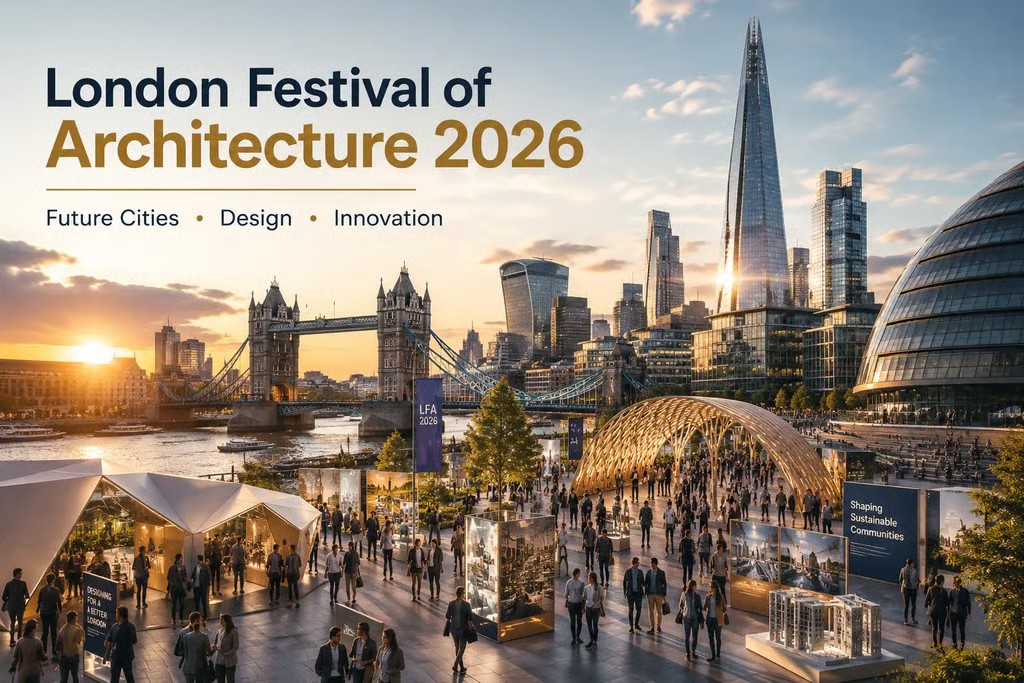
Londin Festival
LONDON
Halfway through June, London is in a conversation it has been avoiding for years. The London Festival of Architecture — a month-long programme of talks, installations, walks, and provocations — has chosen "Belonging" as its 2026 theme. The question is not gentle: who was this city designed for, and what would it take for everyone to actually feel at home?
A Theme Set by Those Who Know Exclusion
The curation panel included Black Females in Architecture, community designer Tayshan Hayden-Smith, and decolonisation specialist Rumi Bose. The result is a festival that feels less like a glossy showcase and more like an uncomfortable, politically engaged reckoning. For the first time, a central hub at The London Centre in Guildhall helps visitors navigate over 400 events across 11 neighbourhoods.
Installations That Stop You in the Street
Outside St Paul's Cathedral, reused granite stones — repurposed from demolished infrastructure — have been arranged into democratic public seating. At the Barbican, Studio Folk and Raskl installed "The Veggery," celebrating community growing projects as a form of claiming space. At Earls Court, the Design Museum's "Future Observatory" explores natural stone construction — a reminder that belonging is also about the materials we build with.
The Hardest Questions
The Palestine Collective's "Belonging(s) Beyond Borders" narrates displacement without apology. "A Simultaneous Agreement" at Kingston extends the question to non-human belonging — ecosystems and waterways. And "My Utopia," a short-film series, features disabled individuals describing genuinely inclusive architecture in their own words. These are testimonies, not polished manifestos.
Walking, Talking, Taking Part
The festival offers over 100 free or low-cost workshops and tours. Walks trace Huguenot silk-weavers, Windrush-era boarding houses, and new Somali and Eritrean community centres. A stone-carving masterclass connects to ancient craft. Özgül Öztürk's "Belonging is Built Here" invites visitors to shape earthen bricks and inscribe them with personal stories of exclusion or welcome. The bricks become the installation — a structure literally made of lived experience. That may be the festival's most precise statement: belonging is not something architecture grants. It is built, collectively, by everyone who insists on being part of the city. The festival runs until June 30. There is still time to show up and ask — loudly, in public — whose city this actually is.



