Every October, when the Royal Institute of British Architects hands out its Stirling Prize for the year's best new building, a quieter but arguably more consequential award is announced alongside it. The Neave Brown Award for Housing doesn't celebrate the flashiest structure or the most photogenic skyline addition. It celebrates something harder: housing that is genuinely affordable, architecturally ambitious, and built for people who need it most. This year's shortlist, announced this week, makes the case that those three qualities can still coexist even as Britain's housing crisis grinds on.
Honoring a Namesake Who Believed Social Housing Could Be Beautiful
The award takes its name from Neave Brown, the modernist architect and social housing pioneer who died in 2018 and whose most famous work — the Alexandra Road Estate in Camden — remains one of the few purely residential developments in Britain ever granted listed status. Brown spent his career arguing, against the grain of an industry that often treated social housing as an afterthought, that low-cost housing deserved the same architectural care and ambition as any prestige commercial project. Nearly a decade after his death, the award bearing his name continues to test whether that belief holds up in practice, year after year, project after project.
The Four Shortlisted Schemes
This year's four finalists, drawn from winners of the broader RIBA UK Awards 2026, span the country and a range of approaches to the same underlying problem.
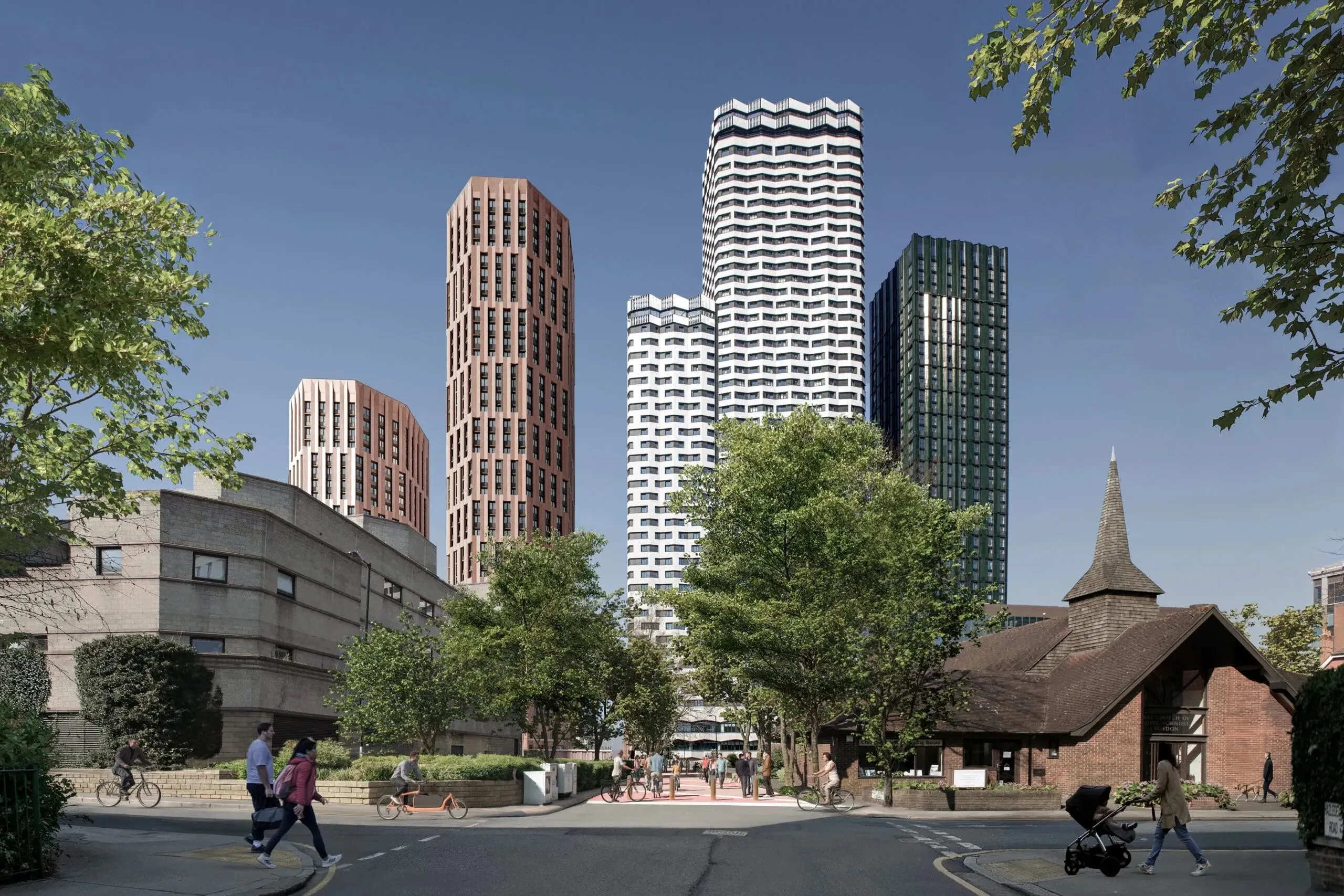
Lion Green Road, designed by Mary Duggan Architects working with RUFF Architects, delivers 157 homes across five distinct pavilions in Croydon, organized around shared communal landscaping — an attempt to build density without sacrificing the sense of a shared neighborhood.
Canada Water Plot K1, from Morris + Company and White Ink, contributes 79 homes within British Land's much larger Canada Water masterplan in London, embedding affordable housing directly inside one of the capital's most closely watched regeneration projects.
Rowan Court, designed by Satish Jassal, takes a different approach entirely: rather than building new from scratch, it transforms a disused 1970s estate in Seven Sisters, north London, into 46 homes for social rent — a model of adaptive reuse that keeps embodied carbon low while still delivering a fully modernized living environment.
St Andrew's Drive Phases 2 and 3, designed by jmarchitects in Glasgow, rounds out the list with 120 affordable homes delivered through a mix of stacked maisonettes, apartments and terraced housing, arranged around shared green space — a suburban-density approach to social housing that prioritizes outdoor access alongside the units themselves.
Why the Judges Chose These Projects
RIBA president Chris Williamson framed the shortlist as evidence that architectural ambition and public policy goals can move in the same direction rather than working against each other. "This year's shortlisted projects demonstrate how high-quality affordable homes can meet both community needs and environmental ambitions," Williamson said in RIBA's announcement. "They also demonstrate the skill and care that architects bring to the Prime Minister's aim of increasing the supply of great affordable housing."
That framing matters because it ties the award directly to a live political target. The UK government has made housing supply — and affordable housing supply specifically — one of its headline domestic priorities, and RIBA's shortlist functions as a kind of proof of concept: examples the government, local authorities and private developers can point to when arguing that "affordable" doesn't have to mean architecturally compromised.
A Model Worth Studying: Adaptive Reuse at Rowan Court
Among the four, Rowan Court stands out for what it represents strategically rather than just aesthetically. Converting a disused 1970s estate into 46 modern, socially rented homes sidesteps many of the costs and carbon impacts associated with ground-up construction, while still delivering the kind of comprehensive transformation that new-build advocates often assume only demolition and rebuilding can achieve. As embodied carbon becomes an increasingly central metric in how the architecture industry judges its own projects — alongside operational energy use and construction cost — schemes like Rowan Court offer a template that other cities grappling with aging, underused housing stock may look to replicate.
The Stakes Beyond the Awards Ceremony
It's worth being clear-eyed about what an architecture award can and can't fix. Britain's housing affordability crisis is driven by forces well beyond design quality — land costs, planning bottlenecks, construction labor shortages, interest rates and decades of underinvestment in social housing stock all play larger roles than any single building's floor plan. No shortlist, however well-curated, resolves those structural pressures.
But the Neave Brown Award does something narrower and still valuable: it keeps a public, high-profile spotlight on the argument that when architects are given real scope and real budget to work with, socially rented and affordable housing can be genuinely good — not just adequate, not just functional, but homes people would choose to live in even if they had other options. That argument matters politically as much as it matters architecturally, because public support for building more social housing often hinges on whether people believe that housing will be a positive addition to their neighborhoods rather than a liability.
What Happens Next
The winner of the 2026 Neave Brown Award for Housing will be announced at the RIBA Stirling Prize ceremony on Thursday, October 15, at Old Billingsgate in London — placing the housing award on the same stage, in front of the same industry audience, as the country's most prestigious overall architecture prize. That pairing is deliberate. By announcing both awards at the same event, RIBA ensures that affordable housing doesn't get treated as a lesser category tucked away from the year's marquee architectural conversation, but stands alongside it as an equally serious measure of what British architecture is capable of.
What This Means for Readers
For anyone who assumes "affordable housing" and "well-designed housing" are inherently in tension, this year's shortlist is a useful corrective. Each of the four finalists demonstrates a different strategy — new-build density in Croydon, masterplan integration in London, adaptive reuse in Seven Sisters, suburban-scale community design in Glasgow — for reconciling cost constraints with genuine architectural ambition. For housing policy watchers, the shortlist offers a working list of case studies worth citing the next time the debate over supply, quality and affordability resurfaces in council chambers or Parliament. And for anyone simply curious about where British architecture's most interesting current thinking is happening, the answer this year isn't a gleaming new museum or a supertall tower — it's four unglamorous, deeply necessary housing schemes, built for people who might otherwise never have gotten architecture's full attention at all.
Published By | Features Editor