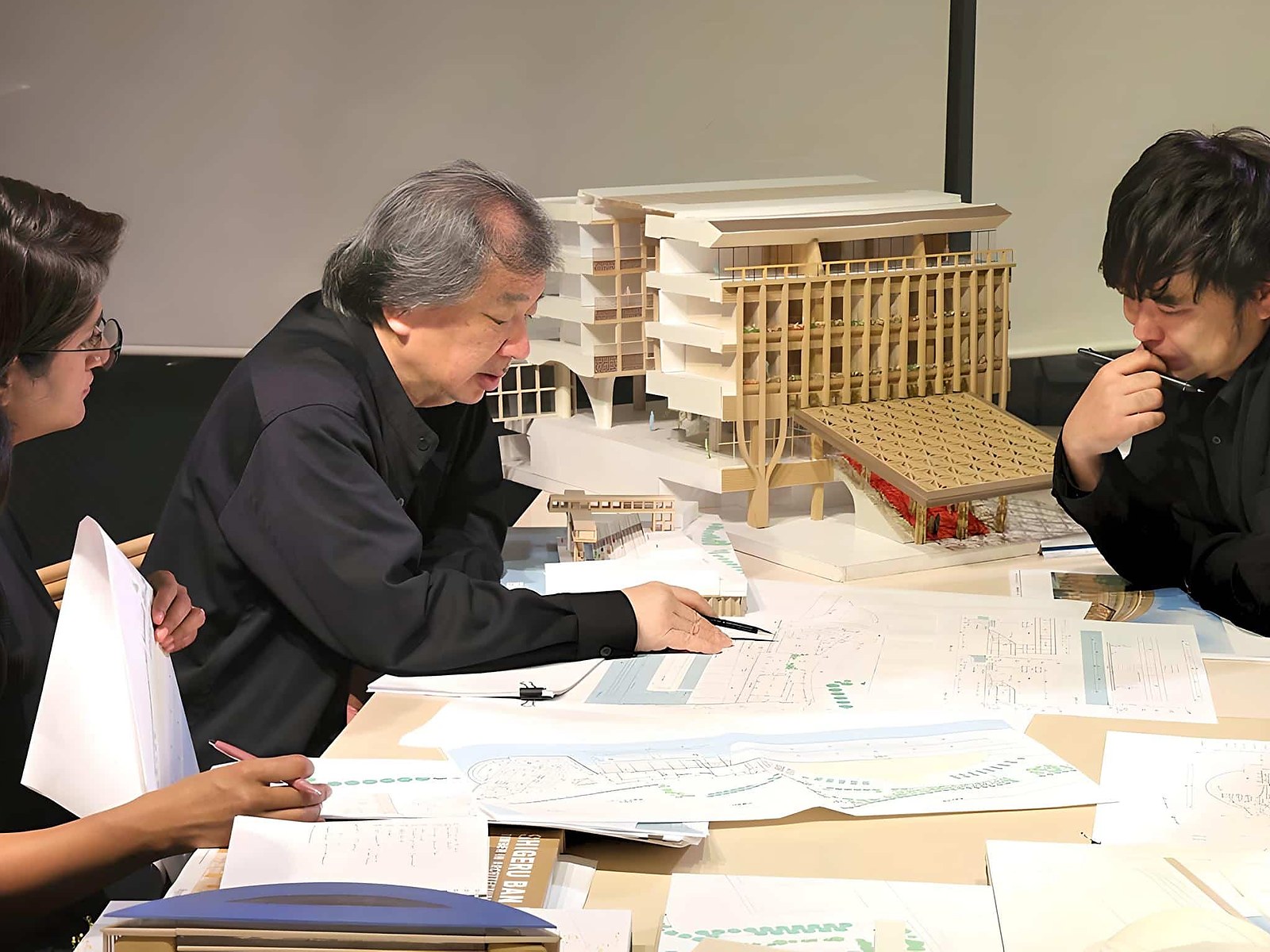
At AIA26, the Japanese master of cardboard cathedrals and disaster-relief shelters accepts American architecture's highest honor — and challenges a gathered profession to put humanity at the center of everything it builds.
SAN DIEGO
The most celebrated architect in San Diego this week builds with the stuff the rest of us throw away. On Thursday, Shigeru Ban — the Japanese visionary who has spent four decades proving that paper tubes can shelter the displaced, span cathedrals and redefine what architecture is for — took the stage at the San Diego Convention Center to headline the AIA Conference on Architecture & Design 2026, where he is being honored with the American Institute of Architects' Gold Medal, the profession's highest individual award in the United States.
Rather than deliver a conventional acceptance keynote, Ban led a June 11 'Architalk' titled 'Humanity, Sustainability, and the Future of Architecture' — three words that double as a fair summary of his life's work. The honor carries historic weight beyond the man himself: Ban is the first non-American Gold Medalist since the late Richard Rogers received the award in 2019.
Building With What Others Throw Away
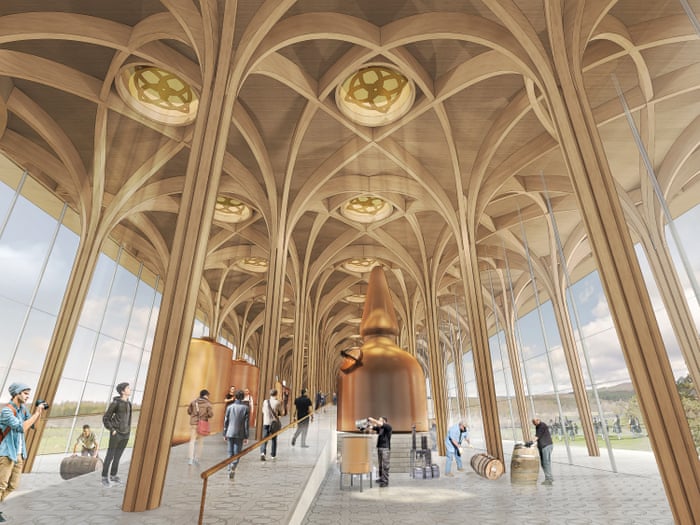
Ban's signature material is so unlikely that it has become his legend. Since the 1980s, he has engineered recycled cardboard tubes — the humble cores inside rolls of paper and fabric — into structural columns, walls and soaring lattices. Treated for fire and water resistance, the tubes are cheap, light, locally available almost anywhere on earth, and fully recyclable when a building comes down. In Ban's hands they have produced works of startling beauty, none more famous than the Cardboard Cathedral in Christchurch, New Zealand — the A-frame sanctuary of paper tubes and shipping containers erected after the 2011 earthquake destroyed the city's stone cathedral, and still in use more than a decade later.
The point was never novelty. Ban's material experiments are an argument: that strength and permanence are not the same thing, that beauty does not require extraction, and that the measure of a building is what it does for the people inside it. The AIA's citation honors precisely this — a career spent revolutionizing architecture through renewable materials like paper and timber, in designs that are resilient and sustainable by conviction rather than by checklist.
Architecture in Service of the Displaced
What separates Ban from nearly every other architect of his stature is where his buildings go. In 1995, after the Kobe earthquake, he founded the Voluntary Architects' Network, a nonprofit that has carried his paper-tube systems into disaster zones and refugee crises around the world for three decades — temporary housing, schools, clinics and privacy partition systems for evacuees sleeping in gymnasiums. He has worked in the aftermath of earthquakes, tsunamis and wars on multiple continents, often arriving before the relief agencies have finished their assessments.
That body of humanitarian work earned him the Pritzker Prize in 2014, and the jury's reasoning then anticipated the AIA's reasoning now: Ban had expanded the very definition of the client. Alongside the museums and concert halls that any master architect accumulates, his portfolio holds tents, shelters and shacks — each detailed with the same care as a commission for a billionaire. For over thirty years he has also been a dedicated educator, teaching at Harvard, Cornell and Columbia, seeding a generation of architects with the radical idea that their skills are a form of aid.
Four Days in San Diego
Ban's Architalk is the centerpiece of a packed program. AIA26, running June 10 through 13, has drawn more than 5,000 architects and design professionals to the San Diego Convention Center for keynotes, an expo floor and hundreds of sessions. The keynote slate runs through Saturday and reaches well beyond the profession's usual borders — author and television host Padma Lakshmi appears with a session titled 'What Food Knows About Architecture,' while urban development expert Sameh Wahba speaks on architects as catalysts for sustainable development. The institute is also celebrating its 2026 Firm Award winner, Duvall Decker Architects, the Mississippi practice admired for proving that design excellence and community investment can be the same business model.

The themes converging in San Diego this week — climate, housing, disaster resilience, public interest design — would have sounded like a niche agenda at an architecture conference twenty years ago. That they now headline the profession's largest annual gathering in the United States is, in no small part, evidence of how far Ban's once-eccentric priorities have traveled toward the center.
What This Means for You
You do not need to be an architect for this story to reach your life. The ideas Ban is being honored for are steadily reshaping the ordinary built world: mass-timber apartment blocks rising in American cities, building codes warming to renewable structural materials, and a growing expectation that new construction account for its carbon. His disaster-relief work matters even more directly — the next time wildfire, flood or earthquake forces a community into shelters, the quality of that shelter will owe something to standards he pioneered. And his deepest principle is portable to any scale, including your own home: materials are not the point; dignity is.
The Final Word
Awards in architecture often arrive as career capstones, gold-plated punctuation at the end of the story. Ban's Gold Medal feels different — less a conclusion than a ratification. The profession that once regarded paper architecture as a charming sideline has now handed its highest American honor to the man who built it, while five thousand of his colleagues take notes. Somewhere in the convention center this week, a young architect is hearing Ban describe a cathedral made of cardboard and rethinking what the job is. That, more than the medal, is the legacy: the future of architecture, it turns out, may be lighter than we thought.
Published By | Design & Fashion Editor