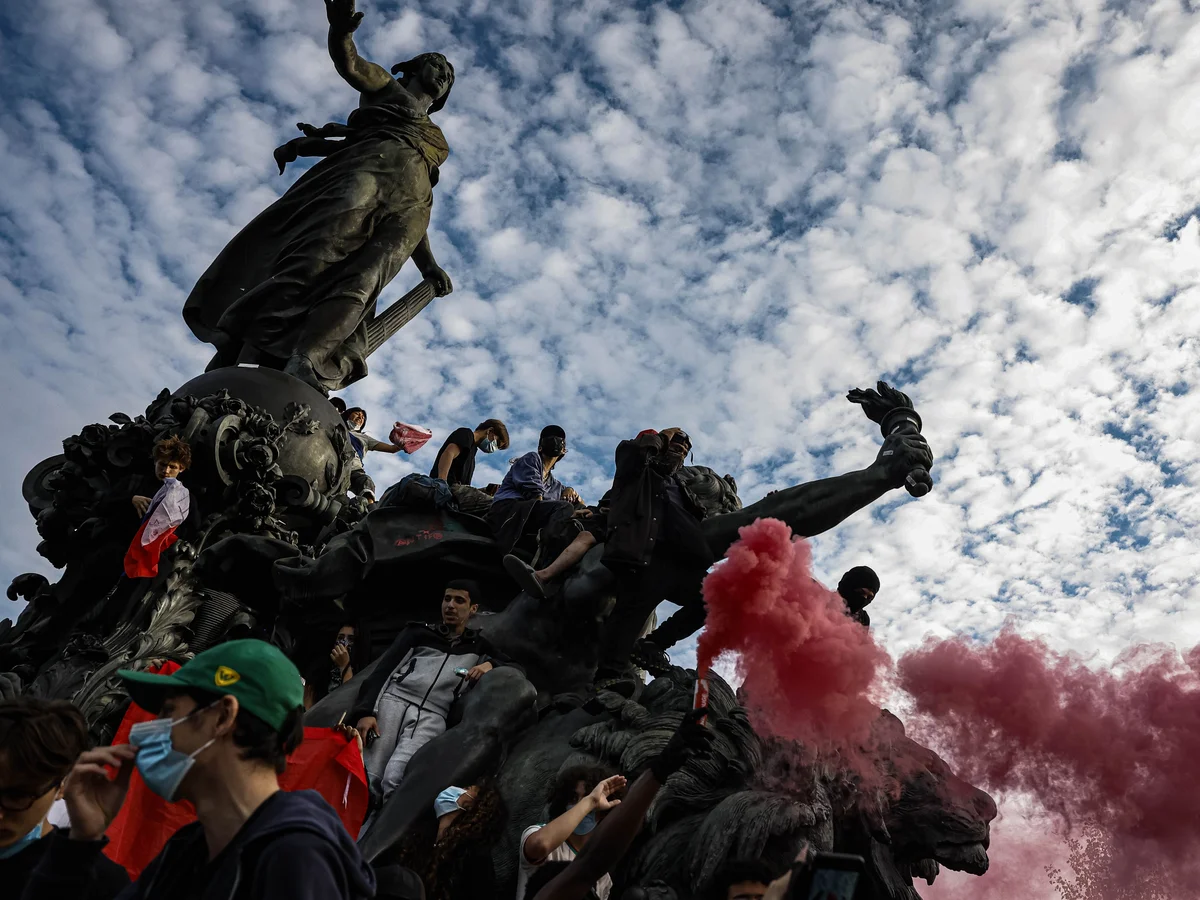
A protest wave that began with a single high-school walkout now threatens a general strike, stretches French police to their limits, and lands on Emmanuel Macron's desk months before the 2027 presidential race.
World Politics
Overview
France enters the Halloween weekend in a state of heightened alarm. Interior Minister Laurent Nuñez has ordered roughly 70,000 police and gendarmes onto the streets, warning of a "very high risk of disorder," after two consecutive Saturdays of mass demonstrations that produced thousands of arrests, hundreds of injured officers and, in at least one town, a burned-out municipal landmark. Yellow Vest groups have called rallies and sit-ins across the country for Saturday, October 31, and a coalition of unions has called a nationwide general strike for November 5, with all four major rail unions filing a joint strike notice for the same day.
What makes the moment notable is not only its scale but its origin. The movement did not start in a union hall or a party headquarters. It began on September 21 with a walkout by students at a lycée in Créteil, and it has since absorbed grievances about wages, fuel and living costs, public services, police conduct and the political rise of the far right. The result is a loose but increasingly coordinated challenge to a government that has very little fiscal room to respond.
The authorities have been reluctant to treat the unrest as a single phenomenon, and the figures in circulation vary depending on who is counting. This article relies on reporting from several outlets and flags discrepancies where they exist.

Background: From a Classroom Walkout to a National Movement
According to reporting by the Latin Times, the spark came on September 21, when students at the Lycée Saint-Exupéry in Créteil walked out over unfilled teaching posts, poor classrooms, overcrowded schedules and the pressure created by Parcoursup, the national university admissions platform. Social media carried images of the walkout across the country within days, and similar actions followed in other schools.
By early October, trade unions and a revived Yellow Vest movement had folded the student protests into a broader set of demands: higher wages and an end to the spending cuts proposed in the 2027 budget. An October 6 national day of action brought together students, teachers, retirees and private-sector workers. The Yellow Vests, a loosely organised movement that first emerged in 2018 over fuel taxes, now accuse Macron's government of an "authoritarian drift" and call for the defence of public freedoms. Murielle Guilbert of the Solidaires federation described the phenomenon as "an aggregation of anger," a phrase that captures how heterogeneous the coalition has become.
The fiscal backdrop is unforgiving. France's public deficit stands at about 5.4 percent of GDP, and the country has been under an EU excessive-deficit procedure since mid-2024. The 2026 budget passed in February only after two no-confidence motions against Prime Minister Sébastien Lecornu's government failed. The 2027 package, unveiled in mid-October, calls for roughly 54 billion euros in spending cuts. Macron's centrist allies lack a parliamentary majority, which means any budget must be assembled through fragile negotiation.
The contrast with 2018 is stark. When the original Yellow Vest crisis erupted, Macron was able to defuse it partly by reversing a planned fuel-tax increase and offering a relief package of roughly 10 billion euros. Analysts cited in the reporting note that no comparable cushion exists today, and a government under European pressure to cut spending cannot easily buy peace.
Key Developments: Two Saturdays of Confrontation
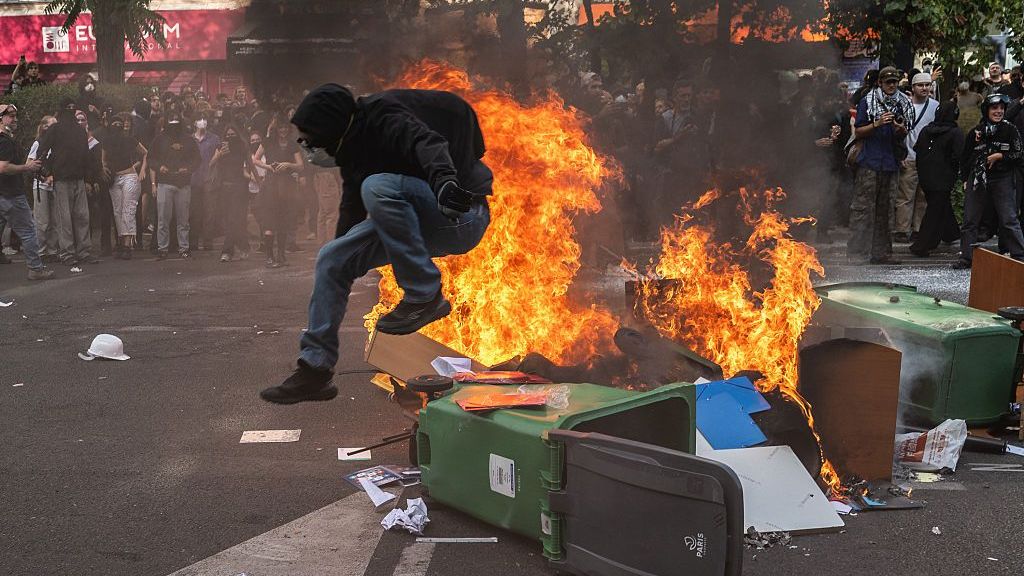
The first major flashpoint was October 17. Government figures put turnout at about 550,000 across some 110 demonstrations, while unions claimed 800,000. The day was marked by arson and looting in Paris and Marseille. In Limoges, rioters set fire to the 143-year-old town hall, which was largely gutted. In Saint-Étienne, a 17-year-old demonstrator lost a hand to what appeared to be a crowd-control grenade. Sources disagree on the toll: one account puts arrests at about 2,400 and injured officers at roughly 1,000, with seven seriously hurt, while another cites 2,628 arrests and 1,144 injured security personnel. Both agree it was among the most violent days of protest in recent French memory.
The following Saturday, October 24, was bigger geographically but calmer. Provisional government figures counted about 410,000 marchers across roughly 289 to 298 actions, depending on the source, while the CGT claimed about 800,000, a number that has not been independently verified. The Interior Ministry reported 1,314 arrests and about 50 to 53 injured members of the security forces. Authorities deployed some 70,000 officers, supported by the military's Opération Sentinelle. Lyon and Marseille banned marches, and clashes resumed in Marseille after dark, with tear gas or water cannon used in at least three cities including Nantes. Serious injuries were reported in Clermont-Ferrand and Toulouse, though the circumstances remain unclear. The Louvre closed for the day. In Paris, prosecutors reported 64 arrests, including six minors, and 40 people were placed in custody on suspicion of weapons offences or preparing violence or property damage.
A dispute over the Paris route also fed resentment: the authorised march was shifted from the Bastille to the Porte d'Italie, a decision Guilbert called "scandalous," although participants ultimately followed the revised route.
Nuñez has said the marches themselves generally passed off well but accused "ultra-left" groups of extreme violence once the formal demonstrations ended. For this weekend, he has said demonstrations will be permitted outside city centres, while evening gatherings promoted online by radical groups will be banned. Police unions, for their part, warn that the staffing needed for a deployment on the scale of October 24 cannot be sustained for long.
Reactions: A Government Under Pressure from Both Sides
Macron condemned the violence as "unbridled" and promised an "uncompromising" response. He also ordered an inquiry into whether intelligence services and police command had anticipated the disorder, an acknowledgement that the October 17 unrest caught the state off guard. At the same time, the government has opened talks with union and student representatives. That track has not gone well. At an October 21 meeting, union leaders said the government offered no substantive concessions, and Guilbert said the government had given "no response at all."
The movement itself is not unified. The SUD Education teaching union has said it will join the Halloween demonstrations. The CGT, as of the latest reporting, had not decided whether to take part on October 31, although it firmly backs the November 5 action. A coalition including the CGT, FSU and Solidaires called the general strike, and the rail unions' joint notice raises the prospect of significant transport disruption.
The unrest is also not purely French. The Latin Times reports parallel disturbances elsewhere in Europe, including student protests in Italy under a "No Meloni Day" banner that led to looting in Milan and a government security decree deploying 500 troops and creating a new offence of violent participation in demonstrations, and protests in Belgium against tuition increases and education cuts that produced 195 arrests across Brussels and Liège by October 18. Demonstrations have also been reported in a number of other European countries. Analysts quoted in that coverage describe the wave as uncoordinated but thematically unified, driven by cost-of-living pressure, education cuts and distrust of the political establishment. One caveat: that article's headline and body text give different figures for injured police in Italy, so those numbers should be treated cautiously.
Analysis: Why This Moment Is Different
Several features set this episode apart from earlier French protest cycles. The first is its youth component. Student mobilisation gives the movement energy and unpredictability, and it raises the political cost of heavy-handed policing, as the case of the 17-year-old injured in Saint-Étienne shows. The second is the convergence of left-wing union organising with Yellow Vest networks that have historically distrusted unions. When those two currents march on the same days, the government cannot easily divide them.
The third is the absence of fiscal room. In 2018, Macron could pay to end a crisis. In 2026, the arithmetic of the deficit and the EU procedure points in the opposite direction, toward the very spending cuts that unions are protesting. That leaves the government with a difficult choice between holding the line and risking a prolonged confrontation, or softening the budget and signalling to Brussels and bond markets that France is not serious about consolidation.
The fourth is the electoral calendar. The next presidential election is scheduled for April 18 and May 2, 2027. Macron cannot run again, but his camp's prospects depend on how the government is seen to handle both order and economic fairness. Protest movements that combine anti-austerity anger with a perception of police repression tend to benefit political forces on the margins, and the Halloween coverage notes the concern over the rise of the far right as one of the grievances voiced in the streets. It is worth being careful here: the sources do not attribute a specific polling shift to the protests, and the electoral consequences remain speculative.
What's Next
The immediate test is Saturday, October 31. If the Yellow Vest rallies and sit-ins outside town halls and the National Assembly pass with limited violence, the government will claim that its security posture has worked. If clashes are widespread, pressure will grow for harsher measures, which in turn could push more unions and students into the streets. The ban on evening gatherings organised online will be an early indicator of how aggressively authorities intend to enforce order.
The second and larger test is November 5. A general strike backed by the CGT, FSU and Solidaires, combined with a joint rail strike notice, could paralyse transport and test public tolerance. The government's talks with unions and student representatives will need to produce something visible before then if it hopes to blunt participation, but the budget constraints described above leave little to offer beyond symbolic gestures or targeted measures on education, such as teaching posts, which was the original grievance.
Finally, there is the question of sustainability. Police unions say they cannot keep up this tempo of deployment, and protest fatigue is a risk for the movement too, especially as winter approaches. Yet the underlying drivers, a squeezed cost of living, an austerity budget and a political system with no clear majority, are unlikely to disappear. How Macron and Prime Minister Lecornu handle the next week will shape not only the fate of the 2027 budget but also the tone of the run-up to the presidential election.
Published By | News Editor