PARIS
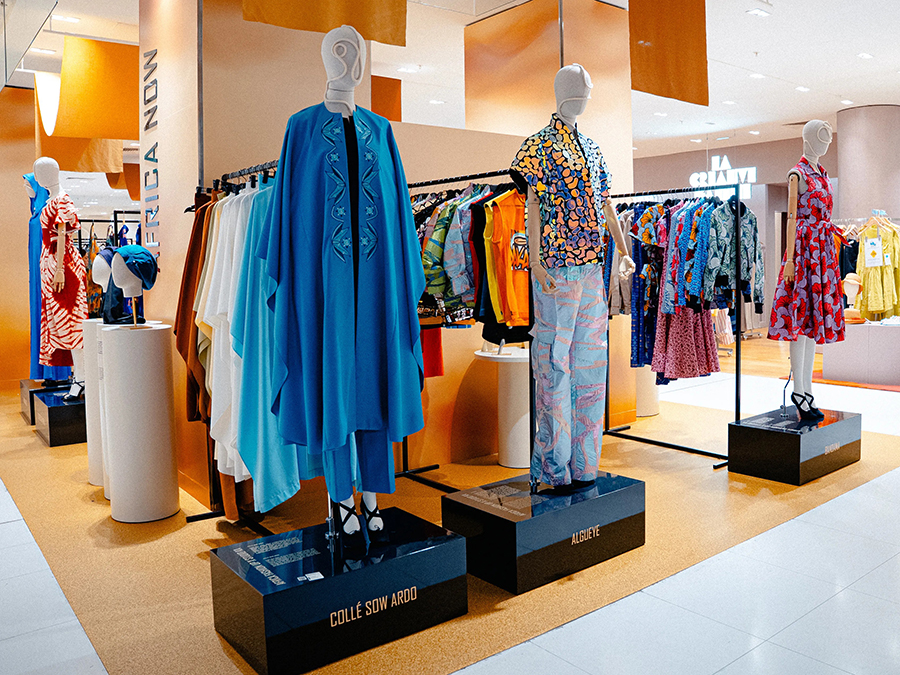
Twice a year now, one of the most photographed retail spaces on Earth — the historic Art Nouveau dome of Galeries Lafayette's Haussmann flagship — hands over a chunk of its prime floor space to designers who, a few seasons ago, would have had no realistic path to that square footage at all. Today marks the return of Africa Now, a pop-up running through July 8 that puts the spring-summer 2026 collections of six African and African-diaspora designers in direct competition, geographically and symbolically, with the luxury houses that usually dominate the building.
Who's in the Room
The lineup this season is deliberately continental in scope. Moroccan label Late For Work, founded by Youssef Drissi — fresh off winning the Fashion Trust Arabia 2025 Grand Prix — anchors the North African contingent. Judy Sanderson, a Portugal-based South African designer who won the 2024/2026 Grand Prix at Maison Mode Méditerranée, brings a Southern African sensibility filtered through European training. Vanhu Vamwe, a label built on ethical, handcrafted production, tells a dialogue between Zimbabwean and Ecuadorian textile traditions — an unusually explicit South-South design conversation for a Parisian retail floor. Rounding out the group are Ghana's Boyedoe, British-Nigerian label Wuman, and Kenyan jewelry house We Are NBO.

The pop-up is the product of a three-way partnership: Adama Paris — Dakar Fashion Week founder Adama Amanda Ndiaye, presenting her own capsule — Studio Ka, the platform founded by French-Ivorian model-turned-entrepreneur Valérie Ka under the Africa Fashion Up program, and CANEX x Tranoï, backed by the African Export-Import Bank.
More Than a Pop-Up
It would be easy to read Africa Now as a seasonal marketing gesture — a feel-good activation that lets a 130-year-old department store burnish its diversity credentials. The organizers position it as something more structural: a recurring access point into Western retail that African designers have historically been locked out of, not for lack of craft but for lack of capital, logistics, and the buyer relationships that take decades to build organically.
This edition expands beyond ready-to-wear into bags, jewelry, and accessories — a deliberate broadening meant to give shoppers more accessible price points and designers more categories to build repeat customers. Organizers have also tied the initiative to social and economic development goals, framing it as a chance to channel Western spending toward community-level empowerment in the designers' home markets.
The Bigger Picture in Fashion
Africa Now lands at a moment when the fashion industry's relationship with African design talent is under scrutiny. The continent's design scenes — from Lagos to Dakar to Nairobi — have built increasingly sophisticated fashion-week infrastructure, even as Western houses have alternated between genuine collaboration and accusations of extracting African aesthetics without proportional credit or compensation flowing back.
A pop-up inside Galeries Lafayette doesn't resolve that tension, but it does something tangible: it puts designers in front of the literal foot traffic of one of the highest-volume retail addresses in Europe, with the institutional backing and price tags of a department store rather than the precarious economics of an independent showroom.

What This Means for You
If you're in Paris between now and July 8: the pop-up is a rare chance to buy directly from designers who, outside this window, mostly sell through limited regional stockists or direct-to-consumer channels.
For shoppers further afield: the run is a useful signal of which African labels are positioned to break into wider international distribution next — Late For Work and We Are NBO, given their recent award wins and jewelry's lower barrier to cross-border shipping, look like the names most likely to appear in other Western retailers' assortments soon.
More broadly, it's a reminder that some of the most interesting design innovation in fashion right now isn't coming from legacy houses recycling archives, but from designers translating regionally rooted craft traditions into contemporary silhouettes — the kind of work that doesn't get discovered without someone handing over the floor space.
Looking Ahead
Organizers have not yet announced whether Africa Now will expand to other Galeries Lafayette locations or international markets, but the program's growth pattern — broader rosters, expanded categories, deeper partners — suggests this is being built as permanent infrastructure rather than a one-off campaign. For a fashion industry perpetually accused of treating African design as a trend rather than a tradition, that distinction is the whole point.
Sources: Galeries Lafayette; Adama Paris; Studio Ka; CANEX x Tranoï; Fashion Trust Arabia; Maison Mode Méditerranée
Published By | Features Editor