Written By |

It's common for some men to abandon their own children while they go out splashing money on other strangers in bars. (Picture imagined by Meta AI)
Sometime back, when I had started a shop, I was having a casual conversation with my friend Mujurizi, asking him to support me. I told him, "You see, we are workmates. If you lose a relative or want to make a party, workmates are the first people you give pledge cards to, or who collect 'Mabugo' (condolence gifts) for you. So, it's equally important to support a workmate or a neighbor when they have a business and have things you want, instead of running to random strangers in town. If you buy from me, whom you know, I will also have money to contribute to you when you are getting married. But you will not walk to a random stranger in town, where you bought clothes once, and ask them to contribute for you."
Most of us have witnessed scenarios where a man would leave his own children starving and takes care of another single mother's children. Or certain rich relative who leaves his own brothers, parents, his own children at home with no education, and runs to help strangers, but is the first to contribute when he sees certain posts on Facebook about a car wash. He feels important and proud that he has really helped.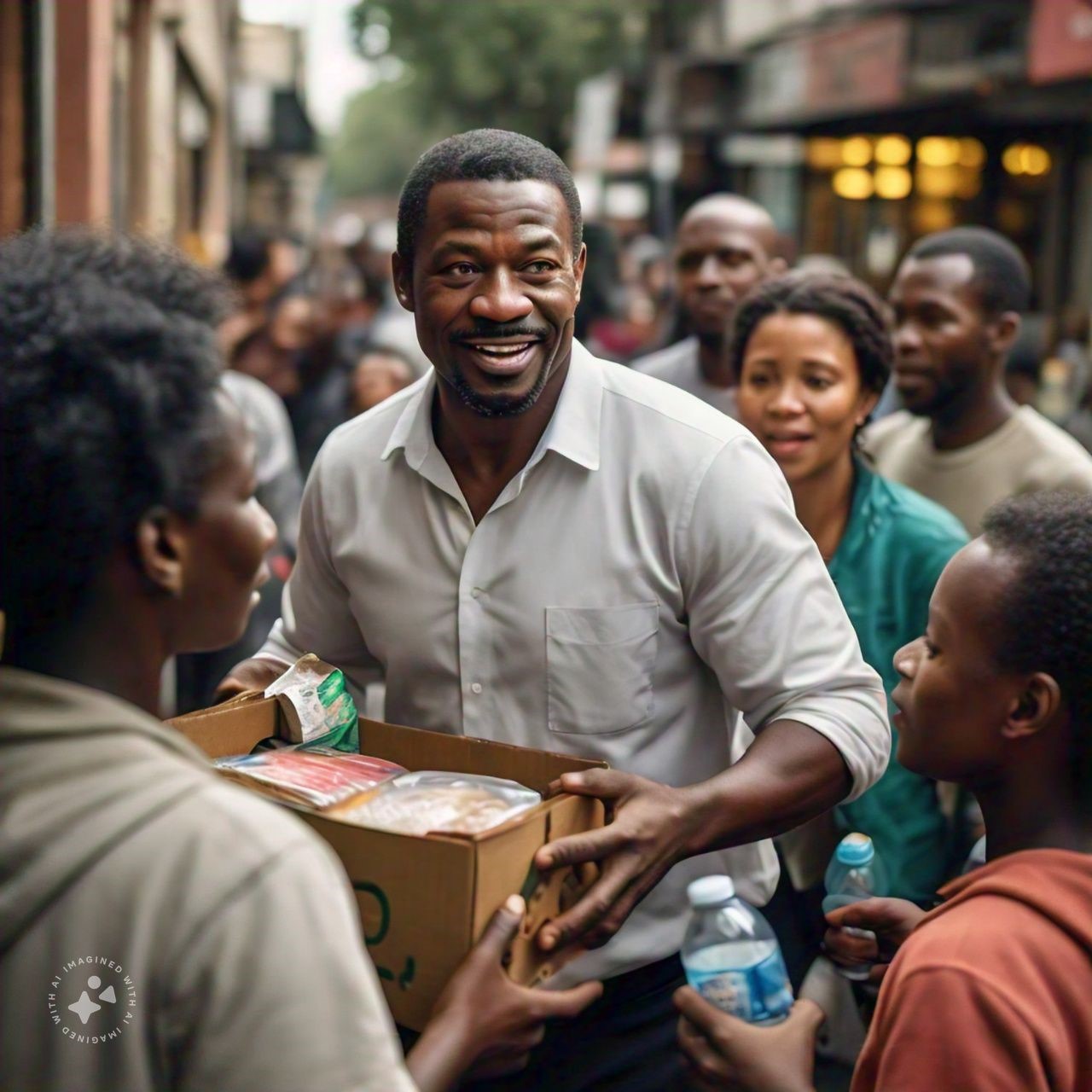
It's not uncommon for some individuals to prioritize helping strangers over supporting their own families. (Picture imagined by Meta AI)
This is where most of us fall. If you want to help genuinely, start with the people around you. When your own brother has money like you, his kids will not steal your property. Appearing to have more empathy for strangers than loved ones is called Fake Empathy. There are several personality disorders associated with this trait, as well as being an obnoxious, arrogant person concerned with the way you are perceived by society rather than by your loved ones. Individuals who lack empathy, if they are high functioning enough, learn at very young ages how to fake it. Sometimes they don't even need to have a personality disorder. They don’t do it because they care, but because they need to in order to fit in. Some of them seek the approval of society and feed on the feeling of being idolized or perceived as amazing by others.
Quite often, people who won’t pay alimony for their children will splash out money to treat friends or people they don’t even know. People who don’t care about a loved one dying in pain at home will be out in the world raising money for some charity. The answer to such a paradox is quite easy. They can happily keep the mask on out and about for a few hours. They can’t keep it on 24/7. They know you know what they really are, so they won’t bother with you anymore. Their loved ones, even work colleagues who have been around long enough, know their true colors. So what you see is what you get. They save the empathetic, humanitarian, jolly good fellow character for strangers. You just get the reality.
Some women have experienced abandonment by their husbands, who then spend money on other people outside of their relationship. (Picture imagined by Meta AI)
Entitlement syndrome
But then, in the same conversation, Anne shared her own version of the story about helping. She said, “My father doesn’t have that much money, but he has tried his best to help his relatives, like educating their children in the same schools where we went. He paid for one of our cousin sisters (my uncle’s daughter) at MaryHill Girls. You know how that school is very expensive. The girl studied from S1 to S4, then she was brought to Bweranyangi Girls for her A’level, all on my daddy’s primary teaching salary. When she joined university at KIU for a bachelor’s in medicine, my father asked the brother to come together so they could educate this girl. Hoho, my uncle abused my father and blatantly told him that since he gave himself the responsibility, he should complete it. To cut a long story short, my daddy gave up on that girl. If you see her now, trust me, you will think she never stepped into those powerful girls' schools. That uncle failed completely to take his daughter to school, and now they have become enemies with my father. To hell with relatives.”
Situations like this are very common and are what we call entitlement. Entitlement is a complex issue, often rooted in a combination of psychological, social, and cultural factors. In such a scenario, several factors can contribute to the sense of entitlement displayed by the child’s father. Some possible causes are
Dependency and Lack of Responsibility: When someone consistently receives help without being asked to contribute or take responsibility, they can develop a dependency mentality. Over time, this can evolve into a sense of entitlement, where the recipient feels they deserve the help without reciprocation. The brother who paid the school fees may have unintentionally fostered this dependency by not setting clear expectations from the start.
This reminds me of my friends who, being in media, started receiving a Christmas package every year from a certain NGO. They would receive 300,000 Ugandan shillings. The organization did this consistently for four years. On the fifth year, when the organization did not send the package, my friends called and asked, "What happened?"
A similar situation happened to me. I used to stop by a bar every evening for tea. The first time, the waitress asked me to buy her a soda. I paid 8,000 Ugandan shillings for my tea and told her to keep the balance. I did this more than ten times, so it became a routine. She would be jolly to welcome me. One day, I only had 10,000 Ugandan shillings and wanted to take tea and use 2,000 for a boda boda back home. When I gave her the money, she never returned the balance. I walked home. I understood it was my mistake, and I knew I had created the problem myself. That's why I never bothered to ask for my balance.
Subsequently, I started asking to pay with MOMO. When I did this more than twice, she felt bad and started avoiding serving me.
Then we also have another common issue of Family Dynamics and Cultural Expectations. In some cultures and family dynamics, there may be an expectation that more successful or financially stable family members will take on additional responsibilities, such as paying for education. This cultural norm can sometimes be interpreted as an obligation, leading to a sense of entitlement from those who receive the help.
Also, Lack of Clear Communication and Boundaries is another problem we have. If the helping brother never communicated his expectations or boundaries clearly, the recipient might assume that the help would continue indefinitely. Clear communication about the scope and limits of the assistance might have prevented the sense of entitlement.
We also alarming Psychological Issues. Individuals with certain personality traits, such as narcissism or low empathy, might be more prone to feeling entitled. They might believe that they deserve special treatment or that others should cater to their needs without considering the effort and sacrifice involved.
I won't tell you how to handle your situations, you need to understand where you belong and sort yourself.
By Dickens Tiharihondijo



