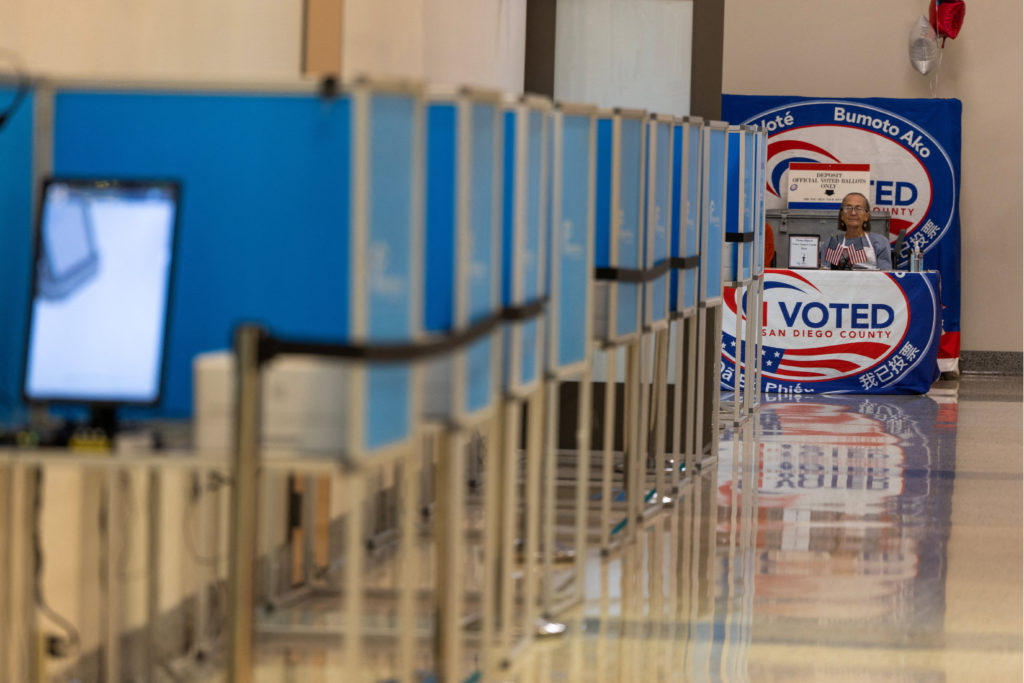
With ballots already being counted, federal prosecutors have demanded that California election workers testify the day after the vote, even as courts keep refusing to let Washington interfere with the count.
World Politics
Overview
Three days before the November 3 midterm elections, the Trump administration's campaign over alleged noncitizen voting has moved from the courtroom to the offices of the people who run elections. The Justice Department has issued grand jury subpoenas to election officials in California, including employees of the Los Angeles County Registrar-Recorder, ordering them to appear on November 4, the day after the election. Federal courts, meanwhile, have so far declined to give the department what it asked for in its civil case: an order requiring California to set aside roughly 20,000 mail ballots that the government says may have come from noncitizens.
The result is an unusual standoff. Counting is under way, with more than half a million mail ballots already processed in Los Angeles County alone according to court filings, while federal lawyers, state officials, and judges argue over whether the federal government may reach into that process at all. A federal judge has told the department that threats against state and county election employees should cease immediately, and the opposition party has sued to stop what it calls a pattern of intimidation. The department maintains that noncitizen voting is a matter for criminal law and that it is entitled to investigate.
Background: A List, a Lawsuit and a Deadline
The dispute centres on a list. According to reporting by CBS News, Justice Department officials sent letters to California authorities about more than 20,000 registered voters whom the department considered likely noncitizens and who had been mailed ballots. Los Angeles County said the list lacked information on how it had been compiled. In a sample of 200 records from the list, the county found that 112 were cancelled or inactive registrations. Both sides, according to the Boston Globe, accept that the list includes at least some citizens, though they disagree about how many.
The department sued California on October 15, more than a week after mail ballots went out to all registered voters, asking a court to force the state to set aside the contested ballots and withhold counting them until citizenship could be verified. California declined to sequester the ballots voluntarily and argued that the lawsuit does not even allege that the people on the list will vote unlawfully. The timing became central to the case. A panel of the Ninth Circuit later said the claimed emergency was partly of the government's own making, noting that it came to court less than three weeks before the election.
The legal framework matters here. The National Voter Registration Act bars systematic changes to voter rolls within 90 days of a federal election, and U.S. District Judge David O. Carter ruled, according to the Boston Globe, that the department's demands ran afoul of that provision. The administration has also leaned on a federal database called SAVE, designed to verify eligibility for benefits, to flag voters. A lawsuit filed by Democrats alleges that this approach produces unreliable results, citing a case in Texas where more than 20 percent of 2,724 flagged voters were later confirmed to be citizens, and a claim that Nevada had 16,000 noncitizen voters that the Department of Homeland Security later narrowed to 185, all of whom Nevada officials say are citizens.
Key Developments
The courtroom sequence has gone against the department so far. Judge Carter rejected its emergency request on Tuesday, October 27, and according to ABC News wrote that the federal government had never before sought to coerce states on the eve of an election. On Thursday he appointed a special master, Daniel B. Garrie, to develop the factual record, including the reliability of the federal list and California's claim that it cannot separate the ballots in time for the December 3 county certification deadline. Carter will decide a renewed request for a preliminary injunction after an evidentiary hearing on November 13, which falls well after the election.
The department also tried the appellate route. On Monday, a divided Ninth Circuit panel dismissed the department's appeal 2 to 1, saying it lacked jurisdiction and granting a motion from Los Angeles County's registrar, Dean Logan. Judges Mark Bennett and Gabriel Sanchez said the government had not given the district court an adequate opportunity to consider its request for temporary relief. Bennett wrote separately that he would have rejected the request on the merits as well. Judge Patrick Bumatay dissented, arguing that the federal government has a sovereign interest in protecting federal elections and in ensuring that noncitizens' votes do not affect the results. Governor Gavin Newsom called the ruling a welcome speed bump to what he described as attacks on democracy, and the department could ask the full Ninth Circuit to reconsider. After the district ruling, the department asked the appeals court to act quickly, citing what it called irreversible ballot processing occurring on an ongoing basis.
Then came the subpoenas. The Boston Globe reports three subpoenas, dated October 21 and October 24, to employees of the Los Angeles County Registrar-Recorder, demanding documents and communications about the federal letters to state officials and about efforts to keep noncitizen votes from being counted. A cover letter describes an official criminal investigation by Homeland Security Investigations. A person familiar with the matter told the newspaper that all four U.S. attorneys in California are issuing subpoenas, and ABC News reports that the subpoenas seek internal documents about federal requests to Secretary of State Shirley Weber. The Globe notes that it is unclear whether charges are planned and that the department does not typically subpoena people it regards as criminal targets to appear before a grand jury. Some county officials received subpoenas as early as September seeking records on individual voters the department suspects of registering illegally.
Alongside the subpoenas are explicit threats. According to Democracy Docket, First Assistant U.S. Attorney Bill Essayli, who represented the department at the hearing, has repeatedly said he would prosecute election officials who do not set aside the ballots until citizenship is confirmed, writing on X that officials would be held accountable and citing two federal statutes. The same report notes that one of those provisions, section 611, makes it a misdemeanor for noncitizens to vote in federal elections and concerns individual voters rather than election workers. California Deputy Attorney General Michael Cohen said it has nothing to do with election administration. Democracy Docket also reports that another judge disqualified Essayli from his post as the California arguments wrapped up, though that order was stayed. Carter, for his part, warned the department that any threats to state and county election employees should cease immediately, a line the Boston Globe also reports.
Beyond California
California is the sharpest front but not the only one. Just Security's October 30 roundup reports that the department confirmed that FBI and ICE agents will not serve as poll monitors, that prosecutors in California were directed to pursue criminal subpoenas of state and local officials over alleged illegal voting, and that a judge has given the department a deadline to list the states it targeted with demands to change election administration. In Washington state, Secretary of State Steve Hobbs refused a request to set aside ballots from 400 people flagged as alleged noncitizens, saying the list includes many U.S. citizens. In Alaska, the department issued subpoenas after a New York Times report that operatives linked to Democratic Senate candidate Mary Peltola recruited a second candidate named Dan Sullivan to draw votes from the Republican incumbent of the same name; Peltola denies knowing of the effort, Trump has called for prosecution, and Governor Mike Dunleavy ordered a state investigation and suggested withholding certification if Peltola wins.
The administration is also being sued in Washington. According to Democracy Docket, three national Democratic organizations, the Nevada Democratic Party, Senate leader Chuck Schumer, House leader Hakeem Jeffries and a naturalized California voter filed suit in the U.S. District Court for the District of Columbia on October 20, naming President Trump, Attorney General Todd Blanche, Homeland Security Secretary Markwayne Mullin and their departments. They argue that threatening to prosecute officials who help registered voters cast and count ballots violates the Voting Rights Act's ban on voter intimidation, and they cite Trump's statement that California election officials would go to jail for a long period of time. The reports reviewed here do not include a Justice Department response to that suit. Separately, Democracy Now reports that the Justice Department's grand jury demands for unredacted California voter records are accompanied by a Wired report about a group founded by a former lawyer for Elon Musk's America PAC that is pushing election-fraud claims.
Reactions
Local officials have responded with a mixture of defiance and appeals to professionalism. Los Angeles County's Dean Logan said that threats and intimidation have no place in elections and, per ABC News, criticised the department's confrontational, adversarial approach while insisting that his office is following state and federal law. Newsom welcomed the appeals court's decision. Trump criticised Carter's ruling, said he would appeal, and called California very corrupt.
The Justice Department's public posture is narrower than its prosecutors' rhetoric. A spokesperson told ABC News that the department does not comment on alleged grand jury subpoenas, but said that civil remedies are still available and that all parties agree noncitizen voting is a matter for criminal law. That argument captures the department's legal pivot: having been rebuffed in civil court, it is leaning on criminal tools, which are less subject to the election-timing limits that judges have enforced in the civil case.
What's Next
The immediate marker is November 4. Los Angeles County employees have been ordered to appear in response to the subpoenas the day after the vote, and the department's conduct then will show whether the subpoenas are a genuine investigative step or primarily a signal. Judge Carter's November 13 hearing will test whether the special master's review supports the department's list or the county's finding that many of the flagged records were cancelled or inactive, and certification in California's counties is due by December 3. The full Ninth Circuit could still be asked to revisit the panel's dismissal.
More broadly, the episode will test how far the federal government can go in contesting the mechanics of an election that it does not run. The courts have so far held to a principle, that rules should not be changed mid-contest, and a judge has publicly told federal prosecutors to stop threatening election workers. Yet the threats and subpoenas have already had a visible effect on the officials responsible for counting votes, and with a close national contest, any dispute over whose ballots count is likely to be litigated again after Tuesday. Voters, meanwhile, have about three days to cast the ballots that the arguments are about.
One caution on the sourcing: several of these accounts were published in the final days before the election and describe fast-moving litigation. An Axios report on October 31 about a judge blocking Justice Department threats against election workers appears in search results, but its text could not be retrieved, so this article does not rely on it. Readers should expect further rulings before polls open.
Published By | News Editor