Written By | Health News Agencies
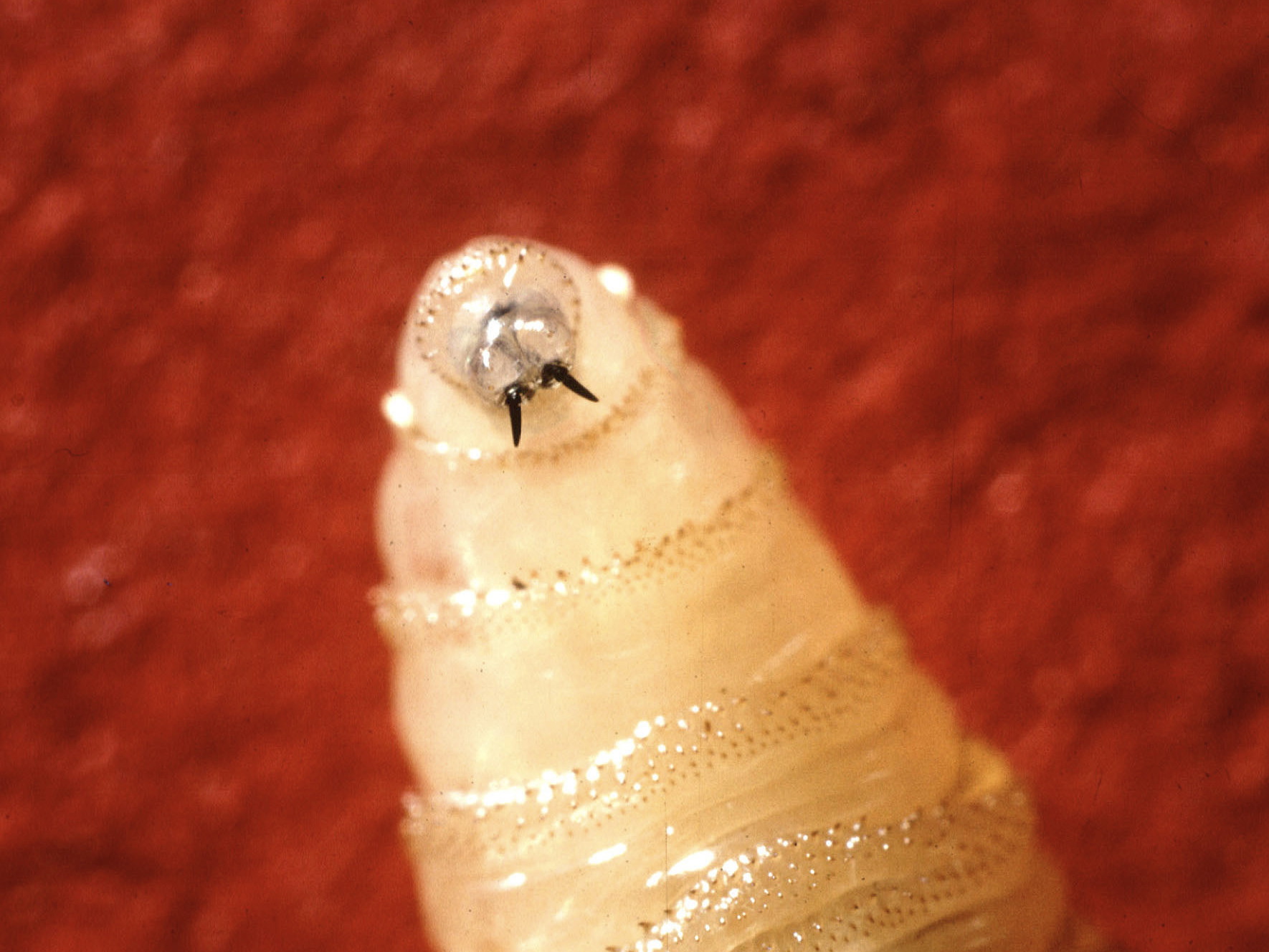
Cochliomyia hominivorax — the species name translates, with no exaggeration whatsoever, as "man-eater" — does not wait for anything to die
SAN DIEGO
Most maggots are janitors. They turn up after death, they clean up what is already rotting, and for all their horror-film reputation they are among nature's more useful employees.
The New World screwworm is not most maggots.
Cochliomyia hominivorax — the species name translates, with no exaggeration whatsoever, as "man-eater" — does not wait for anything to die. The female fly finds an open wound, or a natural body opening, on a living warm-blooded animal. She lays her eggs at the edge of it. The larvae hatch, and then they screw themselves downward into healthy, living tissue using hooked mouthparts, feeding as they go, widening the wound with every hour that passes. Untreated, a serious infestation can kill a cow. Or a deer. Or a dog.
Or, rarely, a person.
The United States destroyed this thing. Not controlled it — destroyed it, in one of the most successful biological control campaigns ever attempted, and pushed its range all the way south to Panama. That was the 1950s and the decades that followed. American ranchers have not had to think about screwworm for the better part of two generations.
They are thinking about it now.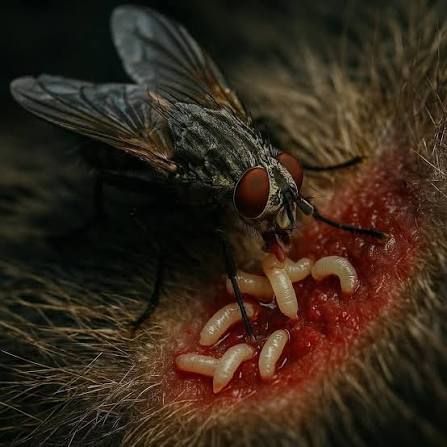
THE DAY IT CAME BACK
On 3 June 2026, the US Department of Agriculture confirmed the first American animal case of the current outbreak: a bovine in Zavala County, in south Texas. It was the first confirmed domestic detection in close to sixty years.
A second case followed in another cow — a one-month-old calf found roughly 5.6 miles from the first detection, in the same county. Since then the parasite has established a foothold serious enough that both Texas and New Mexico now have formally mapped screwworm zones, published as public lookup maps by the Texas Animal Health Commission and New Mexico State University so that residents can check whether they are inside one.
The scale of what is pressing against the southern border is the part that should focus minds. According to the US Centers for Disease Control and Prevention, Central American countries and Mexico have between them now reported more than 209,400 screwworm cases in animals — and more than 2,500 in people.
The human numbers are not theoretical. A recent analysis published in the CDC's Emerging Infectious Diseases journal documented 204 human cases reported through Mexico's national surveillance system between 13 April 2025 and 14 March 2026, concentrated in Chiapas and followed by Yucatán, Oaxaca and Quintana Roo. This from a country that had eliminated the parasite in 2003.
The United States has recorded exactly one human case in this whole saga: a Maryland resident who returned from El Salvador in August 2025, was diagnosed, treated, and recovered. Targeted surveillance around that case came back negative and it was closed. The CDC's position, stated plainly on its situation page, remains that there have been no locally acquired human infestations in the United States and that the risk to people here is very low.
Very low is not the same as zero, and "here" is a border that keeps moving.
THE DASHBOARD THAT READS THE NEWS
Which brings us to San Diego, and to a piece of public health engineering announced on Monday that is quietly one of the more interesting things to happen in outbreak response this year.
Researchers at the University of California San Diego, working with the County of San Diego Health and Human Services Agency's Public Health Services, have built a screwworm tracking dashboard that estimates risk for individual counties across the entire country.
"Our County public health partners alerted us to the need for better situational awareness of New World screwworm," said Eliah Aronoff-Spencer, MD, PhD, professor of medicine at UC San Diego School of Medicine and an affiliate of the university's Design Lab and Qualcomm Institute. "We built a dashboard to generate regional risk profiles."
It pulls together confirmed detections, environmental conditions that favour the fly and its larvae — temperature and moisture are what decide whether this insect can survive a given county — and one data source that conventional disease surveillance has historically treated as noise: news coverage.
That was deliberate, and the reasoning behind it is a fairly damning verdict on how slow official pipelines are.
"Traditional reporting mechanisms for public health are often delayed," said Seema Shah, MD, MPH, medical director of the Epidemiology and Immunization Services Branch for San Diego County's Public Health Services Department. "Lab confirmation can take days or weeks. By incorporating media reports, we can identify potential threats sooner and stay one step ahead."
In other words: a local paper reporting that a rancher found maggots in a calf can reach the dashboard before the confirmatory laboratory result does. It is an imperfect signal. It is also, sometimes, a fortnight earlier.
Mark Beatty, MD, MPH, assistant medical director for the county's Epidemiology and Immunization Services Branch, described what the tool is actually for. "The tool gives you a sense of where you might expect to see cases next," he said. "That's helpful in determining how we should be preparing. Is the threat imminent, or do we have six months?"
And then he said the thing that will stick with anybody who reads this story properly.
"We're in a very concerning phase right now, and the tool backs that up."
For the moment, access is restricted to public health officials and project partners. The researchers say they hope eventually to release a public version.
FASTER THAN ANYONE EXPECTED
Beatty was also candid about the forecast the experts themselves got wrong.
"We knew in 2023 that New World screwworm was going to move northward, but I wasn't expecting it to move as fast as it has," he said. "Although the source of the infections in the U.S. is still under investigation, the fact that it's in the U.S. is 100% clear."
"Once it entered Texas, we quickly saw an increase in detections. It's in a place where it used to live, so it's not surprising it's taking a hold again."
That last observation is the quietly alarming one. This is not an invasive species arriving somewhere alien and struggling. This is a native returning to habitat it evolved in. The American South is not hostile ground for Cochliomyia hominivorax. It is home.
The fly spreads in several ways at once. Adults can travel miles under their own power hunting for a host. But infested livestock, pets, birds and wildlife carry it further and faster than it could ever fly — which is why animal movement controls sit at the centre of the federal response.
THE WEAPON THAT WON LAST TIME
In the 1950s, screwworm was costing livestock producers in the American Southwest alone an estimated $50 million to $100 million every year — in 1950s dollars. The campaign that ended it remains a landmark in applied biology.
The method is called the sterile insect technique, and it is elegant to the point of being beautiful. Screwworm females mate once. So: rear male flies by the hundred million, sterilise them with radiation, release them into the wild in overwhelming numbers, and let wild females mate with duds. Each such mating is a reproductive dead end. Do it long enough, across a wide enough front, and the population does not merely decline. It collapses.
The USDA is now running that playbook again, combined with pesticide treatment and quarantines restricting animal movement.
The infrastructure is already going up. In February 2026 the USDA announced completion of a sterile fly dispersal facility at Moore Air Base in Edinburg, Texas, built in partnership with the US Army Corps of Engineers, with a domestic sterile fly production facility targeted at a maximum capacity of 300 million sterile flies per week. Officials are currently releasing on the order of 100 million sterile flies a week across the United States and Mexico.
There is a next-generation weapon in the queue as well. Authorities are seeking Environmental Protection Agency approval for a genetically modified all-male strain currently in field testing — an approach that sidesteps the need to separate sexes in a factory producing hundreds of millions of insects a week. UC San Diego researchers, meanwhile, are developing further genetic technologies aimed at future control or eradication.
None of this is fast. Sterile insect campaigns are measured in seasons and years, not weeks.
ONE HEALTH, OR NO HEALTH
The San Diego dashboard came out of Resilient Shield, a UC San Diego initiative and CDC-funded centre led by Aronoff-Spencer. Resilient Shield is one of 13 core facilities making up Insight Net, the CDC's national network for modelling outbreaks and disease threats.
Its operating principle inverts the usual academic relationship. Rather than researchers guessing what agencies need, the agencies submit the problems they are actually stuck on.
"In public health, we always know our most urgent priorities, but too often we don't have the immediate resources or in-house technical solutions to achieve them," Shah said. "The screwworm is a perfect example. It is a critical threat, but it is an issue our academic partners might never have prioritized without our direct ticket."
The centre draws on human disease data, livestock data, environmental and weather information, national health records and social listening, with technology partners including Google and MITRE, and partners spanning the California Department of Public Health and the Navajo Nation. The first request it ever received was about influenza.
On the ground, the response is explicitly a One Health operation — the principle that human, animal and environmental health cannot be managed in separate buildings.
"We are working closely with the California Department of Food and Agriculture to connect local veterinarians with screwworm resources for surveillance in our region," said Emily Trumbull, DVM, veterinarian and lead for the county Epidemiology Unit's One Health Program. "The flies can affect any warm-blooded animal, so working together with veterinarians serving livestock, pets and wildlife is critical for identifying suspect cases and preventing cases in people."
Read that carefully. The veterinarian looking at a sick calf is, in this system, part of the early warning network for human infection.
WHAT THIS MEANS FOR YOU
Start with the reassurance, because it is real: the CDC assesses current risk to the public in the United States as very low, and there has never been a locally acquired human case here.
Now the practical part, because the people most exposed are not city dwellers in New York — they are anyone with an open wound in or near an affected zone, anyone with outdoor animals, and anyone travelling to Mexico or Central America.
The single most important prevention measure is almost insultingly simple: keep open wounds clean and covered, no matter how small and no matter where on the body. The fly needs a wound. Deny it one. The CDC also advises loose-fitting long-sleeved shirts and trousers, hats and socks to limit exposed skin; an EPA-registered insect repellent; clothing and gear treated with 0.5 per cent permethrin; and sleeping indoors or in screened rooms or tents.
Know the warning signs. According to CDC guidance, symptoms include unexplained, painful wounds or sores that do not heal; a foul-smelling odour or bleeding from the site; and seeing maggots, or feeling movement, in open wounds or in the nose, mouth, eyes, ears or genitals.
And then the instruction that matters most, which runs against every instinct a human being has: do not try to remove them yourself.
There is no drug that kills New World screwworm larvae. The only treatment is complete physical removal of every larva from the infested tissue, sometimes surgically — and a partial job leaves the rest to keep burrowing. Contact a healthcare provider immediately. Clinicians with questions can reach the CDC's Parasitic Diseases Hotline on 404-718-4745 during business hours, or the Emergency Operations Center on 770-488-7100 outside them.
If you keep animals, the equivalent rule applies. Check them. Any wound on any warm-blooded animal — livestock, horse, dog, cat — is a potential site, and suspicious cases should go straight to a veterinarian, who reports to the state animal health official and the APHIS office. For people, healthcare providers report suspected cases immediately to state or local health departments.
THE LESSON UNDERNEATH THE HORROR
It is easy to read a screwworm story purely as a gross-out — the maggots, the mouth hooks, the larva photographed next to a nickel for scale.
The more useful reading is about what eradication actually means. The United States did not beat this parasite permanently in the 1950s. It beat it locally and then maintained a barrier, at continuous cost, hundreds of miles to the south. When the barrier weakened — as it did after the 2023 outbreak identified in Panama and Costa Rica, which then rolled north through every country in Central America and Mexico — the geography that had protected American herds for six decades stopped protecting them.
Elimination is not a finish line. It is a subscription.
What is genuinely new this week is not the parasite. It is the speed of the response infrastructure being assembled around it: a county-level risk engine that reads local news faster than it waits for laboratories, wired into a national CDC modelling network, feeding officials who now have a defensible answer to the only question that matters operationally — is it coming for us this month, or do we have until spring?
For now, the flies are winning ground faster than the experts predicted. Two hundred million sterile males a week are being thrown at the problem. A genetically engineered strain waits on a regulator's desk.
And in San Diego, a dashboard blinks, county by county, watching for the next headline.



