SAN DIEGO
After more than a decade of planning, delays and design revisions, the Lucas Museum of Narrative Art is entering its final stretch before opening. And this past week, the museum used the biggest stage in pop culture — Comic-Con International's Hall H — to give the public its clearest look yet at what's actually inside.
A Different Kind of Panel This Year
Where last year's Comic-Con appearance centered on museum founder George Lucas himself, joined by filmmaker Guillermo del Toro for the institution's first public preview, this year's session, "Inside the Lucas Museum of Narrative Art," shifted the spotlight to the people building its programming. Moderated by Keke Palmer on Thursday, July 23, in Hall H, the panel brought together Seth Green and Matt Senreich of Stoopid Buddy Stoodios, DC Comics president and chief creative officer Jim Lee, and Ryan Linkof, the museum's senior curator and head of film programs — a lineup that traded big-picture vision for the granular specifics of what will actually greet visitors starting September 22.
The most concrete reveal of the panel came from Green, who confirmed that the museum will display a curated selection of episodes from "Star Wars: Detours," the long-shelved animated comedy series he and Senreich produced years ago that has never been publicly released. For "Star Wars" completists, it's the kind of announcement that turns a museum visit into an event — a piece of franchise history that fans have spent years petitioning to see, finally surfacing not on a streaming platform but inside a museum gallery.

The Building Itself Is Still the Headline
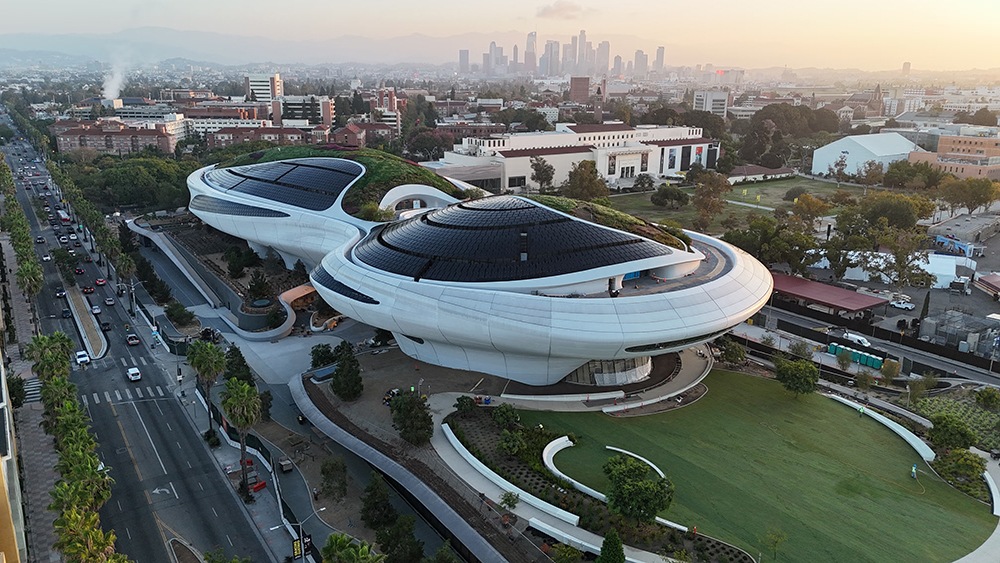
For all the programming news, the museum's architecture remains its most immediately striking feature — and its most audacious bet. Designed by Ma Yansong of the Beijing-based firm MAD Architects, with Stantec serving as executive architect, the building eschews straight lines almost entirely in favor of fluid, organic geometry. Its sculptural five-story form spans roughly 300,000 square feet across an 11-acre campus in Exposition Park, clad in more than 1,500 individually molded fiberglass-reinforced polymer panels that give the structure its now-famous resemblance to a landed spacecraft.
That comparison isn't incidental — Lucas himself has leaned into it, and the building's undulating silhouette has drawn comparisons to everything from a smoothed river stone to, per its more skeptical critics, a beached whale. Whatever the metaphor, the ambition behind it is unmistakable: MAD Architects has described the project as its first overseas cultural landmark, and the firm has treated the commission as an opportunity to prove that a museum's exterior can be as narrative-driven as the art inside it — a building that tells a story about motion, flow and continuity before a single visitor steps through its doors.
A six-minute preview video shown at last year's inaugural Comic-Con panel, narrated by "Star Wars" actor Samuel L. Jackson, offered the public's first real look at renderings of the completed interior spaces, and this year's panel built on that foundation with more granular detail about how the galleries will actually function as exhibition space rather than architectural spectacle alone.
A Founder's Philosophy, Built Into the Walls
Even without Lucas on this year's panel, his framing of the project's mission has continued to define how it's discussed. At the museum's first Hall H appearance, Lucas described his vision in blunt, almost defiant terms, calling it "a temple to the people's art" — a pointed statement about narrative art forms like illustration, comics, and film concept art that have historically been excluded from traditional fine art institutions.
Guillermo del Toro, who sits on the museum's board, expanded on that philosophy in terms that doubled as a mission statement for the institution as a whole. "The shape of the museum for me — what it is, is flow," del Toro said during the inaugural panel. "And what is beautiful is that we are collectors. George is a collector. I'm a collector, but I know I don't own anything. I'm holding the artworks briefly for the next person that is going to hold it or see it." He went further, framing narrative art as a form of cultural resistance: "Comics were the first ones to punch Nazis," he said, before adding, "We realize that stories shape the world... Myth belongs to us. Propaganda belongs to a very small group. Myth unites us and propaganda divides us."

Why a Billionaire's Passion Project Matters to Design Culture
It would be easy to dismiss the Lucas Museum as a vanity project — a filmmaker with means building a monument to his own genre. But its architectural ambitions place it in conversation with a broader, more consequential debate in museum design: whether institutions built around popular and genre art deserve the same architectural seriousness traditionally reserved for encyclopedic art museums. Ma Yansong's design answers that question emphatically, treating narrative art's home with the same formal daring MAD has brought to its most acclaimed cultural buildings elsewhere in the world.
The museum also arrives at a moment when Los Angeles's cultural infrastructure is being reshaped block by block, with new institutions competing not just for visitors but for a role in defining how the city understands its own relationship to entertainment, mythology and image-making — industries that, unlike almost anywhere else, are literally the city's primary export.
What This Means for Visitors
For anyone planning a trip once the museum opens on September 22, this year's Comic-Con panel offered practical intelligence as much as inspiration: expect film programming drawn from deep archives (including material as rare as unreleased "Star Wars" animation), curatorial input from major figures across comics and animation, and a building whose exterior is meant to be experienced as part of the collection rather than simply a container for it. Merchandise previewed at the museum's Comic-Con exhibit booth — including shirts, totes and pins — suggests the institution is also positioning itself, unapologetically, as a full-fledged pop-culture pilgrimage site rather than a quiet art house.
The Bottom Line
With less than two months until doors open, the Lucas Museum of Narrative Art used its second consecutive Comic-Con appearance to make its case in increasingly concrete terms: this is not simply a monument to one filmmaker's collection, but an architectural and curatorial bet that narrative art — comics, illustration, concept design, animation — deserves a home as ambitious as the stories it tells. Whether Ma Yansong's spaceship-like structure becomes one of the decade's defining museum buildings will only be answered once the public walks through it. But if this year's panel is any indication, the institution isn't short on confidence about the answer.
Published By | Features Editor