Background
For most of 2026, the war in Ukraine has not been Washington's war. Since February, the United States has been consumed by its conflict with Iran — a campaign that has closed the Strait of Hormuz, drawn missile fire onto American bases in Jordan and Kuwait, pushed oil above $90 a barrel and swallowed the attention of the president, the Pentagon and Congress. Russia's full-scale invasion of Ukraine, now well into its fifth year, has continued largely offstage, and American diplomacy on it has been in what one Ukrainian official has described as a deep freeze for the better part of eight months.
That freeze began to thaw this week. On September 4, President Donald Trump announced that he was dispatching his special envoy Steve Witkoff and his son-in-law and senior adviser Jared Kushner to Moscow and then to Kyiv with what he called "an idea for peace." The pair last met Putin at the Kremlin in January; neither had visited Kyiv since Trump returned to office. Their trip was preceded by a quieter one: CIA Director John Ratcliffe travelled to Russia days earlier and, according to accounts of the visit, pressed senior Russian officials to bring the war to a close.
The timing was not accidental. Trump has repeatedly claimed he could end the war quickly, and the political value of a breakthrough is rising as the November 3 midterm elections approach. It is also true that the battlefield has moved. Neither army has managed a decisive advance along the 1,250-kilometre (775-mile) front line, and the fighting has shifted upward — into an air war of drones and missiles that both sides can wage at scale and neither can decisively win. Russia has begun deploying fast, jet-powered drones that are harder to intercept. Ukraine, in turn, has spent months striking Russian refineries and depots deep behind the lines. Air-raid sirens are now an ordinary feature of daily life in Kyiv.

The Moscow Meeting
Witkoff and Kushner landed at Moscow's Vnukovo airport on Saturday, September 5, and were met by Kirill Dmitriev, the head of Russia's sovereign wealth fund and Moscow's most practised interlocutor with the Trump orbit, who greeted them as "peacemakers." The choreography that followed was deliberate. The envoys dined at an upscale restaurant near the Kremlin and were driven to their meetings in a Russian-made Aurus limousine rather than an American embassy vehicle — a small departure from protocol, and a pointed one.
Putin received them at the Senate Palace inside the Kremlin. The meeting ran more than three hours behind closed doors and was followed by a private dinner. Yuri Ushakov, Putin's foreign policy adviser, told reporters afterward that the exchange had been constructive, frank and useful, and conducted with unusual candour. Putin said he felt comfortable working with the two men and asked them to pass on his regards to Trump. No breakthrough was announced.
One concrete thing did emerge. Putin ordered a 72-hour halt to Russian strikes on Kyiv beginning at midnight on Saturday, framed as a courtesy tied to the envoys' onward journey. He was careful to specify that the pause applied to the capital only, not to the war as a whole. Volodymyr Zelenskyy reciprocated, agreeing to suspend Ukrainian strikes on Moscow until Monday; Ukrainska Pravda reported that Kyiv had ordered something closer to a front-wide "silence regime" for September 5 to 8, though the practical effect appears to have been narrower.
The pause did not hold beyond the two capitals. Russian attacks across several Ukrainian regions overnight into Sunday killed one person and injured at least ten, according to Ukraine's State Emergency Service. In Zaporizhzhia, drone strikes killed a 74-year-old man and wounded three others; in the Khmelnytskyi region, a drone damaged an apartment building and injured seven. Ukraine's air force said it intercepted 82 of 108 Russian drones and six missiles. In Russia's Belgorod border region, local authorities said a Ukrainian drone struck a vehicle, killing a man and seriously wounding a woman. The Russian Defence Ministry claimed its air defences downed 258 Ukrainian drones over 14 regions, occupied Crimea and the Black and Azov seas — a figure, like most such claims from both sides, that cannot be independently verified.
Ushakov also disclosed something that had little to do with Ukraine. The talks, he said, covered "economic issues and potentially large, mutually beneficial joint projects for Russia and America" in considerable detail. That Moscow chose to publicise this is itself informative: the Kremlin appears to view the peace process at least partly as a corridor toward broader normalisation with Washington, war or no war.
What Russia Is Still Demanding
Beneath the hospitality, the Russian position appears unchanged. Ushakov and Kremlin spokesman Dmitry Peskov both restated that Ukraine must withdraw from Donetsk and Luhansk and cede the four provinces Russia claims before any ceasefire can be seriously discussed — terms Kyiv has rejected consistently and rejected again this week. Deputy Foreign Minister Sergei Ryabkov argued that Washington needs to reckon with facts on the ground that he said are moving against Ukraine. Ushakov pointed to Russian advances in the east as grounds for confidence that Moscow can secure its aims by other means if diplomacy fails.
Putin also held to a procedural position that has repeatedly frustrated American mediators: that any settlement must ultimately be negotiated directly between Russia and Ukraine, with the United States in a secondary role. That formulation sounds accommodating and functions as a brake. It allows Moscow to welcome American envoys warmly while declining to treat their proposals as binding.
Kyiv's Position — and Its Vulnerability
Zelenskyy has said he is ready for a substantive conversation, and Ukraine pledged safe passage for the American delegation. His red lines have not moved: no territorial concessions, and no abandonment of Ukraine's NATO ambitions, regardless of the pressure Washington applies.
He negotiates, however, from a weakened position. Ukraine is running short of air-defence interceptors, a shortage thrown into relief on September 4 when a Russian drone struck the headquarters of the SBU security service in central Kyiv — the first such strike on the building since the invasion began, injuring 12. Foreign Minister Andrii Sybiha called it a major escalation. In the hours before the American delegation reached Moscow, Russian strikes hit Kyiv and Boryspil airports. Zelenskyy called the timing deliberate, a message aimed at the incoming envoys, and said Ukraine would keep making Russian skies dangerous with its own long-range strikes. With Ukrainian airspace closed and its airports under fire, simply getting Witkoff and Kushner into Kyiv on Sunday was a logistical problem.
Ukraine's domestic politics are also strained. Zelenskyy replaced his prime minister and defence minister in July and dismissed his commander-in-chief later that month, after the largest street protests since 2022 and the continuing fallout of the corruption scandal that forced out his former chief of staff. A leader who concedes territory under these conditions would be taking a considerable risk.

Reactions
Trump said the envoys were "bringing with them a proposal to end the war" and that "there may be a good chance we will do it." He also said on September 4 that Putin "is not looking to attack NATO territory" — a remark that landed awkwardly in Berlin, where German officials have been accusing Russia of sabotage operations on European soil.
European reaction has been muted and wary. Officials in several capitals have privately expressed concern about a deal negotiated over Ukraine's head, particularly one bundled with commercial arrangements between Washington and Moscow. Kyiv's own framing has been careful: openness to talks, firmness on substance.
Analysts have been blunter. The reception in Moscow — the limousine, the dinner, the three hours of Putin's time — read to many observers as an exercise in flattery rather than a signal of flexibility. Nothing Russian officials said publicly on Saturday differed materially from what they have been saying for two years.
What's Next
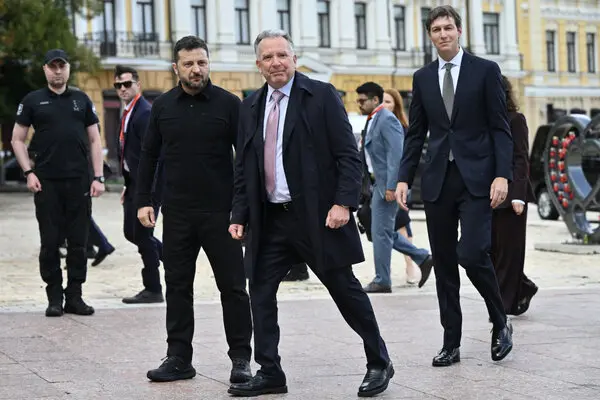
Witkoff and Kushner were due in Kyiv on Sunday, September 6, to relay Putin's assessments to Zelenskyy directly and to present what the White House is calling a concrete proposal. Officials have promised further details in the coming weeks — language that suggests the document is a framework rather than a finished settlement.
The 72-hour pause on strikes against Kyiv expires Tuesday. Whether it is extended, and whether it is broadened beyond the two capitals, will be the first practical test of whether this weekend produced anything durable. Beyond that lie the questions that have defeated every previous round: who controls Donbas, what security guarantees Ukraine receives and from whom, and whether a ceasefire precedes a political settlement or follows it.
The contradiction at the centre has not moved. Russia wants territory and a neutral Ukraine. Ukraine wants its sovereignty and credible security guarantees. Warmth in Moscow does nothing to close that gap in Kyiv — and the strikes that continued overnight, on both sides, while the envoys were still in the air, are a reasonable measure of how much either capital currently expects from this round.
Published By | News Editor