BUSINESS NEWS
Uganda's economy is riding a wave of record foreign direct investment and booming coffee exports, even as growth has cooled from the torrid pace recorded a year ago, according to the latest official statistics and independent economic analysis. The country's central story this month is less about whether money is flowing in — it clearly is — and more about whether that capital will be converted into lasting industrial development before Uganda's oil-driven growth cycle plays out.
The headline numbers illustrate both the momentum and its limits. Uganda's economy expanded 5.8 percent year-on-year in the third quarter of the 2025/26 fiscal year, a marked slowdown from the 8.5 percent growth recorded in the same quarter a year earlier, according to Uganda Bureau of Statistics data reported by IndexBox. Agriculture, long a mainstay of the Ugandan economy, grew just 2.1 percent year-on-year in the quarter, down sharply from 10.3 percent growth in the same period the year before. Industry fared better, with value added rising 5.9 percent, driven by manufacturing growth of 4.8 percent and a robust 7.2 percent expansion in construction. Despite the quarterly deceleration, official projections from the Uganda Investment Authority put full-year 2026 growth at 6.8 percent, with the economy's overall size projected to approach $66 billion.

Inflation, meanwhile, has remained subdued: the annual headline rate for the year ending March 2026 stood at 2.8 percent, essentially flat from 2.9 percent the previous month, giving the Bank of Uganda room to maneuver on monetary policy even as the shilling has come under some pressure. The currency's official mid-rate against the US dollar averaged 3,620 shillings per dollar in the third quarter, a 2.3 percent depreciation from the prior quarter's average of 3,538. Commercial bank lending to the private sector also ticked up, with outstanding loans and advances rising 2.7 percent quarter-on-quarter to 76.8 trillion shillings.
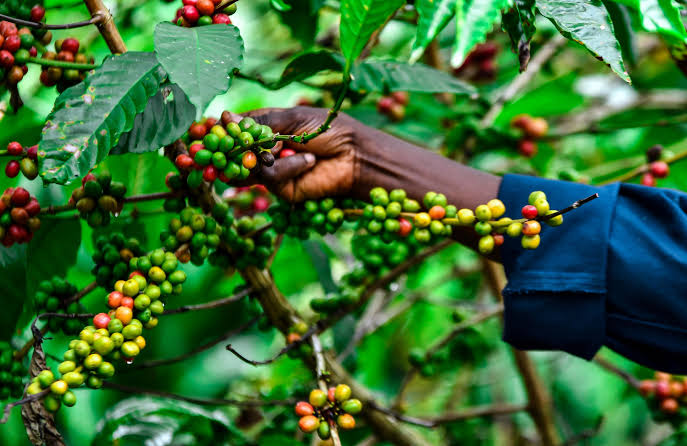
The more striking story, however, is on the investment side. Foreign direct investment has climbed from $1.1 billion in 2013 to a record $3.12–3.4 billion in 2024, according to figures reported by Uganda Online and the Monitor, and FDI remained strong at roughly $3.2 billion in the twelve months to March 2026 — evidence, analysts say, of sustained investor confidence even amid political noise. Coffee, Uganda's signature agricultural export, has been a parallel success story: export earnings roughly doubled to between $2.2 and $2.46 billion in the 2024/25 season, up from $1.84 billion the year before, buoyed by high global coffee prices.
But the composition of that investment boom points to a structural imbalance that has become the central theme of business commentary this month. Oil-related projects account for nearly four in five foreign investment dollars entering Uganda today; by 2023, as much as 97.4 percent of FDI inflows were linked to oil sector activity, according to data cited by the Monitor. The Netherlands and France — home to major oil and gas investors — together accounted for roughly 78 percent of total FDI inflows, with much of that capital tied to the development of Uganda's petroleum resources rather than a broad-based diversification of the country's investment base.
At the center of that oil story is the long-anticipated Lake Albert development, led by French energy major TotalEnergies in partnership with the China National Offshore Oil Corporation (CNOOC). Uganda plans to begin exporting crude oil towards the end of 2026, a milestone that would anchor a wider energy initiative valued at roughly $15 billion, including the East African Crude Oil Pipeline connecting Uganda's oilfields to the Tanzanian coast. Analysts at the African Development Bank and CNBC Africa have suggested oil production could help drive average annual growth approaching 8 percent over the coming five years, a rate that would represent one of the strongest growth trajectories on the continent if realized.
It is against this backdrop that a widely discussed analysis published by The Investigator News this month has crystallized the debate now shaping Uganda's business community: is the current investment boom a foundation for sustainable industrial development, or simply a larger-scale extension of the country's traditional role as a commodity exporter? The piece argues that Uganda possesses a genuine industrial policy framework on paper, but its enforcement outside the oil sector remains uneven, and that the country faces a narrowing window to close the gap between policy design and policy discipline before oil revenues start flowing in earnest. The central risk identified is that Uganda could end up simply industrializing its extraction of raw resources — building pipelines, storage, and export infrastructure — without building the downstream manufacturing, processing and value-addition capacity that would allow oil wealth and coffee earnings to translate into broad-based job creation and economic diversification.
This tension has direct implications for how different stakeholders are likely to act in the coming months. For the government, the approaching first-oil milestone raises the stakes on fiscal management: officials will face pressure to demonstrate that oil revenues are being channeled into infrastructure, education and industrial incentives, rather than simply financing consumption or debt service. For private investors — both the international oil majors already committed to Lake Albert and potential entrants in manufacturing, agro-processing and services — the test will be whether Uganda can offer the regulatory predictability, energy reliability and skilled workforce needed to build businesses beyond the extractive sector. For coffee farmers and cooperatives, sustaining the recent doubling of export earnings will depend on continued favorable global prices as well as domestic investment in processing capacity that captures more value locally rather than exporting raw beans.

The stakes are not purely economic. Uganda's ability to convert its investment boom into durable growth will shape public expectations ahead of the country's political transition period, feeding into the broader debate — playing out alongside contentious political developments this year — over whether the benefits of growth are being broadly shared or concentrated among a narrow set of elites and foreign investors. Civil society groups and opposition politicians have periodically pointed to the disconnect between headline GDP growth figures and the everyday economic experience of ordinary Ugandans, a gap that becomes more consequential the closer the country gets to becoming a meaningful oil exporter.
Looking ahead, several markers will indicate which direction Uganda's economy is heading. The actual start of crude oil exports later this year will be the most closely watched event, both for its direct fiscal impact and as a signal of whether the broader pipeline and refinery infrastructure is functioning as planned. Continued monitoring of non-oil FDI flows — investment in manufacturing, agribusiness, tourism and services — will indicate whether diversification efforts are gaining traction or whether the economy is becoming more, not less, dependent on petroleum. And the government's budget allocations in the coming fiscal year, particularly around industrial incentives, infrastructure and skills training, will offer an early test of whether Kampala is translating investment-boom rhetoric into the kind of industrial policy discipline that independent analysts say the moment demands.
Published By | Business News Editor