Background
On Tuesday, July 28, President Donald Trump held back-to-back meetings at the White House with two wartime allies whose conflicts have come to dominate his second term: Ukrainian President Volodymyr Zelenskyy and Israeli Prime Minister Benjamin Netanyahu. The Oval Office session with Zelenskyy was scheduled for 9:30 a.m. Washington time, with Netanyahu due to arrive at 11 a.m. Both leaders were also expected to attend the funeral of Senator Lindsey Graham, the South Carolina Republican and close ally of both men, who died on July 11 at age 71 after a brief and sudden illness. Graham's final act as a public official had been a visit to Kyiv, where he helped secure an agreement on sanctions aimed at punishing countries that purchase Russian oil, gas and other exports.
The two meetings arrive at a moment when both of the wars Washington is entangled in have reached what several outlets described as critical or crossroads stages. The Iran war, which began with US-Israeli strikes on Iran in late February, has cycled through repeated ceasefire attempts and collapses over the following five months. As of late July, the Pentagon had just paused a campaign of thirteen consecutive nights of strikes on Iranian targets, a pause Trump said came at Tehran's request, while warning that strikes would resume if a durable ceasefire were not reached. Iranian officials, for their part, rejected a US-backed ceasefire proposal delivered by Iraqi Prime Minister Ali al-Zaidi after his own White House meeting with Trump, calling it an unacceptable temporary arrangement that left the future status of the Strait of Hormuz unresolved. Iran's health ministry has said 59 people were killed and 666 injured inside Iran since late June alone, part of a toll that has mounted over months of exchanges.
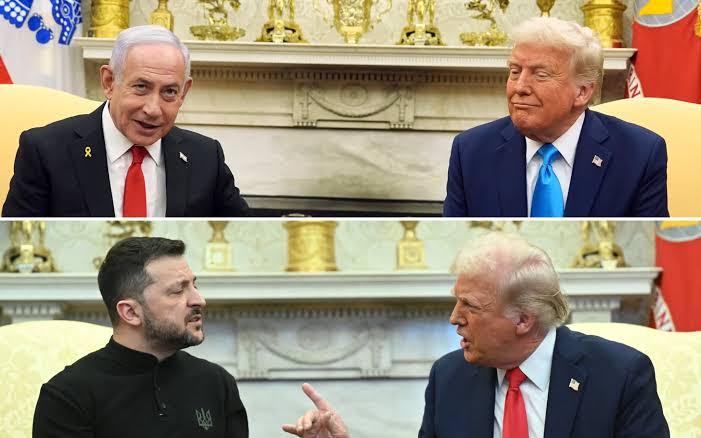
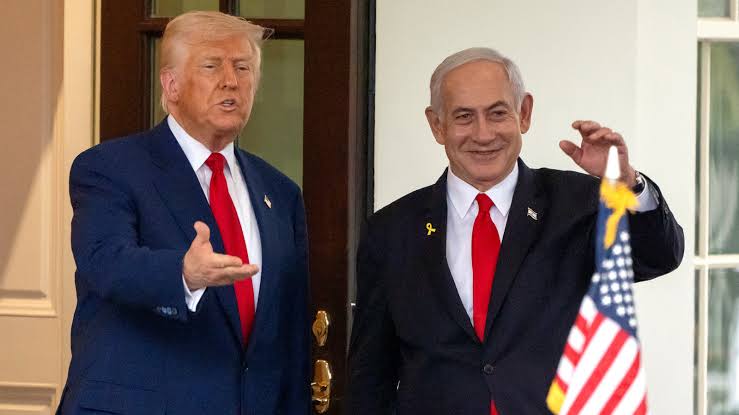
The relationship between Trump and Netanyahu has been under visible strain throughout this stretch of the war. Netanyahu had pushed to continue fighting both Iran and Hezbollah in Lebanon, while Trump and Vice President JD Vance pursued a negotiated settlement with Tehran, and disagreements between the allies had at points burst into public view. Tuesday's sit-down was the first face-to-face meeting between the two leaders since the Iran war began, and by several accounts amounted to the eighth meeting overall between them since Trump returned to office in 2025.
Ukraine's war with Russia, meanwhile, is approaching its fifth year, having outlasted four British prime ministers and now a fifth, Andy Burnham, who took office roughly a week earlier and hosted Zelenskyy aboard a Royal Navy aircraft carrier as his first foreign-leader meeting. Kyiv has spent recent months pressing Washington for stronger air defenses and a more assertive US role in pressuring Moscow toward talks, even as Russian long-range strikes and Ukrainian drone raids on Russian territory have both intensified.
Key Developments
According to White House officials, the Trump-Netanyahu discussion was expected to center on the ongoing Iran conflict, a framework agreement the United States and Israel signed with Lebanon following the Israel-Hezbollah war, and the expansion of the Abraham Accords. Netanyahu was also expected to share Israeli intelligence with Trump on the state of Tehran's nuclear program. On Lebanon specifically, Israel has agreed to let the Lebanese army deploy into some southern villages under a limited "pilot program," with a further round of talks between Israel and Lebanon set to take place in Rome the following week to discuss expanding that arrangement. Speaking Monday, Trump characterized his differences with Netanyahu over Iran as "a little difference," adding that the two leaders remained "pretty close" on strategy.
The Zelenskyy meeting centered on a different but related diplomatic push: a proposed mutual "air truce" that Washington and Kyiv have discussed presenting to Moscow, which would halt long-range air strikes on both sides even without resolving the broader war. Zelenskyy said ahead of the visit that anti-ballistic defense and deeper strategic cooperation with the United States were his "number-one priority" heading into the talks, adding that "peace needs to be brought closer." The idea followed an inconclusive July 23 meeting in Manila between Secretary of State Marco Rubio and Russian Foreign Minister Sergei Lavrov, after which the Kremlin's spokesman, Dmitry Peskov, offered only cautious and noncommittal openness to further talks. Ukrainian and American officials were also said to be coordinating a new round of broader peace proposals to present to Moscow, including another attempt to arrange direct talks between Zelenskyy and Russian President Vladimir Putin, amid a belief in Kyiv and Washington that shifting dynamics in the war could create an opening to push Russia toward the table.
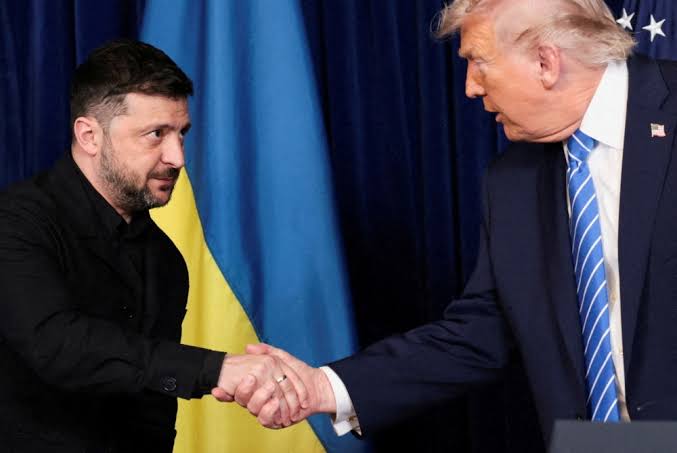
After his White House meeting, Zelenskyy was scheduled to travel to the US Capitol to meet with all 100 US senators, a session complicated by a separate controversy: the Trump administration has told Congress it does not intend to finish spending roughly $400 million in aid already authorized for Ukraine until fiscal year 2029, a delay that has drawn criticism from Democrats and some Republicans who argue the Pentagon is sitting on assistance both parties backed the previous year.
Reactions
European leaders moved to publicly reaffirm their support for Kyiv in the run-up to the Washington meetings, with officials stressing that Ukraine would not be left to negotiate alone. Inside the Iran file, reactions were more fractured: Tehran's rejection of the Iraqi-mediated ceasefire proposal signaled that a durable pause remained elusive despite the pause in US strikes, while Trump has said he is still weighing what he described as a "massive" and expanded attack on Iran should negotiations fail to produce results.
On the Russian side of the Ukraine file, the run-up to Zelenskyy's Washington visit saw an intensification rather than a lull in hostilities: more than 390 Ukrainian drones were reported targeting the Moscow region overnight ahead of the meetings, even as Kyiv and Washington discussed the air-truce concept. The Kremlin dismissed press reports about the specifics of the proposed truce as fabrications, with Peskov saying Moscow's position would be determined solely by Russia's own interests rather than by outside proposals. In Washington, the bipartisan friction over the delayed $400 million in Ukraine aid added a domestic political undercurrent to a visit otherwise framed around wartime diplomacy, with lawmakers from both parties pressing the Pentagon for an explanation.
What's Next
In the immediate term, both Zelenskyy and Netanyahu were due to join Trump and other dignitaries at Senator Graham's funeral service, a moment that underscored the degree to which the two conflicts have become intertwined with the same small circle of Washington relationships. On Lebanon, the next concrete step is the follow-up round of talks in Rome the following week, where negotiators are expected to discuss widening the pilot program allowing the Lebanese army into southern villages. On Iran, the central open question is whether the current pause in US strikes holds or gives way to the larger escalation Trump has said he is considering, with Tehran's rejection of the Iraqi-brokered proposal suggesting the two sides remain far apart on terms, particularly regarding the Strait of Hormuz.
On Ukraine, attention will turn to whether the proposed air truce gains any real traction in Moscow, given the Kremlin's noncommittal public posture, and whether the broader push for direct Zelenskyy-Putin talks makes any progress. Zelenskyy's Capitol Hill meeting with senators is likely to keep pressure on the administration over the withheld $400 million in aid, a dispute that could shape the tone of US-Ukraine relations even as the diplomatic track continues. Taken together, Tuesday's dual meetings leave both wars in roughly the same position they entered the day: neither resolved, but each facing a moment that participants on multiple sides described as pivotal.
Published By | News Editor