Written By | International News Agencies
Poverty in Liberia worsens despite 5% growth
Economic & Social Transformation
Liberia is having its best macroeconomic run since the end of its civil war, and its poverty rate is going up. Both statements are supported by the same set of 2026 institutional reports. Reconciling them is the central economic question facing President Joseph Nyuma Boakai's government as it approaches the halfway point of its term, and the September 2026 launch of the World Bank's first Public Finance Review for the country in years has turned that question into a costed policy argument.
A strong headline, three different versions of it
The World Bank puts Liberian real GDP growth at 5.1 percent in 2025, driven by a mining sector that expanded 17.0 percent after growing just 2.1 percent in 2024. Services added 4.4 percent on trade, transport and improved electricity supply; agriculture slowed to 2.6 percent as rubber output eased and earlier price effects faded. The International Monetary Fund agrees on the 5.1 percent figure and projects growth strengthening to 5.5 percent in 2026, with the medium term settling near 5.6 percent. The African Development Bank, in its African Economic Outlook 2026 country note updated in June, reports a more modest 4.6 percent for 2025 (up from 4.0 percent in 2024) and forecasts 5.0 percent for 2026 and 5.3 percent for 2027.
The inflation picture diverges more sharply. The World Bank records headline inflation averaging 8.5 percent across 2025, with food inflation swinging from 9.7 percent year-on-year in December 2024 to minus 1.7 percent by December 2025 while non-food inflation moderated from 11.1 percent to 6.6 percent. The AfDB reports average inflation falling from 8.2 percent in 2024 to 6.0 percent in 2025 and expects it to climb back to 8.2 percent in 2026 on higher fuel and food import costs. The Central Bank of Liberia has held a restrictive stance throughout, trimming its policy rate only from 17 percent in January 2025 to 16.25 percent in December — a deliberately cautious easing for an economy where the exchange rate appreciated 5.4 percent year-on-year in 2025 after depreciating 1.1 percent the year before.
The gap between these numbers is not trivia. It reflects how much of Liberia's measured output now comes from a handful of large extractive operations whose production and pricing are reported on different cycles from the rest of the economy — which is exactly the structural issue the poverty data exposes.
The mining engine gets much bigger
Two decisions taken within six weeks of each other have locked in Liberia's extractive trajectory for a generation. On 30 January 2026, the government and ArcelorMittal signed an amendment to their Mineral Development Agreement extending it to 2050 with a right of renewal for a further 25 years. ArcelorMittal is paying the government $200 million for the mining rights extension and for reserved capacity on the railway it is funding. The agreement underwrites an expansion to 20 million tonnes of annual iron ore production, with a projected path to 30 million tonnes, anchored by a $1.8 billion concentrator that brings the company's cumulative investment in Liberia to roughly $3.5 billion — the largest foreign direct investment in the post-war economy. Critically, the deal provides for the Tokadeh–Buchanan rail corridor to be operated by an independent entity from October 2030, converting a single-user concession asset into a multi-user national one.
In December 2025 the legislature moved to ratify a separate agreement giving Ivanhoe Atlantic rail and port access for its Liberty Corridor project. That scheme routes ultra-high-grade ore — above 67 percent iron content — from the Kon Kweni deposit in Guinea across 243 kilometres of Liberian rail to a planned deep-water port at Didia, with construction targeted to begin in 2026, first exports the following year, and a first-phase run rate of up to five million tonnes a year. The delivery model is an explicit public-private partnership among mining companies, development finance institutions, infrastructure operators and the state.
Together these projects make Liberia a transit economy for West African iron ore as well as a producer of it. What they do not automatically do is broaden the tax base. The Public Finance Review found that mining revenues rose nearly fivefold over a decade, from about $27 million in 2016 to $141 million in 2025. That is real progress, and it is also a modest sum relative to what the sector moves — which is why the Bank's headline recommendation is about capture rather than volume.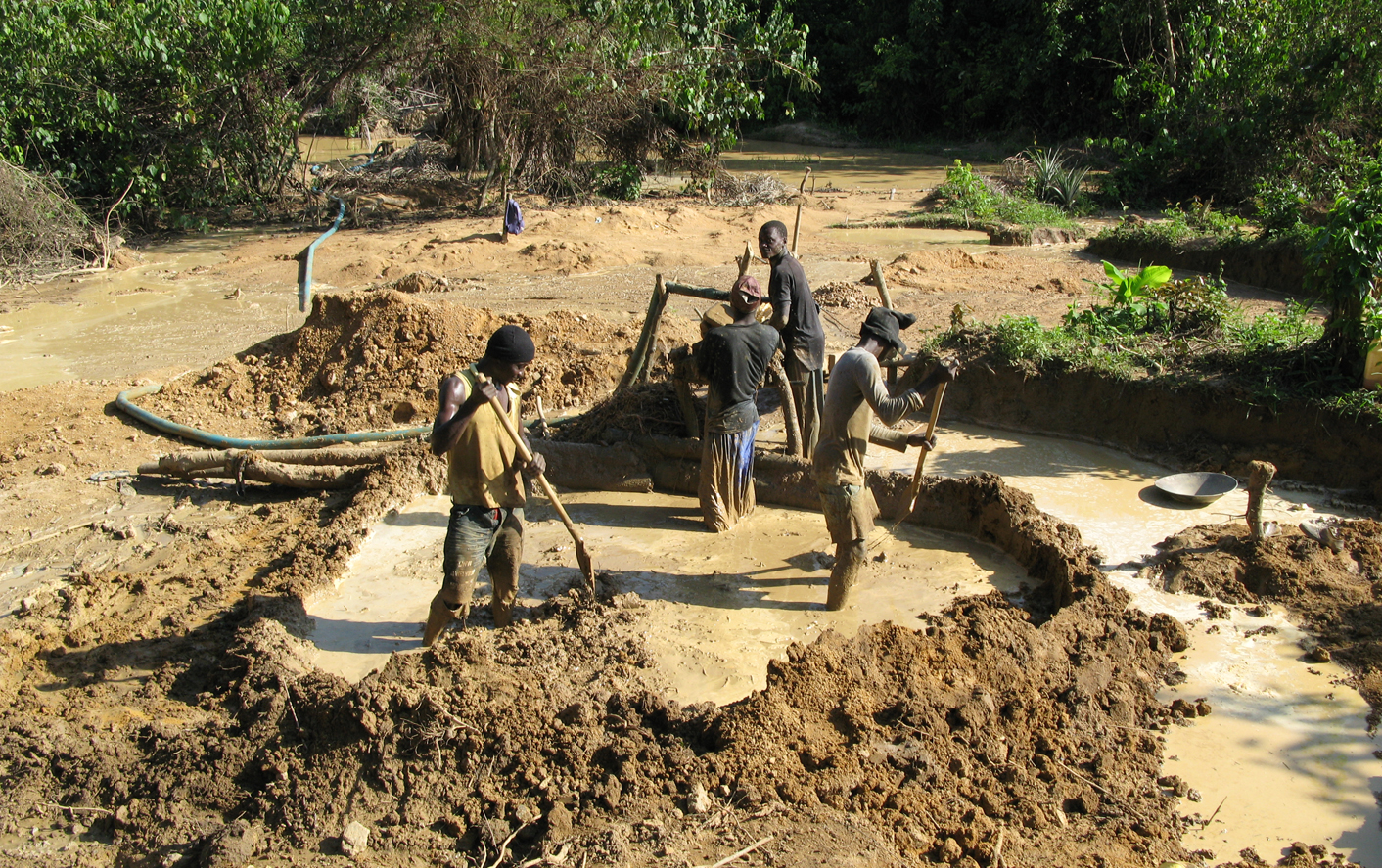
The fiscal turnaround is the government's strongest card
On the public finances, the record is unambiguous. The overall fiscal deficit fell from 7.1 percent of GDP in 2023 to roughly 1.1 percent in 2025 on the World Bank's measure, with the primary balance swinging to a surplus of 0.2 percent of GDP from a 1.0 percent deficit the year before. Public debt declined from 57.2 percent of GDP in 2024 to 54.6 percent in 2025. Domestic revenue climbed from $699 million in 2024 to $848 million in 2025, and the Liberia Revenue Authority has been reported as within roughly $45 million of a $1 billion collection year.
The IMF has rewarded this. On 27 April 2026 the Executive Board completed the third review under Liberia's Extended Credit Facility, releasing SDR 19.30 million (about $26.49 million), and simultaneously approved a new Resilience and Sustainability Facility arrangement worth SDR 193.8 million. A staff mission to Monrovia from 10 to 23 June conducted the fourth ECF review and the first RSF review, and a staff-level agreement announced on 28 July 2026 put roughly $26.1 million in ECF financing and $23.9 million in RSF financing before the Board, which is expected to consider the reviews in late September 2026. Fund staff expect the primary fiscal surplus excluding grants to reach 2.4 percent of GDP in 2026.
What the Public Finance Review actually says
Launched in Monrovia on 7 September 2026 under the title "From Stabilization to Fiscal Transformation," the review sets the government's own numbers against its own ambitions. World Bank Country Manager for Liberia Georgia Wallen noted that Vision 2030 and the ARREST Agenda for Inclusive Development — the administration's framework covering agriculture, roads, rule of law, education, sanitation and tourism — will require approximately $8.4 billion over five years across infrastructure, human capital, economic transformation, governance and social inclusion.
Against that requirement, the review estimates that sustained reform could generate additional annual fiscal space of 3.9 to 5.3 percent of GDP by 2030. The components are specific: a tax gap of roughly 3 percent of GDP that could be closed through compliance and enforcement rather than higher rates, backed by technology and fuller implementation of the Revenue Code and Medium-Term Revenue Strategy; better information-sharing and coordination among the agencies that administer natural resource revenues; improvements in project preparation, procurement and payroll management, with tighter alignment between domestically financed projects and donor-funded investment; and stronger oversight of state-owned enterprises, more prudent debt management, and explicit integration of climate and commodity-price risk into fiscal planning. Wallen was careful to frame the report as a sequencing exercise rather than a new reform list — an acknowledgement that Liberia's constraint is implementation capacity, not the supply of good ideas. For context on the scale of leakage available to be recovered, the AfDB estimates illicit financial flows from Liberia at about $966 million a year.
The social ledger, which has not moved
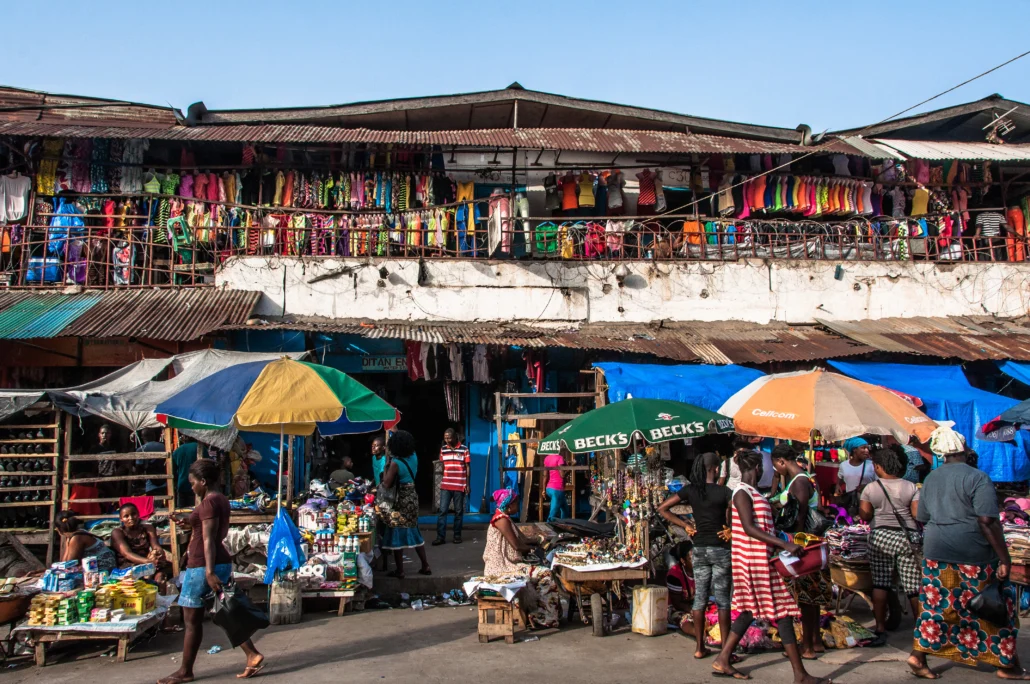
Here the story turns. The AfDB reports poverty at 33.6 percent in 2025, up from 33.1 percent in 2024, despite increased social spending, and youth unemployment above 40 percent, which it attributes to skills mismatches. The World Bank's sixth Liberia Economic Update, released in October 2025 and focused on private sector job creation, found that roughly 87 percent of Liberian workers are in smallholder farming or unregistered micro-enterprises, and that average annual employment growth has fallen from 19.8 percent in 2017 to 8.9 percent in 2025 — now close to the regional average but well short of what is needed to absorb a rapidly growing workforce. Its blunt conclusion was that the private sector as currently structured cannot generate quality jobs at scale, dominated as it is by informal micro-firms with minimal hiring capacity.
The financial system mirrors the split. Capital adequacy stands at 35.0 percent, far above the 10 percent regulatory floor, while non-performing loans remain elevated at 16.2 percent — a banking sector that is well capitalised and not lending productively. External buffers are thin: foreign reserves of $576 million at end-2025 covered about 2.0 months of imports on the World Bank's measure, with the AfDB putting import cover at 2.6 months and projecting 2.9 months for 2026. The current account deficit narrowed to 6.5 percent of GDP in 2025 from 8.1 percent on the Bank's accounting, though the AfDB's wider measure has it at 14.4 percent falling from 15.9 percent — another artefact of how extractive flows are treated.
Electricity is where delivery is visible
The most concrete transmission mechanism from fiscal space to household welfare is power, and it is the one area where the numbers have clearly shifted. Electricity access has roughly doubled to 32.5 percent, and residential tariffs fell 53.8 percent from $0.52 per kilowatt-hour in 2014 to $0.24 in 2024. Between January and December 2025, approximately 81,776 new household connections reached nearly 376,000 people through World Bank-financed projects and other partners. The government has launched a Mission 300 Compact Delivery and Monitoring Unit to drive toward a 75 percent national access rate at 100,000 new connections a year. Repairs to Unit 1 of the Mt. Coffee hydropower plant are nearing completion, with the full 88 megawatts due to be restored by June 2026, and a tender for an additional 42 megawatts has been launched. The World Bank's active portfolio in Liberia stands at $936.8 million across 18 projects, and three new financing agreements worth $125 million were signed to support energy access, digital growth and road connectivity.
The test ahead
Liberia's 2026 position is best understood as a well-managed enclave economy that has bought itself time. Stabilisation is done: deficits are down, debt is falling, revenue is rising, and the Fund's programme is on track. What has not yet happened is the conversion of mineral rents into employment, and the poverty and informality data suggest the mechanism for that conversion does not currently exist.
Three things will indicate whether the next phase is different. First, whether the independent rail operator scheduled for October 2030 genuinely opens the Tokadeh–Buchanan corridor to agricultural and timber freight rather than functioning as a mining utility under new management. Second, whether the Liberia Revenue Authority's compliance drive closes a meaningful share of the 3 percent of GDP tax gap, since that is the only fiscal space not contingent on commodity prices. Third, whether the electricity connection rate holds near 80,000 a year — the one metric that reliably converts public investment into measurable changes in how Liberians live and work. Growth of 5 percent is a necessary condition for poverty reduction in Liberia. On the evidence of 2025, it is nowhere near a sufficient one.



