Written By | International News Agencies
Iceland's relationship with the European Union has long been unusually ambivalent for a small, trade-dependent European economy
Iceland has voted to reject a government proposal to resume long-frozen negotiations to join the European Union, according to final results reported Sunday by national broadcaster RUV, capping a referendum campaign that exposed deep and closely balanced divisions over sovereignty, fisheries and the small Nordic nation's place in a turbulent world. With all but one constituency counted, the "No" side won 52.5 percent to 47.5 percent for "Yes" — a margin RUV described as effectively unreversible given the small number of outstanding ballots, concentrated in a southwest constituency where the measure was already trailing. The result is a significant setback for Prime Minister Kristrún Frostadóttir's left-leaning coalition, which had championed the vote as a way to let citizens, rather than politicians, decide whether Reykjavik should reopen a membership process that has sat dormant for more than a decade.
Background
Iceland's relationship with the European Union has long been unusually ambivalent for a small, trade-dependent European economy. The country is not an EU member but participates in the bloc's single market through the European Economic Area (EEA) agreement, in force since 1994, and is part of the Schengen passport-free travel zone. That arrangement gives Iceland access to EU markets and adopts much of the bloc's regulatory framework without a seat at the table where those rules are written — a status supporters of membership have long called untenable and opponents have long called sufficient.
Iceland applied for full EU membership in 2009, in the traumatic aftermath of the 2008 financial crisis, when its outsized banking sector collapsed, the krona cratered and joining the euro looked to many like a path to lasting stability. Accession talks opened in 2010 but stalled almost immediately over the toughest chapters in the negotiation: agriculture and, above all, fisheries. In 2013 a new center-right government led by the Independence and Progressive parties shelved the bid, and Reykjavik formally withdrew the application altogether in 2015, ending the first chapter of Iceland's EU flirtation without a public vote on the outcome.
The current government, a coalition of Frostadóttir's Social Democratic Alliance, the pro-EU Liberal Reform Party (Viðreisn) and the populist People's Party (Flokkur fólksins), took office in late 2024 promising to break that stalemate by putting the question of resuming — not necessarily completing — negotiations directly to voters. The referendum, held Saturday, asked a single consultative question: should Iceland resume accession negotiations with the European Union? A "Yes" vote would not have made Iceland a member; it would only have restarted talks last active more than a decade ago.
Fisheries dominated the campaign because they sit at the intersection of economics and identity. Iceland's waters and the cod, haddock and capelin stocks within them have been managed exclusively by Reykjavik since the country's victories in the mid-20th-century "Cod Wars" with Britain, and fishing remains a pillar of the national economy and export base. EU membership would, under the bloc's Common Fisheries Policy, require some sharing of quota-setting authority with Brussels — a prospect the "No" campaign cast as surrendering hard-won sovereignty. EU Fisheries Commissioner Costas Kadis had signaled openness to special exemptions for Iceland given its singular dependence on fish stocks, but skeptics dismissed the idea that any accommodation would be durable once formal negotiations began, and it was not enough to shift the outcome.
The economic case for EU membership has always rested heavily on Iceland's exposure to currency volatility. With a population of under 400,000 and a floating currency pegged to nothing, Iceland has repeatedly seen the krona swing sharply during periods of stress, complicating trade, mortgages and long-term investment planning; adopting the euro, available only through EU membership and subsequent entry into the eurozone, has been the strongest argument pro-EU campaigners could offer to businesses and households tired of that volatility. Opponents countered that the country's small, open economy has weathered repeated shocks — including the 2008 collapse and, more recently, global inflationary pressure — without the euro, and that monetary independence lets Reykjavik tailor interest-rate policy to its own tourism- and fishing-driven business cycle rather than one set for the eurozone's much larger and more diversified economies.
Key Developments
Polls closed at 10 p.m. local time Saturday after a day of voting that drew heavy interest across the island of roughly 270,000 eligible voters. The count swung through the night: early tallies from around 87,000 counted ballots showed "Yes" narrowly ahead, at roughly 51 percent, prompting cautious optimism among pro-EU campaigners and initial headlines suggesting a breakthrough. But as more rural and coastal constituencies — many of them dependent on fishing and historically more skeptical of Brussels — finished reporting, the "No" side steadily overtook and then extended its lead.
By Sunday morning, RUV declared the outcome effectively settled at 52.5 percent "No" to 47.5 percent "Yes," with only the southwest constituency still to fully report and no realistic path for the result to flip. "The nation rejects accession negotiations with the European Union," the broadcaster wrote in its summary of the count. Because the referendum was consultative rather than binding, the result carries no automatic legal force — Iceland's parliament, the Althing, is not compelled by law to act on it — but Frostadóttir's government had committed before the vote to abide by whatever the public decided, effectively making the outcome politically binding in practice.
Reactions
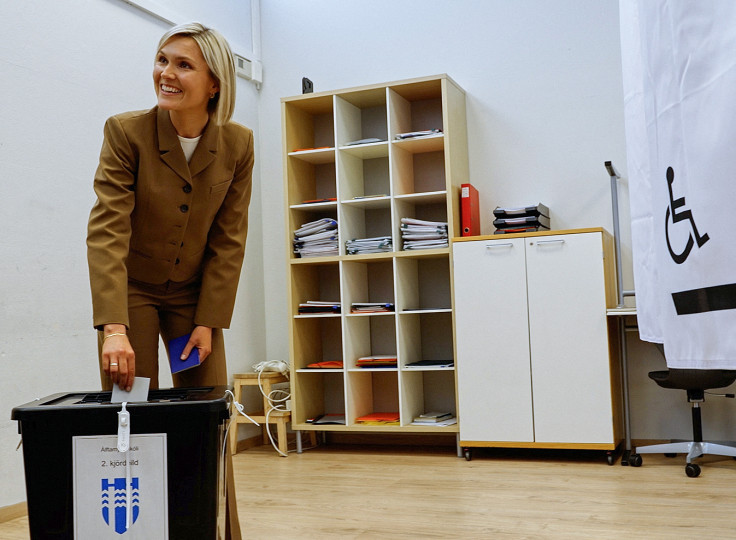
Speaking after casting her own ballot Saturday, before the final tally was known, Frostadóttir called the contest "a tight race, extremely exciting," adding that the campaign had "lifted discussions about the EU, about Iceland's place in the world, about our general geopolitical situation and status, to a higher level." She, Foreign Minister Þorgerður Katrín Gunnarsdóttir and Social Affairs Minister Inga Sæland were scheduled to hold a joint press conference Sunday afternoon local time to address the result and its implications for the coalition, whose three constituent parties do not share a unified stance on EU membership — Viðreisn has long been the most enthusiastically pro-EU of the three.
"No" campaigners, drawing heavily on support in fishing communities and rural districts, framed the result as a vindication of arguments that Iceland's prosperity and identity rest on retaining full control over its natural resources and monetary policy rather than ceding authority to Brussels. Opposition parties from the previous center-right government, which had shelved the original accession bid in 2013, are likely to present the outcome as confirmation that their earlier judgment was correct. Coverage in the run-up to the vote, including analysis from CNN and other outlets, noted that the campaign played out "under the shadow" of the Trump administration's renewed interest in Arctic security and Greenland, a dynamic that added a layer of geopolitical anxiety to what might otherwise have been a narrower debate about fish quotas and currency stability.
What's Next
With the "No" side prevailing, Frostadóttir's government is expected to shelve any near-term push to reopen accession negotiations, honoring its pledge to respect the referendum despite its non-binding legal status. That leaves unresolved the underlying questions that drove interest in EU membership in the first place: how a small economy tied to a volatile currency, the krona, manages financial shocks without the stabilizing anchor of the euro, and how Iceland balances deep economic integration with the EU single market against a preference for staying outside its political institutions.
The vote will also be watched well beyond Reykjavik. Iceland's referendum was seen across Europe as a test case for how smaller, resource-dependent economies weigh sovereignty against integration at a moment of heightened economic nationalism and security uncertainty, including debates in Norway — another prosperous non-member tied to the EU through the EEA — about its own long-standing ambivalence toward membership. For now, Iceland's answer, delivered by the narrowest of margins, is that it prefers to keep negotiating its future from outside the room rather than inside it.



