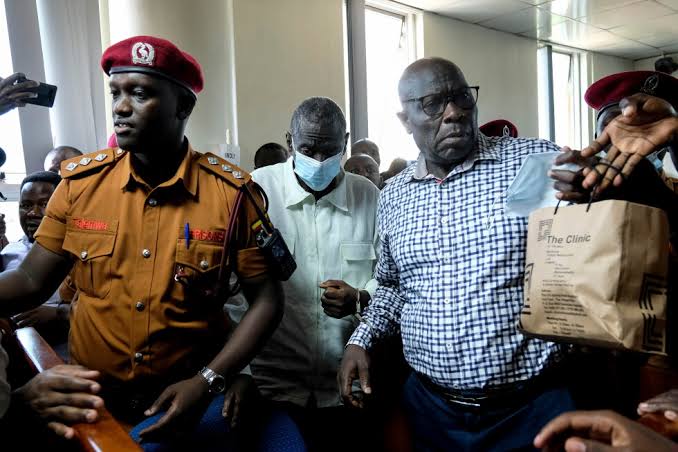
A Ugandan court this month allowed the treason trial of veteran opposition leader Dr. Kizza Besigye to continue even as the 69-year-old sat hospitalized and reportedly unable to speak, a development that has come to symbolize the widening reach of the state's campaign against dissent nearly two years into what critics call an accelerating authoritarian turn under President Yoweri Museveni. The ruling, handed down by Judge Emmanuel Baguma in mid-August, cleared the way for the prosecution to call its first witness and, in the days since, to tender a batch of videos and audio recordings that state lawyers say capture Besigye plotting with associates to overthrow the government. The case, which carries a potential death sentence, has become the highest-profile test yet of how far Uganda's judiciary and security establishment are willing to go to neutralize the country's most durable opposition figure.
Besigye's path to the dock has been unusual even by the standards of Uganda's turbulent opposition politics. A former personal physician to Museveni during the 1980s bush war that brought the president to power, Besigye broke with his one-time patient and mentor in the early 2000s and has since run against him in four presidential elections, each time alleging fraud and each time returning to a familiar cycle of arrest, house detention and prosecution. His current legal ordeal began on November 16, 2024, when he was seized by security operatives in Nairobi, Kenya, while attending meetings with Ugandan exiles — an operation that Kenyan and Ugandan officials have never fully explained and that rights groups, including Amnesty International, characterized as an unlawful cross-border abduction. He resurfaced four days later in a Kampala military court, charged alongside fellow FDC figure Haji Obeid Lutale with illegal possession of firearms. By February 2025, after his lawyers successfully challenged the military court's jurisdiction over a civilian, the case was transferred to the ordinary courts and the charges were upgraded to treason, a capital offense under Ugandan law.
Prosecutors allege that between 2023 and November 2024, Besigye engaged in a sprawling international conspiracy to raise a paramilitary force and topple the government, with planning meetings said to have taken place in Geneva, Athens, Nairobi and Kampala. The state's first witness, an American-based private investigator named Andrew Wilson, testified that he was contacted in 2021 about facilitating paramilitary training and told the court he met Besigye in Nairobi in November 2024, where the conversation allegedly turned to acquiring weapons, drone technology and explosives for use against Ugandan officials and diplomatic missions. Besigye has denied the charges, and his legal team has questioned both the credibility of the state's witnesses and the fairness of proceeding with a trial in which the defendant cannot meaningfully participate. Court filings indicate Besigye has been hospitalized since August 4; a medical note presented to the court said he could follow proceedings but was unable to speak, prompting a dispute between the defense and a co-accused over whether he was in fact refusing to attend or too unwell to do so. Judge Baguma ruled the trial would proceed regardless, a decision defense lawyers have signaled they may appeal.
The case has been complicated further by the arrest of Besigye's lead counsel, Erias Lukwago, the Lord Mayor of Kampala, who was detained and charged with failing to report an alleged act of treason — a move his party, the FDC, and the opposition National Unity Platform (NUP) jointly condemned as "state lawlessness" designed to strip Besigye of effective representation. Lukwago's arrest drew comparisons to a broader pattern human rights monitors have tracked through 2026: the steady narrowing of space for anyone seen as adjacent to opposition activity, from lawyers and journalists to ordinary social media users.

That pattern has been on vivid display elsewhere in Uganda's political system this year. In late June, Gen. Muhoozi Kainerugaba — the commander of Uganda's armed forces and Museveni's only son — ordered a security shutdown of the Daily Monitor, the country's largest independent newspaper, along with the broadcasters NTV Uganda and Spark TV, all owned by Kenya's Nation Media Group. Soldiers sealed the outlets' premises overnight without prior notice, and Kainerugaba declared on social media, "In Uganda, I do not believe in a free press," adding that "all bad stories about Uganda" would henceforth need clearance from his office. The government later described the closure as part of a presidentially sanctioned security inquiry involving the military, police and intelligence services, though officials never specified what offense triggered it. The outlets continued limited digital operations throughout the roughly month-long closure before Museveni authorized their reopening following what local reporting described as weeks of high-level negotiations between the government and Nation Media Group's leadership. It was the latest in a recurring cycle for the Monitor, which the government also shuttered for ten days in 2013, and for NTV, which was pulled off air in 2007 after critical coverage of the government.
The shutdown has fed into a broader narrative, increasingly discussed in regional and international commentary, that Museveni — who at 81 has now governed Uganda for four decades and secured a seventh term in a January 2026 election held amid an internet blackout and opposition fraud allegations — is actively managing a succession in favor of his son. A widely circulated Foreign Policy analysis published August 18 argued that the media closure, the intensified prosecutions of government critics, and Kainerugaba's increasingly open assertions of authority together suggest a transition already underway in practice, even as Museveni shows no public sign of intending to relinquish power during his lifetime. Separately, courts have handed down a string of prison sentences this month for online criticism of the ruling family: a university student, Elson Tumwine, was sentenced August 5 to two months under the Computer Misuse Act for a TikTok video critical of Museveni and parliament speaker Anita Among, while another defendant, Juma Musuuza, received a 12-month sentence for social media posts described as hate speech and "malicious information" about Museveni, Among and Kainerugaba.
For Uganda's opposition and civil society, the through-line connecting the Besigye trial, the media shutdown and the TikTok prosecutions is a state apparatus increasingly willing to use the machinery of security and criminal law to manage political risk ahead of an anticipated leadership transition. The immediate question hanging over the Besigye case is procedural: whether an in-absentia trial of a hospitalized defendant facing a capital charge will withstand appellate and international scrutiny, and whether Lukwago's prosecution leaves Besigye's defense meaningfully intact. The larger question is what precedent the case sets for how the Ugandan state treats its most prominent internal critic as the country moves through a period of economic transformation — driven by imminent oil exports — and political uncertainty in equal measure. Regional diplomats, Western embassies and organizations such as Human Rights Watch and the International Crisis Group are expected to continue monitoring the trial closely, particularly given the charge's capital nature and Besigye's stature as Uganda's longest-serving opposition leader. What happens next in the Kampala courtroom, and to Besigye's health, will likely shape how the rest of the 2026 political calendar unfolds.
Published By | Political Editor