Written By | Sports Desk
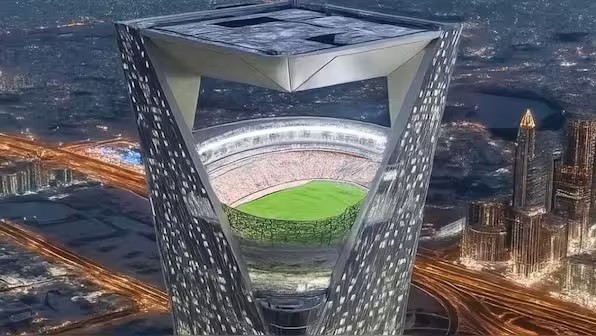
Neom Stadium was meant to float 350 metres above the desert for the 2034 World Cup. Reports now say it has been shelved indefinitely.
LONDON
Architecture has a long tradition of the unbuildable: drawings so ambitious they were never meant to leave the page. This week, one of the most audacious renderings of the century moved a step closer to that category. Saudi Arabia has reportedly shelved Neom Stadium, the elevated arena planned as a centerpiece of the 2034 FIFA World Cup.
The news broke on October 4 in a Reuters exclusive, and Dezeen reported on October 5 that the project had been "shelved indefinitely." Officials have not formally confirmed a cancellation, but the story has already redrawn the map of the tournament, and raised bigger questions about what happens when design ambition meets fiscal reality.
A Stadium Built for the Sky
The numbers explain why the project captured imaginations. Neom Stadium was planned as a 46,000-seat arena set 350 metres above the ground, and the bid for the World Cup described it as the "most unique stadium in the world." It was designed as part of The Line, the linear megacity at the heart of the Neom development in northwest Saudi Arabia. Arabian Business describes The Line as a steel-and-glass structure about 100 miles long, and puts the stadium's cost at around $2.5 billion.
In design terms, it was a stadium that rejected the usual rules. Most arenas are anchored to the ground, surrounded by car parks and transit. This one was to be lifted into the air as part of a city that was itself conceived as a single continuous building. It was a fascinating proposition, and a deeply expensive one.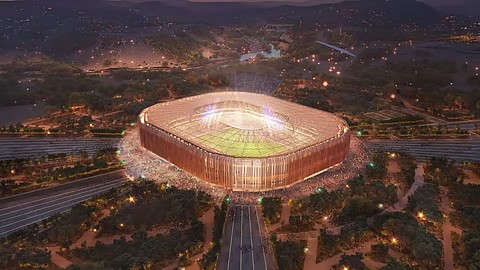
Why It Stalled
The shelving is the latest sign that Neom is being rethought. Dezeen notes that the project's chief executive, Nadhmi al-Nasr, departed in 2024, and that Saudi Arabia's Public Investment Fund conducted a feasibility review of The Line in 2025. Dezeen also reports that the Trojena ski resort is no longer hosting the 2029 Asian Winter Games.
In April, the head of the fund said The Line was no longer a priority and was not vital before 2030, though he denied that projects had been cancelled. Arabian Business points to additional pressure: delays and downscaling at The Line, a strategic pivot toward projects with faster financial returns, and an economic backdrop that includes an expected fiscal deficit and a projected 3.6 percent contraction in GDP. It also cites disruption to energy shipments from Houthi attacks.
Earlier reporting had suggested the stadium was one of the sports-linked pieces the kingdom would try to rescue from the wider Neom retreat. Its apparent shelving suggests even those priorities have shifted.
A World Cup in Flux
Saudi Arabia had planned 15 venues for 2034: 11 new stadiums and four renovated or expanded ones, across cities including Riyadh, Jeddah, Al Khobar and Abha. Arabian Business puts the combined value of the venue program at $22.7 billion. Neom Stadium was one of the 15, and its status as the signature image of the bid made it more than a seat count.
It is not yet clear whether a replacement will be built or whether the tournament will go ahead with 14 stadiums, as Dezeen notes. Other venues are moving forward. Arabian Business reports that the Aramco Stadium in Al Khobar is scheduled for completion by the end of 2026. The 2034 tournament will also be the first hosted by a single nation in the expanded 48-team format.
The Design Lesson
For architects and designers, the story is a case study in the gap between spectacle and delivery. Renderings are cheap, and concepts are persuasive. Construction is neither. The best stadiums of the last decade have succeeded by combining a memorable form with a realistic program of use, funding and legacy. A venue 350 metres up a megacity is hard to justify on those terms once the megacity itself is under review.
Critics of speculative megaprojects have long argued that striking images can conceal weak fundamentals. Supporters answer that every landmark began as an improbable proposal. Both camps will find fuel in this episode.
What the Cancellation Would Mean for Architecture
Even if Neom Stadium never rises, it has already left a mark. The concept pushed conversations about what a stadium can be: a building that is also infrastructure, part of a city, and part of the skyline. Designers will study the renderings for years, even if the project itself stays on paper.
There is a more practical lesson in how projects of this scale are communicated. A stadium announced as the most unique in the world sets expectations that a conventional arena never has to meet. When the numbers change, the contrast with that early promise becomes starker. Developers and architects who learn from the episode may favor staged, flexible plans over single, all-or-nothing gestures.
For the engineers and contractors who had been preparing for the build, the uncertainty is the hard part. Large venues depend on long supply chains and early commitments, and an indefinite shelving leaves many questions about what comes next unanswered.
What This Means for You
If you are a football fan planning for 2034, the practical message is to watch for official updates before booking anything tied to a specific venue. Ten years out, the plans will keep evolving. If you follow architecture, expect a lively debate about how to value visionary projects that never get built, because the renderings still shape taste even when the steel never arrives. And for anyone who works in design, it is a reminder that the most important drawing in a project is often the budget.
The Verdict
Neom Stadium may yet return in some form, and officials have been careful not to declare it dead. For now, though, the most dramatic stadium of the 2034 World Cup is a rendering rather than a structure. The idea of an arena in the sky was a spectacular one. The reality of building it seems to have brought the project back down to earth.



