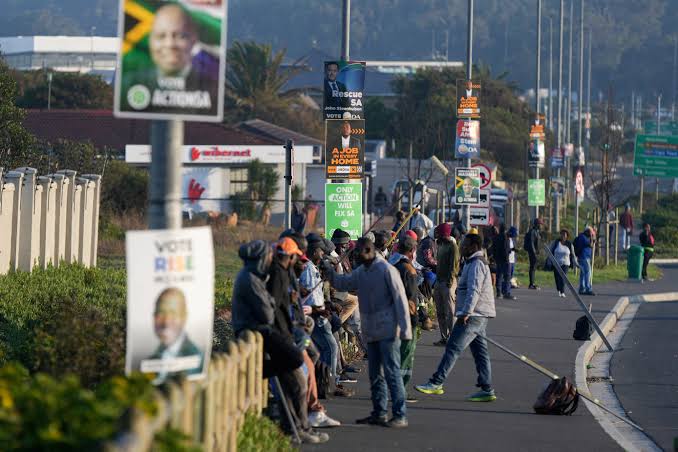
Pretoria/Cape Town, South Africa
A grim set of unemployment figures released last week by Statistics South Africa has reopened public friction inside the country's Government of National Unity, with coalition parties publicly criticizing one another's economic stewardship less than three months before South Africans go to the polls in local government elections on Nov. 4. The data, showing joblessness at its highest level in four years, has become the clearest test yet of whether a coalition built to govern nationally can survive a campaign in which its own member parties are competing against each other for control of the country's towns and cities.
What the Numbers Show
Statistics South Africa reported on Aug. 11 that the country's official unemployment rate rose to 33.6% in the second quarter of 2026, up 0.9 percentage points from 32.7% in the first quarter and the highest level recorded in four years. The number of unemployed South Africans grew by 345,000 to reach 8.5 million, while total employment fell by a further 16,000 over the same period. Using the expanded definition of unemployment, which counts discouraged work-seekers who have stopped actively looking for jobs, the rate climbed to 43.8%.
The figures landed amid an already fraught political backdrop. South Africa's Government of National Unity was formed after the African National Congress lost its outright parliamentary majority in the 2024 general election for the first time since the end of apartheid, forcing it into a power-sharing arrangement with the Democratic Alliance and several smaller parties. That arrangement has held at the national level for roughly two years, but the Nov. 4 municipal elections — set by President Cyril Ramaphosa and now the subject of an Independent Electoral Commission registration and campaign drive that has already attracted 508 registered parties — will be the first electoral test in which coalition partners face off directly against each other, ward by ward, for control of local government.

A Coalition Turns on Itself
The reaction to the jobs data broke largely along the fault lines that will define that campaign. Democratic Alliance leader Geordin Hill-Lewis, whose party sits inside the GNU as a coalition partner but is simultaneously preparing to contest municipalities against the ANC, said the pace of economic reform under the coalition had been inadequate. "South Africa does not lack economic potential. It lacks urgency," Hill-Lewis said. "South Africa cannot afford to lose another quarter to slow reform. We need urgency, clear priorities, and a relentless focus on growth and jobs." He pointed to excessive regulatory red tape, unreliable basic services, underperforming ports and rail infrastructure, and high crime rates as the principal obstacles deterring investment and job creation, adding, "Growth cannot be one priority among many. It must be the priority."
Songezo Zibi, national leader of RISE Mzansi, a smaller party represented in Parliament, described the data as evidence of a deeper economic stalemate rather than a one-off setback. "Towns and cities are where economic activity actually happens," Zibi said. "Without capable, functional, and accountable local governance, businesses cannot expand, basic services fail, and local economies crumble." He linked the unemployment figures directly to the collapse of service delivery in many municipalities and called for immediate state intervention to repair core infrastructure — water, energy and freight logistics chief among them — arguing that Parliament's Standing Committee on Public Accounts had rightly intensified its scrutiny of the government departments overseeing those sectors.
ActionSA, a party that sits outside the formal GNU structure but has at times cooperated with it, offered the sharpest critique. Member of Parliament Alan Beesley noted that South Africa's manufacturing sector had shed 100,000 jobs over the preceding year, a 6% contraction in that industry alone, and accused the coalition of tolerating both bureaucratic dysfunction and the growth of illicit trade networks. "While South Africa's legitimate productive economy continues to shed jobs, the GNU has failed to address the conditions driving businesses out of the market," Beesley said, pointing to findings emerging from the ongoing Madlanga Commission — a state inquiry examining corruption allegations — as evidence of deeper institutional rot. Beesley accused GNU ministers of being "consumed by internal political infighting and horse-trading while continuing to enjoy the luxuries of office," and ActionSA renewed its call for President Ramaphosa to replace the ministers responsible for employment, economic growth, trade and industry, and small business development. "It cannot be acceptable for Ministers to remain in office indefinitely while the number of South Africans without work continues to rise," he said.
Why the Timing Matters
The political significance of the unemployment data is inseparable from its timing. With the municipal elections roughly 12 weeks away, every economic indicator released between now and Election Day is likely to be read primarily through a campaign lens. The GNU's central paradox — that the ANC and the DA must continue governing cooperatively at the national level while campaigning as rivals at the local level — makes moments like this data release especially combustible. Neither major partner wants to be blamed for the coalition's economic record heading into a vote that will, for the first time, put actual municipal power up for contest between them rather than merely cabinet seats negotiated after a national election.
That dynamic helps explain why Hill-Lewis, despite the DA's continued participation in the national government, was willing to publicly distance his party from the coalition's economic performance rather than defend it. It also explains the urgency behind ActionSA's demand for ministerial reshuffles: unlike the ANC and DA, ActionSA has an incentive to position itself as an alternative to both coalition partners in municipalities where service delivery has visibly deteriorated.

Structural Roots of the Crisis
Economists and commentators tracking South Africa's labour market have pointed to structural, rather than purely cyclical, causes for the deterioration. Persistent electricity supply constraints, although improved from the severe load-shedding crisis of 2022 and 2023, continue to raise costs for manufacturers. Rail and port logistics operated by the state-owned freight utility have struggled with reliability, raising export costs for mining and agricultural firms. High and, in some sectors, rising levels of organized crime — including cargo theft, illegal mining and construction-site extortion rackets — have been cited by both government and opposition figures as deterrents to formal investment. Meanwhile, South Africa's youth unemployment rate, though not separately detailed in the latest release, has for years run well above the national average, feeding both social frustration and, opposition parties argue, the country's persistently high crime rates.
What to Watch
In the near term, attention will turn to how the Ramaphosa administration responds to ActionSA's call for cabinet changes and whether the president uses any reshuffle, should one occur, to signal a shift in economic priorities ahead of the municipal vote. The Standing Committee on Public Accounts' continued scrutiny of infrastructure-related departments, flagged by Zibi, is likely to generate further politically charged findings in the coming weeks. Above all, the Nov. 4 elections themselves will serve as the definitive verdict on whether South African voters hold the GNU collectively responsible for the unemployment crisis or differentiate between its constituent parties — an outcome that will shape not only municipal governance but the viability of the national coalition heading toward the next general election.
The stakes are heightened by the fact that South Africa's municipalities directly administer many of the services — water, electricity distribution, waste collection, local roads and business licensing — that most immediately shape whether small and informal businesses can operate profitably. Zibi's argument that "local economies crumble" without functional governance is, in that sense, not simply rhetorical: independent research bodies that track municipal performance have for several years documented a growing number of South African municipalities failing to meet basic service-delivery and financial-management standards, a trend opposition parties are likely to invoke repeatedly between now and November. Whichever party or coalition controls those councils after the vote will inherit both the political credit and the practical burden of addressing the conditions the latest jobs data have laid bare.
Published By | News Editor