At an inaugural festival staged across seven industrial sites, a Pritzker-winning architect has placed a vivid orange structure inside a waste complex, and asked visitors to look at what we throw away.
EHIME PREFECTURE, Japan
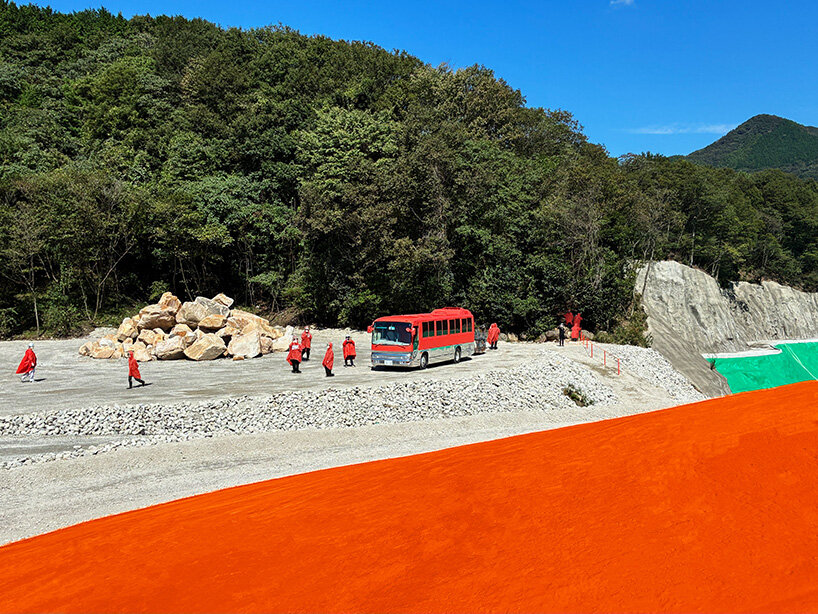
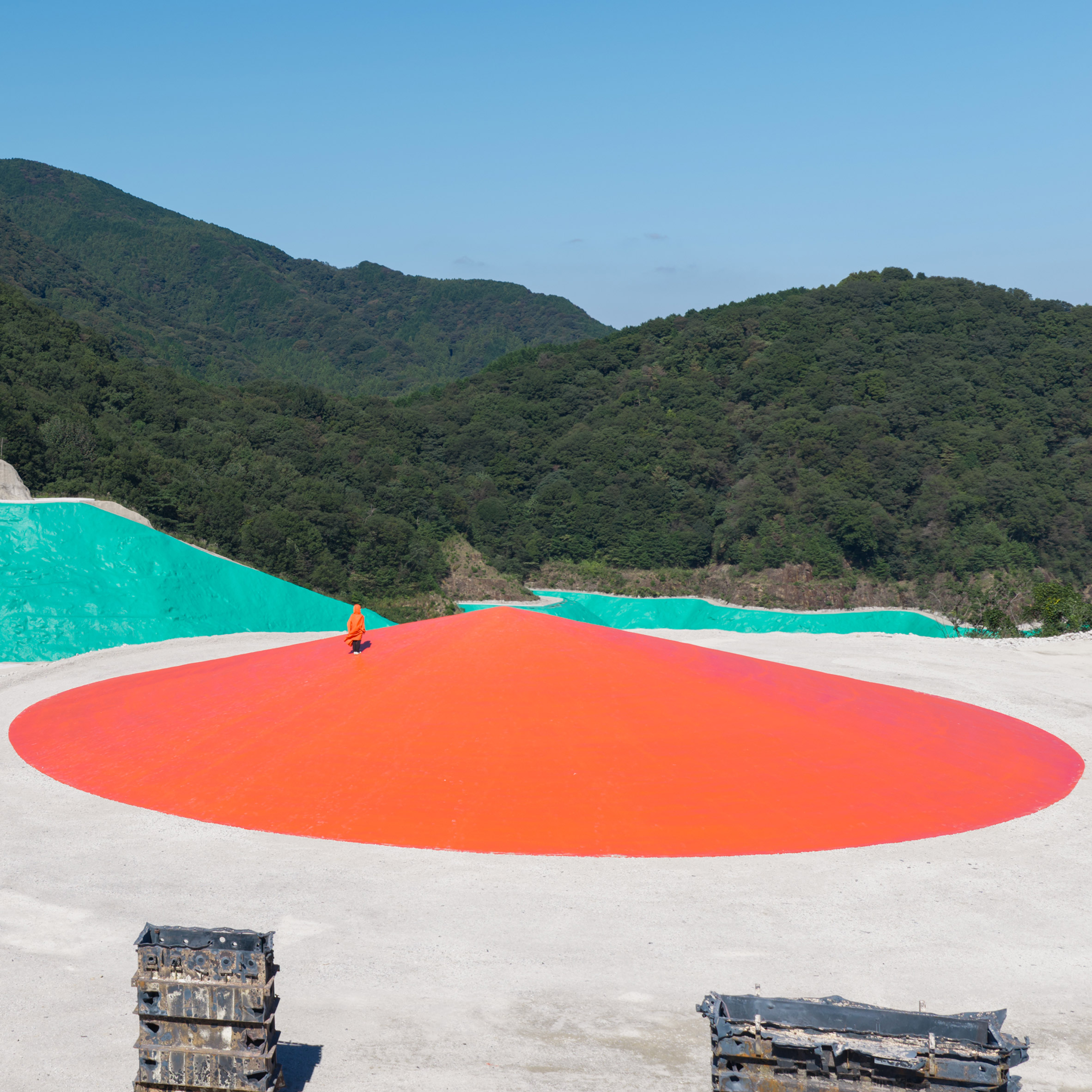
Most architects spend their careers avoiding landfill sites. Ryue Nishizawa has moved into one. For a new festival in Japan’s Seto Inland Sea region, the SANAA co-founder has placed a bright orange peak-like structure against a turquoise landfill, in a project that Designboom describes as a luminous viewpoint rising within the site and that Dezeen headlined as a “luminous viewpoint” inside a Japanese landfill.
The work, titled Landscapes of Waste, is subtitled “A landscape shaped by nature, industry, and people.” It is among the most unusual architectural commissions of the year, and one of the clearest examples of design turning towards infrastructure that is usually hidden.
Note on timing: this story first appeared in design media on October 26 and 28 and is still circulating widely; this article takes a closer look.
A festival built on industry
The installation is part of Setouchi Art and Industry 2026, an inaugural, decentralised festival organised by the Japan Industrial Art Foundation. According to Designboom, it spreads across seven industrial sites in Okayama and Ehime prefectures, treating factories and facilities as places to exhibit art and architecture rather than backdrops to be hidden.
Nishizawa’s site is the landfill and recycling complex operated by Oono Development in Toon, Ehime Prefecture. (Designboom refers to the host both as Oono Development and Oono Associates, so the exact entity name should be verified.) The landfill is expected to fill over about 15 years, a reminder that the landscape visitors see is a temporary, evolving one.
Curation and supervision for the festival come from Kazuyo Sejima, Nishizawa’s SANAA partner, with advisors Yuko Hasegawa, Yusuke Okura and Atsuhiro Miyake.
What was built
The central element is a vivid orange form that stands out against the turquoise tones of the landfill. The colour is not arbitrary. Designboom reports that the orange of the installation, and of workwear provided for visitors, comes from a natural mineral produced in Ehime Prefecture. That detail ties an industrial site to its regional geology: the hue of the structure is borrowed from the ground of the place.
Around it, a collaborative team shaped the visitor experience. Shingo Masuda and Katsuhisa Otsubo designed the plaza, which includes a roundabout, a forest path, an elevated path and a rest area, as well as a bus stop. Suzuko Yamada designed the bus and the visitor wear, with design collaboration from Kazuya Suzuki of Posa. Cinematographer Kenji Agata contributed a video presentation shown on the bus, and Takayuki Noami of Non-REM Studio handled music and sound engineering.
The reporting reviewed for this piece does not state the structure’s dimensions, its construction materials, or include direct quotes from the architect. Those details will likely emerge as more photographs and statements are released.
Why a landfill?
The idea of making waste visible is not new, but it is rarely done with this level of architectural ambition. Landfills are typically fenced, screened and spoken of in euphemisms. By inviting visitors onto the site, in work clothes, aboard a bus with its own film and soundtrack, the festival turns a process most people prefer not to think about into a shared experience.
There is also a precedent in Nishizawa’s own career. He designed the Teshima Art Museum in the same Seto Inland Sea region, a building that is closely associated with the idea that architecture can sharpen perception of a landscape rather than dominate it. His approach has often involved minimal gestures that change how a place is seen. A single orange form against a turquoise pit is exactly that kind of gesture.
The colour contrast also does practical work. Orange is the colour of safety wear, of construction and of warning; here, it is repurposed as an invitation. Visitors in matching tones become part of the landscape they are viewing.
A growing region of design pilgrimage
The Seto Inland Sea has become a destination for design travellers, and the festival adds a new layer. Designboom’s feed this week also points to a forthcoming James Turrell exhibition set to open the Superblue Kyoto venue in early 2027, a sign of how much cultural programming is gathering in Japan.
The industrial angle gives Setouchi Art and Industry a different identity from the art islands nearby. Rather than escaping into pristine nature, it asks visitors to examine the systems that sustain modern life, from waste handling to recycling and the regional economies that depend on them.
What this means for you
If you are planning a trip to Japan, the festival is a reminder that the most interesting design stops are not always museums. Check the official festival schedule before you go, as the sites are decentralised and some are working industrial facilities with their own access rules.
If you design or build, the project offers a transferable idea: infrastructure can be a client. Water plants, substations, depots and landfill sites are places where design attention can change public perception, and where small, well-judged interventions can carry a lot of meaning. And if you simply care about the things you throw away, the project is a quiet prompt to think about where they go.
The bottom line
Landscapes of Waste is a modest-looking intervention with an ambitious argument. By placing a single saturated form in the middle of a landfill, Nishizawa asks us to treat waste as a landscape, something shaped by nature, industry and people alike. It is a good test of whether architecture can change the way we feel about the parts of the world we usually look away from.
Published By | Features Editor




