NIAMEY
Reporters Without Borders demanded an immediate investigation this week into the disappearance of Moussa Kaka, one of Niger's best-known journalists, who left his office in the capital on Monday evening and never reached home. Six days earlier, soldiers from Niger's own army had attacked the presidential palace, the state broadcaster and the country's main airport in the most serious internal challenge to the military government since it seized power in July 2023.
The two events are not formally connected, and no Nigerien official has linked them. But together they describe the condition of a government that survived an attempt to overthrow it only with foreign help, and that is now looking for enemies — inside the barracks, and outside them.
Kaka, a former longtime correspondent for Radio France Internationale who now directs the private broadcaster Radio Télévision Saraounia, has not been heard from since Monday, according to RSF. His relatives and colleagues have been unable to reach him.
"The disappearance of Moussa Kaka, a well-known journalist, is particularly concerning at a time when Niger is going through a period of heightened political and security tensions," said Sadibou Marong, director of RSF's sub-Saharan Africa bureau, in a statement calling on the authorities to open an investigation without delay.
Anne Bocandé, RSF's editorial director, told RFI that the absence of any information was itself the alarming part. "At this point we have no information about the circumstances, the context or where Moussa Kaka could be today," she said, adding that the political instability of recent days made the silence more worrying.
The night of Aug. 28
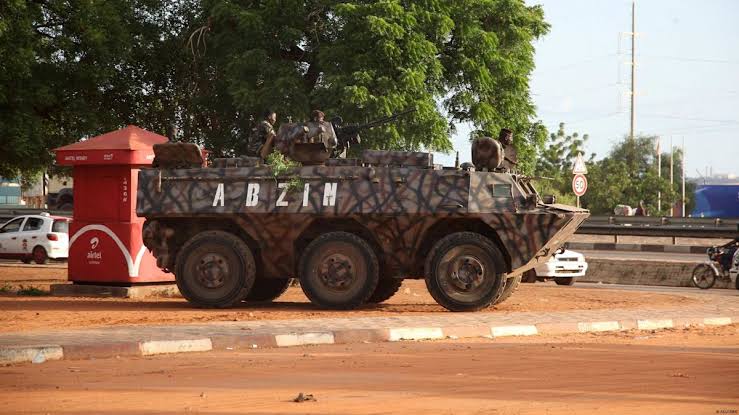
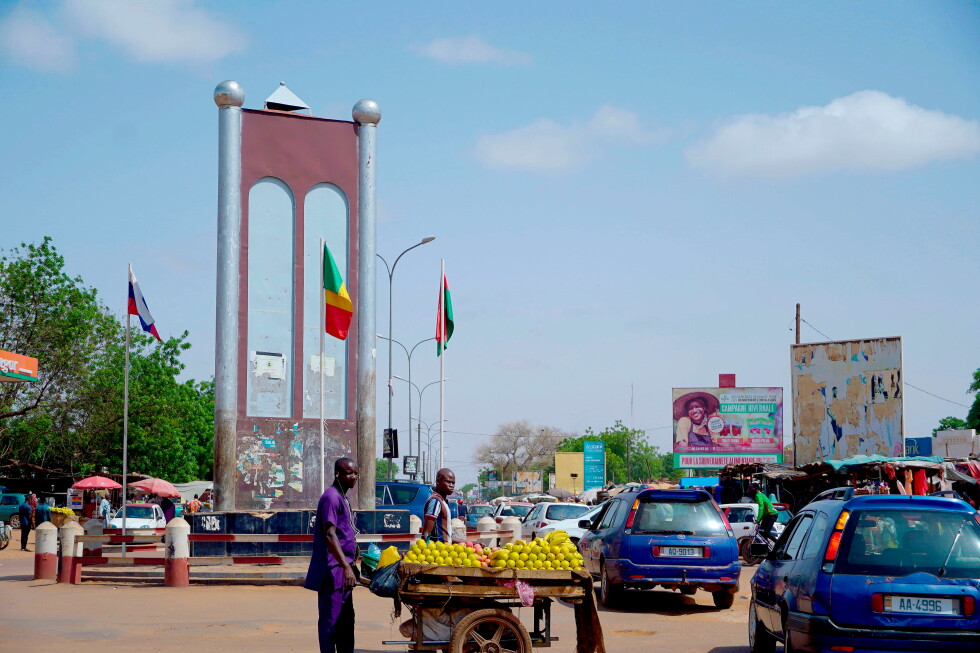
The mutiny began in the hours between Friday, Aug. 28, and Saturday, Aug. 29. Gunfire and explosions were heard across Niamey, concentrated on Base 101 — the air force installation inside Diori Hamani International Airport — and on the district housing the presidential palace. Attackers also moved on the headquarters of the state broadcaster, ORTN.
It was the third attack on the capital's airport this year. The first two, in January and June, were carried out by the Islamic State's Sahel Province and by Jama'at Nusrat al-Islam wal-Muslimin, the al-Qaida affiliate known as JNIM. This time the attackers wore the same uniform as the men defending the buildings.
The choice of targets — palace, broadcaster, airport — is the standard sequence of a West African coup attempt, as the Belgian analysts Nina Wilén and Yvan Guichaoua noted in a commentary published Sept. 1 by the Egmont Institute. Niger's defense minister nonetheless described the events in the government's first communiqué, issued Saturday evening, as a mouvement d'humeur — a mood movement — pointedly avoiding the word coup.
State television showed dozens of mostly young soldiers paraded in public after the fighting ended. Dozens were killed or arrested, according to the state broadcaster and international news agencies; no official casualty figure has been published. The mutineers issued no communiqué of their own and never took full control of the radio and television buildings, which is part of why their intentions remain contested.
Analysts and diplomats say the rebelling soldiers came largely from the southwest — the Dosso, Téra and Tillabéri areas — regions that have absorbed the heaviest losses in the fight against jihadist groups. The grievances attributed to them are the ordinary grievances of a losing army: casualties, conditions at the front, favoritism, and unequal treatment between corps. Wilén and Guichaoua argue the two readings are not mutually exclusive, and that the mutineers' aims may have shifted in real time as the night went on.
What is not contested is who ended it. Russia's Africa Corps, stationed at Base 101, provided aerial and ground support to loyalist forces, according to analysts and diplomats, with drone strikes on the holdout soldiers at the base precipitating their surrender. Moscow's ambassador in Niamey, Viktor Voropayev, was quoted by Russian media saying senior Nigerien officers had visited the Africa Corps base and thanked its personnel for helping suppress the rebellion.
Wassim Nasr, a senior research fellow at the Soufan Center, said loyalist forces had regained the "upper hand at least at the airport (and base)" by Saturday, while some units moving toward the capital could not immediately be identified as pro- or anti-government.
Three years, and the numbers got worse
President Abdourahamane Tiani — his name is also rendered Tchiani — commanded the Presidential Guard for twelve years before deposing the elected president, Mohamed Bazoum, in July 2023. The justification offered then was that the civilian government could not stem jihadist violence and that Niger needed to reclaim its sovereignty. Bazoum remains in detention. The European Parliament passed a resolution earlier this year demanding his release.
By its own stated measure, the junta has not delivered. The Global Terrorism Index 2025 recorded that Niger had the largest increase in terrorism deaths of any country in 2024, rising 94 percent to 930. The Global Peace Index 2026 ranked Niger the third most terrorism-affected country in the world for 2025, behind Burkina Faso and ahead of Mali and Nigeria. Tillabéri, the region that surrounds Niamey, became the deadliest in the central Sahel. Kidnappings — including of foreigners in the capital — rose sharply, and armed groups in the east have struck security forces and oil infrastructure.
Niger expelled Western security partners after the coup and turned to Russia. Three years on, the balance of force in the countryside has shifted toward the jihadists, not away from them.

Friends, old and new
The response to the mutiny was a map of Niger's realignment. Algeria, ordinarily reticent about its neighbors' internal affairs, sent four fighter jets, a transport aircraft and an aerial refueling tanker to Base 101 on Monday, days after donating four helicopters along with ammunition and other materiel. Turkey expressed solidarity with the Nigerien people while avoiding explicit backing for the government. Italy, the last European state with an active military presence in the country, said only that its few hundred troops at the airport were safe.
Niger's partners in the Alliance of Sahel States, Mali and Burkina Faso, offered nothing on the ground and published a supportive declaration late on Saturday evening — the same belated pattern seen in April, when Mali faced coordinated attacks and the alliance's support arrived after the fact.
Nigerien authorities, for their part, have accused several foreign countries, including France, of being behind the unrest, without providing evidence. Relations with the former colonial power have deteriorated steadily; Niger suspended all access to RFI in May as part of a wider crackdown on French media, having cut the broadcaster's FM signal days after the 2023 coup.
What the press-freedom file shows
Kaka's disappearance sits inside a documented pattern. He was one of six journalists arrested in October 2025 under Niger's cybercrime law and accused of "complicity in distributing documents likely to disturb public order." The documents in question are understood to have been an invitation to a press briefing held by the Solidarity Fund, a body the military government created to solicit public donations. When the junta used that briefing to announce new mandatory contributions from workers, critics circulated the invitation widely online. Kaka was later released provisionally. The last journalist still held in the case was freed on Friday — the day the mutiny began.
What to watch
The most probable next move is a purge. Wilén and Guichaoua expect the government to comb the armed forces and the wider security sector for suspected mutineers and disloyal officers in the coming weeks, and to pull units judged reliable back toward Niamey to protect the president. Both steps carry the same cost: thinner cover in the countryside, at a moment when JNIM and Islamic State Sahel are already gaining. Neither group has commented on the mutiny, but a divided army is a weaker adversary, and both know it.
The second thing to watch is the price of Russian help. Moscow's role in Niger had been deliberately understated — training, maintenance, intelligence. Regime protection is a different category of service, and it creates a different kind of debt. Tiani owes his survival in office to a foreign force stationed on Nigerien soil, a fact the Russian ambassador took care to publicize. Algeria's unusually visible support suggests Niamey intends to hedge rather than depend on a single patron, and Turkey may be asked for more drones.
The third is whether Moussa Kaka is found, and by whom. Niger's government has spent three years narrowing the space in which anyone can describe its performance. A missing broadcaster, four days after the army turned on itself, is the kind of fact that tends to establish how the rest of the year will go.
Published By | News Editor