Written By | International News Agencies
Russia launched its full-scale invasion of Ukraine more than four and a half years ago, and the front line now stretches roughly 1,250 kilometres (about 780 miles).
World Politics
Overview
German Chancellor Friedrich Merz travelled unannounced to Kyiv on Sunday, October 4, arriving to air raid sirens and explosions as Russia struck a second Kyiv bridge in as many days. His visit, aimed at finalizing a joint drone-production deal and releasing a fresh package of military and energy aid, coincided with a separate diplomatic development: Ukrainian President Volodymyr Zelensky said Washington wants to convene trilateral talks among the United States, Ukraine and Russia before the end of October. Taken together, the two threads capture the contradiction at the heart of the war as it enters its fifth year. Europe is deepening its commitment to arming Ukraine, Russia is escalating its strikes on the capital's infrastructure, and an American-brokered negotiating track is being warmed up again after months in which Washington's attention was largely elsewhere.
This article draws on reporting from Al Jazeera, the Associated Press, the Moscow Times, Business Recorder and other outlets. Where sources differ on figures, that is noted below.
Background: A War in Its Fifth Year
Russia launched its full-scale invasion of Ukraine more than four and a half years ago, and the front line now stretches roughly 1,250 kilometres (about 780 miles). Peace efforts have come in waves. Earlier in 2026, Ukrainian officials described an initial round of talks with Russian representatives as productive, but subsequent rounds failed to produce progress, largely because Moscow maintained what Kyiv and its partners describe as maximalist conditions. Reporting this week also notes that American diplomacy on Ukraine stalled as Washington became absorbed in the conflict with Iran, which has dominated the administration's foreign-policy bandwidth for roughly seven months.
Germany has become Ukraine's most important European backer. According to figures cited by the Moscow Times, Berlin has provided more than 43.3 billion euros (about 48.8 billion dollars) in aid since the invasion, including weapons and equipment. An April 2026 military pact between the two countries was described in coverage as worth more than four billion dollars. Merz, who has repeatedly argued that Ukraine's defence is inseparable from European security, has made the case that Russian military power left unchecked will eventually be directed at NATO members.
Key Developments: Merz in Kyiv
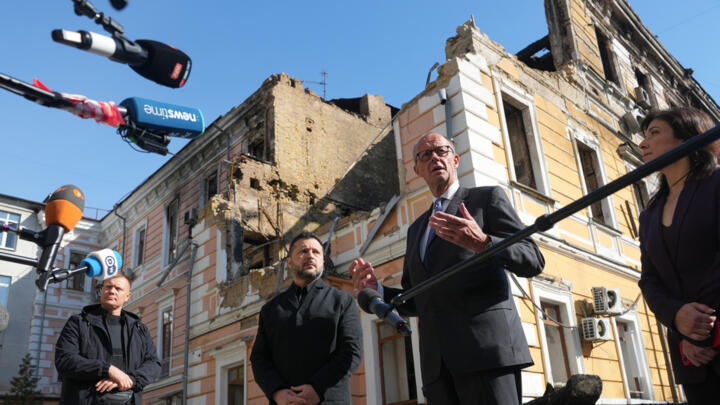
Merz arrived in the Ukrainian capital on the morning of October 4 in an unannounced visit, a precaution routine for senior leaders travelling to a city under regular aerial attack. Local media recorded four air raid alerts that Sunday morning. He met Zelensky at the National Academy of Sciences, and he was accompanied by Economy Minister Katherina Reiche and executives from defence and energy firms, including Siemens Energy, Diehl Defence, Hensoldt and Quantum Systems. The composition of the delegation signalled that the visit was about industrial cooperation as much as symbolism.
The centrepiece was a planned joint drone and weapons production arrangement. Reports describe work on long-range systems with a reach of more than 1,000 kilometres (Al Jazeera put it at over 600 miles, which is consistent) as well as anti-jet drone production involving firms such as Quantum Systems and WIY Drones. Zelensky wrote on X that the two countries would make important agreements to strengthen Ukraine's defences and that Russia must be stopped together.
Money accompanied the hardware. Sources differ on how the figures are rendered: the Moscow Times reported a package of 1 billion euros in military assistance plus 350 million euros for repairs to the energy sector, while Al Jazeera reported 1.1 billion dollars and 394 million dollars respectively. The two sets of numbers appear to be the same announcement expressed in different currencies, but the reports do not make that explicit. Energy repairs are a pressing concern as autumn turns toward winter and Russia continues to strike civilian infrastructure.
In remarks reported by several outlets, Merz called Russian attacks barbaric and described them as daily war crimes. He said that if Russia is not stopped, its war machine will sooner or later turn against Europe, told Ukrainians they could continue to count on German help, and said he had travelled to Kyiv because Ukraine needs all possible support in the coming weeks.
Russia's Strikes on Kyiv's Bridges
The timing of the visit was underscored by Russian action on the ground. During Merz's stay, Russia struck the Northern Bridge across the Dnipro River in Kyiv, the second bridge in the capital hit over the weekend. Damage was reported to the road surface and to the hot-water supply system in the affected area. Ukrainian officials said two people were wounded in the bridge attack, and one person was killed in an aerial bombing in the northeastern city of Sumy.
Analysts and Ukrainian authorities interpret the bridge campaign as an effort to disrupt logistics between the two banks of the capital and the routes leading east toward the front. Russia has also stepped up its use of ballistic missiles and jet-powered drones. Moscow's Foreign Ministry has announced plans for what it called mass retaliatory strikes, and Russia has reportedly warned diplomats and foreign nationals to leave Kyiv, a signal Ukrainian officials treat as preparation for a heavier barrage. For its part, Ukraine has been targeting Russian oil refineries and has pledged to intensify those attacks. Zelensky said Kyiv residents are living through terrible nights and days.
The Diplomatic Track: Talks by End of October
Alongside the military news, Zelensky told reporters that the United States is in contact with both Kyiv and Moscow and is proposing a meeting at the technical level, in a trilateral format, by the end of October. He said Ukraine is ready to support that timeline and is open to holding the meeting in the United Arab Emirates or in another country proposed by Washington. Business Recorder, which carried the remarks, noted that earlier American efforts had stalled as attention shifted to Iran.
The Kremlin has not rejected the idea. Spokesman Dmitry Peskov was quoted as saying Moscow does not rule out such a possibility and that it is a matter of the foreseeable future. Separately, on October 1, Putin said Russia had been ready to resume peace talks in September but on its own terms, according to Ukrainian outlet Ukrainska Pravda; the formulation suggests that Moscow's conditions have not fundamentally changed. In mid-September, Kyrylo Budanov, who heads the Ukrainian presidential office, said at a conference that Kyiv was preparing for talks in October, without confirming a location, and Zelensky has also said he is willing to meet Putin on the sidelines of the G20 summit in Miami to settle concrete decisions.
It is worth being precise about what is and is not on the table. The proposed meeting is described as technical, not a summit of leaders, and no date or venue has been announced. The gap between a technical session and a negotiated ceasefire remains large, and the pattern of previous rounds is that Russian demands, rather than procedural questions, have been the obstacle.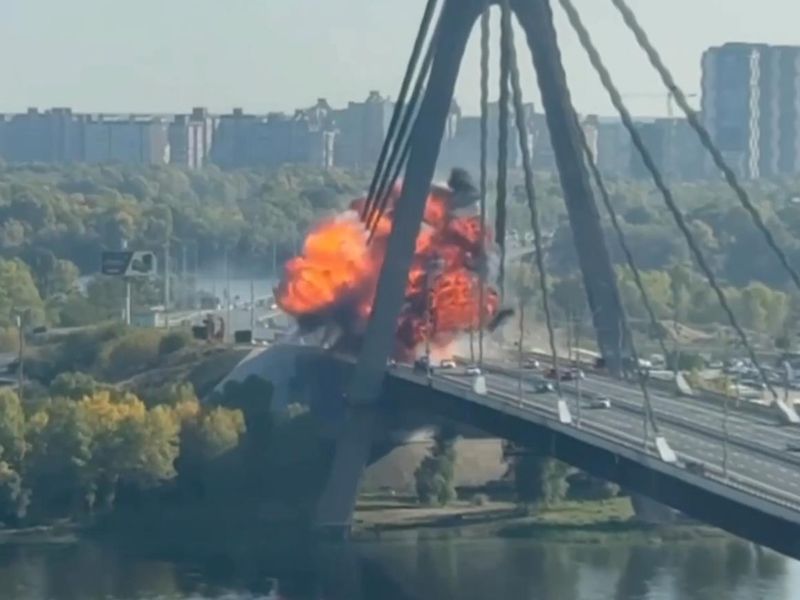
Reactions and Analysis
For Kyiv, the Merz visit delivers tangible production capacity at a moment when long-range strike systems and interceptor drones are central to its strategy. Co-producing weapons with a German industrial base also hedges against fluctuations in American support, a theme that has recurred throughout the year as Washington's priorities shifted. For Berlin, the visit reinforces Merz's positioning as Europe's leading advocate of sustained military aid, and it places German industry directly in the supply chain for Ukrainian defence.
Russia's response has so far been rhetorical and kinetic rather than diplomatic. Threats of mass retaliatory strikes, warnings to diplomats and the systematic targeting of bridges suggest Moscow intends to enter any talks while pressing its advantage in the air. Observers will be watching whether those strikes coincide with the opening of the American-brokered track, and whether Russia treats the Merz drone deal as an escalation that justifies tougher bargaining.
The United States occupies an ambiguous position. Washington is reportedly eager to restart the process, yet its capacity is constrained by the Iran conflict and by a domestic political calendar dominated by next month's midterm elections. A visible diplomatic initiative on Ukraine could serve the administration politically, but it needs a Russian counterpart willing to compromise.
What Comes Next
Several markers will indicate whether the diplomatic window is real. The first is whether Washington formally announces a date and venue, with the United Arab Emirates the most-mentioned option. The second is whether Moscow confirms its attendance and at what level. The third is the scale of the retaliatory strikes Russia has promised, and Ukraine's response against Russian refineries, since a sharp escalation could either harden positions or add urgency to talks.
On the German side, attention turns to the signing and implementation of the drone-production agreement and the disbursement of the aid package, as well as how quickly production lines can deliver systems before winter. For Ukrainian civilians, the immediate concern is practical: repaired bridges, restored heating and hot water, and protection from a campaign that now explicitly targets the capital's connective tissue. In short, October opens with Europe doubling down, Russia escalating and Washington attempting to restart a negotiation that has repeatedly stalled.
Note on Discrepancies
Aid figures appear in euros in some reports and in dollars in others, with slightly different totals; this article reports both as published. Casualty figures from the bridge strikes come from early reports and may be revised.



