Written By |
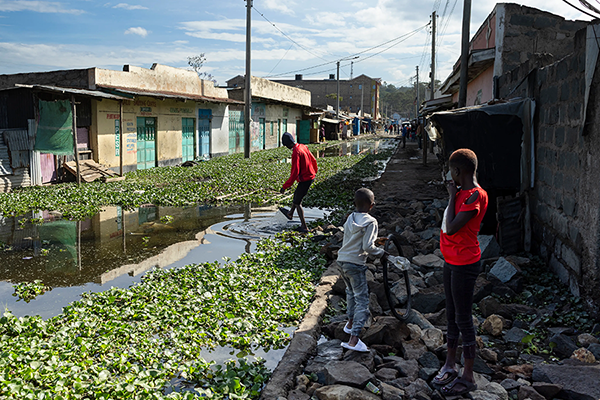
A young resident washes his feet in water over a flooded access road to their residential blocks. [File: AFP]
Nairobi -
Tourist boats that once cruised Kenya’s famed Lake Naivasha are now being used to rescue residents stranded in flooded homes, as the lake continues to expand at an alarming rate.
Water levels in the Rift Valley lake have been rising for over a decade, but residents of the low-income Kihoto settlement say this year’s flooding is unlike anything they have seen.
“It hasn’t happened like this before,” said 51-year-old resident Rose Alero. “People are suffering.”
Local officials report that the lake has pushed an unprecedented 1.5km (about 1 mile) inland, swallowing entire neighbourhoods. In some homes, water reaches waist height. Across the district, toilets have overflowed, increasing the risk of disease. “People are stuck. They have nowhere to go,” Alero said, adding that many neighbours have already fallen ill.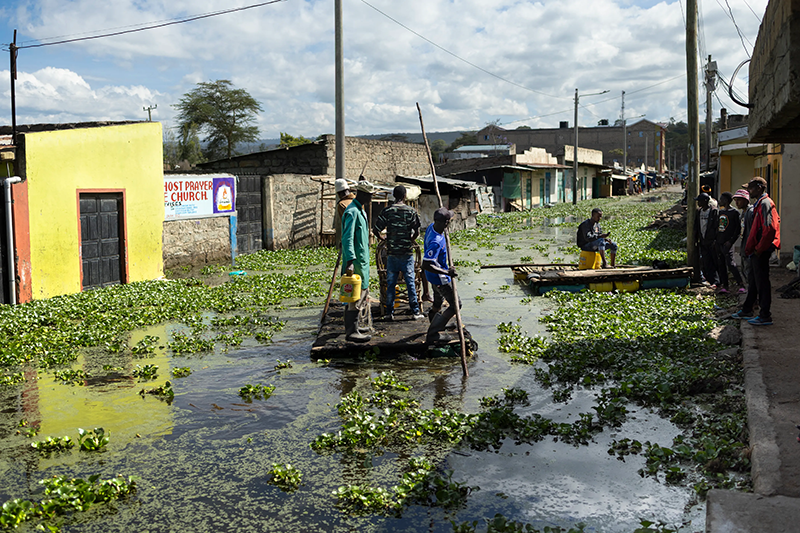
Residents use push poles to manoeuvre their makeshift rafts over a flooded access road to their residential blocks in Kihoto, Naivasha. [File: AFP]
The destruction is extensive: hundreds of homes are underwater, churches have collapsed, and police stations sit submerged among floating vegetation. During one sudden surge, schoolchildren were forced to evacuate on makeshift rafts.
Nakuru County’s head of disaster risk management, Joyce Cheche, estimates that at least 7,000 people have been displaced. Rising waters have also disrupted wildlife, tourism, and local commerce.
While the county has offered transport support and introduced health measures, financial compensation has yet to be provided. Flower farm workers—critical to Kenya’s export economy—are staying away from work due to fears of cholera and potential landslides. Cheche also warned of increased encounters with the lake’s sizeable hippo population. “We didn’t see it coming,” she admitted.
Residents use push poles to manoeuvre their makeshift rafts over a flooded access road to their residential blocks. [File: AFP]
At the lake’s edge, skeletal acacia trees now stand submerged as water advances roughly one metre (3.3 feet) each day. The same phenomenon is affecting several other Rift Valley lakes, displacing hundreds of thousands.
Most scientific studies attribute the surging water levels to increased rainfall driven by climate change. However, Kenyan geologist John Lagat of the Geothermal Development Corporation argues that tectonic activity plays a major role. He explained that the lakes lie along a major geological fault, and shifting plates have gradually sealed underground water outlets, trapping more water. He noted that heavy rainfall and land degradation from population pressure also contribute “substantially” to the flooding.
Back in Kihoto, Alero fears the worst as the rainy season approaches. “We are very worried,” she said from her flooded home. “We can’t tell what will happen.”
Source: AFP



