Written By | International News Agencies
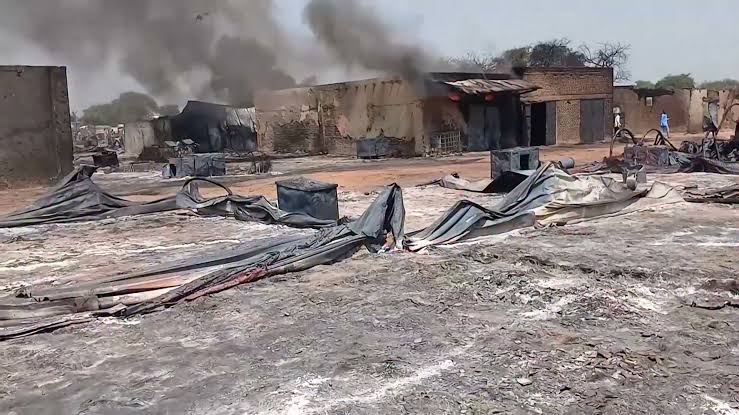
Two civilians were killed and others wounded, and vehicles were damaged, the government says. It has not named the victims or said how many people were hurt
NIAMEY
Niger's military government has accused neighboring Chad of carrying out a drone strike in the remote north that killed two civilians, calling it an "act of aggression," summoning Chad's ambassador and announcing it will take the case to the United Nations Security Council and the African Union. Chad denied any role on Tuesday and challenged Niamey to publish its evidence. No independent party has confirmed who launched the drone. The dispute, between two states that sit on the front line of the Sahel's jihadist insurgencies, comes two months after a failed mutiny in Niger's capital shook the junta led by Gen. Abdourahamane Tiani.
What Niger says happened
According to Niger's account, as reported by Africanews and the Rio Times, a drone struck the Emi Lulu area of the Agadez region in the early hours of Saturday, Oct. 24, at about 1 a.m. Africanews places the strike at the Salvador Pass, in a mountainous, sparsely populated mining region near the borders with Algeria and Libya that is a known route for smugglers and armed groups. Two civilians were killed and others wounded, and vehicles were damaged, the government says. It has not named the victims or said how many people were hurt.
The government read a statement on national television on Monday, Oct. 26. It described the attack as a violation of Niger's sovereignty and accused Chad of supporting mercenaries and of targeting civilians and strategic infrastructure. It also claimed the attack was carried out "with the support" of France, according to Africanews. Niger says its security and judicial authorities found material and technical evidence, but it has not made that evidence public, the Rio Times reported.
Niamey announced a package of diplomatic steps. It summoned the Chadian ambassador and demanded an immediate halt to "hostile actions" and compensation for the damage. It said it would bring the matter before the UN Security Council and the African Union's Peace and Security Council, and called for an independent international investigation. It also cited Article 51 of the UN Charter, which recognizes the right of self-defense, and said "restraint is not weakness."
Chad's denial
Chad responded on Tuesday, Oct. 27. Communication Minister Gassim Chérif Mahamat read a statement on national television saying that N'Djamena "in no way ordered, conducted or supported any air military operation from its soil against Niger," according to reporting by the Senegalese outlet Seneweb. Chad also denied helping any foreign power carry out hostile action against Niger. It urged Niamey to publish the evidence it says it holds so that its reliability and scope can be assessed, and said it supports an independent international investigation. It demanded an end to what it called "unfounded accusations."
In a counter-accusation, Chad said Niger shelters armed Chadian rebel groups, the Rio Times reported. That claim, like Niger's, is unverified, and neither government has produced public evidence. France had made no public reply to the latest accusation when the Rio Times wrote its report. Paris withdrew its troops from Niger in December 2023 and handed its last base in Chad to the Chadian authorities in January 2025, the same report noted.
The backdrop: a mutiny and a search for culprits
The drone accusation cannot be understood apart from the events of late August. Soldiers staged a mutiny in Niamey on Aug. 28 and 29, according to the analysis group ACLED and other reporting. Gunfire and explosions were reported near Diori Hamani International Airport, the presidential palace and the state broadcaster. Soldiers attacked Base 101, which adjoins the airport and hosts Russia's Africa Corps, according to Wikipedia's account of the episode. ACLED's Héni Nsaibia assessed the uprising as a mutiny rather than a coordinated coup attempt, saying the mutineers appeared to have expected other units to join them and that this support never came.
The government put it down with help from Russia's Africa Corps. On Aug. 30, at Niger's request, Algeria sent four Su-30 fighter jets and an air-to-air refueling tanker to Niamey, according to ACLED. Al Jazeera reported that Niger's army, aided by Russian fighters, retook the base on Aug. 30. State media said hundreds of soldiers took part and dozens were killed or arrested, and the government acknowledged for the first time that civilians had died in the violence. No official casualty toll has been published, according to Wikipedia's account.
Niger's response quickly turned outward. On Friday, Sept. 4, the ruling military council met for the first time since the unrest. Government spokesperson Soumana Boubacar said on state television that the operation had been "instigated and sustained by a vast network of collusion headed by the French regime of Mr. Macron," and called the mutineers "traitorous and renegade elements." State television also aired a video of an air force captain naming Benin, Chad, Ivory Coast and the regional bloc ECOWAS as backers of the attack, Al Jazeera reported. The Rio Times says the broadcast claimed Chad and French special forces had planned to back the mutineers, offered without evidence.
The denials were swift. French Foreign Minister Jean-Noël Barrot called the accusation "pure fantasy" on Sept. 5, telling RFI: "There never was any intention, nor means that France would have mobilised." Benin rejected the claim, saying "no one in their right mind" believed it. Al Jazeera noted that analysts saw the allegations as aimed at domestic opinion rather than as a legal case. Africanews describes relations between Niger and Chad as already deteriorating before the drone strike. The Channels Television network reported on Sept. 12 that Niger had named a new chief of staff after the mutiny, a sign of the shake-up the episode forced inside the armed forces.
Why the north matters
The strike location is significant. The strike site lies in a remote mining region near the Algerian and Libyan borders that Africanews describes as a key route for smuggling and militant activity. A drone strike in this territory could have many authors, including Chadian forces, a foreign power, a rival armed group or an accident, and the available reporting does not allow anyone to say which. The Rio Times itself stressed that no independent party has confirmed who launched the drone, where it took off or the death toll, and that the distance from the site to the Chadian border has not been given.
The security context
Niger's rulers are fighting on several fronts. ACLED records 1,490 political-violence events and 5,836 fatalities in Niger between July 2023, when Tiani seized power, and July 2026, against 1,390 events and 3,199 fatalities in the three years before the coup. Events rose by roughly 7 percent, but fatalities rose by more than 80 percent. The most serious threats come from Islamic State Sahel Province and JNIM, the al-Qaeda affiliate, whose insurgency has spread since early 2024 across Dosso, southern Tahoua and, to a lesser extent, Agadez, ACLED says. Both groups have attacked Niamey's airport and increasingly fight each other.
ACLED's assessment of the mutiny's consequences bears directly on the current dispute. Even if Tiani stays in power, it expects the armed forces to be further weakened, with a purge potentially reducing cohesion, and the regime likely to redirect resources from counter-jihadist operations toward monitoring internal threats. A government that fears its own army has a political incentive to emphasize external enemies, though nothing in the evidence reviewed shows that the drone strike claim is invented. Niger has also staked its foreign policy on the Alliance of Sahel States with Mali and Burkina Faso, a bloc that has broken with France and ECOWAS and that described the August plot as a "betrayal by a group of soldiers" that was "contained and thwarted."
Analysis: diplomacy as domestic politics
Taking a bilateral dispute to the Security Council and the African Union is a heavy step for an incident with two reported deaths, and it fits a pattern. Niamey frames its security failures as the work of hostile neighbors and former colonial powers, a narrative that plays well with a public that, according to a Channels Television headline, rallied in the thousands to back Tiani after the mutiny. It also gives the junta a legal vocabulary, invoking Article 51 and sovereignty, that is more durable than a television accusation.
But the approach carries risks. If Niger cannot substantiate its claims, particularly the allegation of French support, it will deepen the impression that its accusations are political theater, and that matters in a region where border security depends on cooperation among neighbors. Chad, for its part, has agreed to an independent investigation, a posture that, if Chad is telling the truth, costs it little and puts pressure on Niamey to share what it has.
For outside powers, the key concern is escalation. Two governments facing internal pressure, armed groups operating across a porous frontier and overlapping foreign military presences, including Russian forces in Niger, make miscalculation more likely than in a stable neighborhood.
What to watch next
Four things will show where this goes. First, whether Niger publishes any of the evidence it says it holds, and whether the Security Council or the AU Peace and Security Council actually takes up the complaint, which remains unclear. Second, whether an independent investigation, which both capitals say they support, is agreed and who would lead it. Third, whether France responds and whether Niger escalates against Chadian diplomats or the border. Finally, watch the internal front: any further arrests or purges in the Nigerien army, and the next public appearance of a leadership whose rhetoric has so far been delivered mostly through state television.