BISSAU, Guinea-Bissau
Ten months after soldiers overturned a disputed presidential election and installed a military government, Guinea-Bissau's ruling junta is racing to prove it can do what most West African coup-makers have not: hand power back on schedule. A new constitution, approved by voters in a late-August referendum and formally unveiled September 1, has redrawn the country's political architecture just as the regional bloc ECOWAS keeps a sanctions threat hanging over the transition and a December 6 election deadline draws closer.
The stakes go beyond Guinea-Bissau's borders. The tiny, coup-prone nation of roughly 2 million people has become the latest test of whether the Economic Community of West African States can still enforce its own democratic norms in a region where Mali, Burkina Faso, Niger and Guinea have all fallen to juntas since 2020 and largely ridden out the bloc's punishments. How Bissau's transition ends — with a genuine handover to elected civilians or another entrenched military government — will shape whether ECOWAS's remaining leverage over coup leaders means anything at all.
How the crisis began
The upheaval traces to November 23, 2025, when Guinea-Bissau held presidential and legislative elections pitting incumbent President Umaro Sissoco Embaló against opposition candidate Fernando Dias. Partial tallies that circulated before a full count could be certified showed Dias leading with 278,846 votes, or 49.43%, to Embaló's 268,516 votes, or 47.60% — a margin of fewer than 2 percentage points. A definitive official result was never produced: election servers were damaged and voting materials were seized before the tabulation could be completed, according to accounts of the vote's collapse.
Three days after the election, on November 26, soldiers moved. Brigadier General Dinis N'Canha, head of the presidential military office, announced that troops had taken control of state institutions. The following day, General Horta Inta-A Na Man — widely known as Horta N'Tam — was declared transitional president. Embaló, the ousted incumbent, was reported to have subsequently left the country for Senegal.
The African Union's Peace and Security Council moved quickly to brand the takeover an "unconstitutional change of government" and suspended Guinea-Bissau's participation in AU activities, while urging the military authorities to "respect the popular will" and complete the vote count and results proclamation that the coup had interrupted. ECOWAS took a harder line still. In mid-December, the bloc rejected the junta's initial transition proposal outright and warned of "targeted sanctions" against those responsible, demanding the release of political detainees — chief among them former Prime Minister Domingos Simões Pereira, an Embaló rival who was placed under arrest as the military consolidated control — and their full participation in the political process that follows.
Building a transition — and a new republic
Facing that pressure, the junta moved to install a civilian face on the government. Ilídio Vieira Té, a former finance minister, was named prime minister, and on December 4 the ruling council announced the formation of a National Transitional Council. A 12-month transitional charter was adopted December 10, and on January 21 the authorities fixed December 6, 2026, as the date for new presidential and legislative elections — a one-year timetable that ECOWAS has pressed the junta to shorten, without success so far.
Conditions for detained opposition figures have eased since the winter. Pereira's detention conditions were improved and some political leaders were released, according to a March update from the pan-African policy monitor Amani Africa, though opposition figures reportedly declined to join an "inclusive government" the junta had proposed — a sign that trust between the military authorities and the civilian opposition remains thin even as the transition clock runs down.
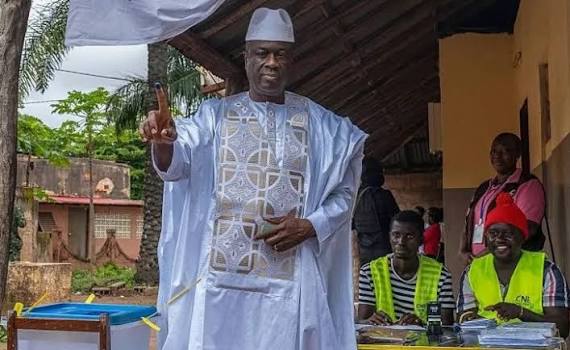
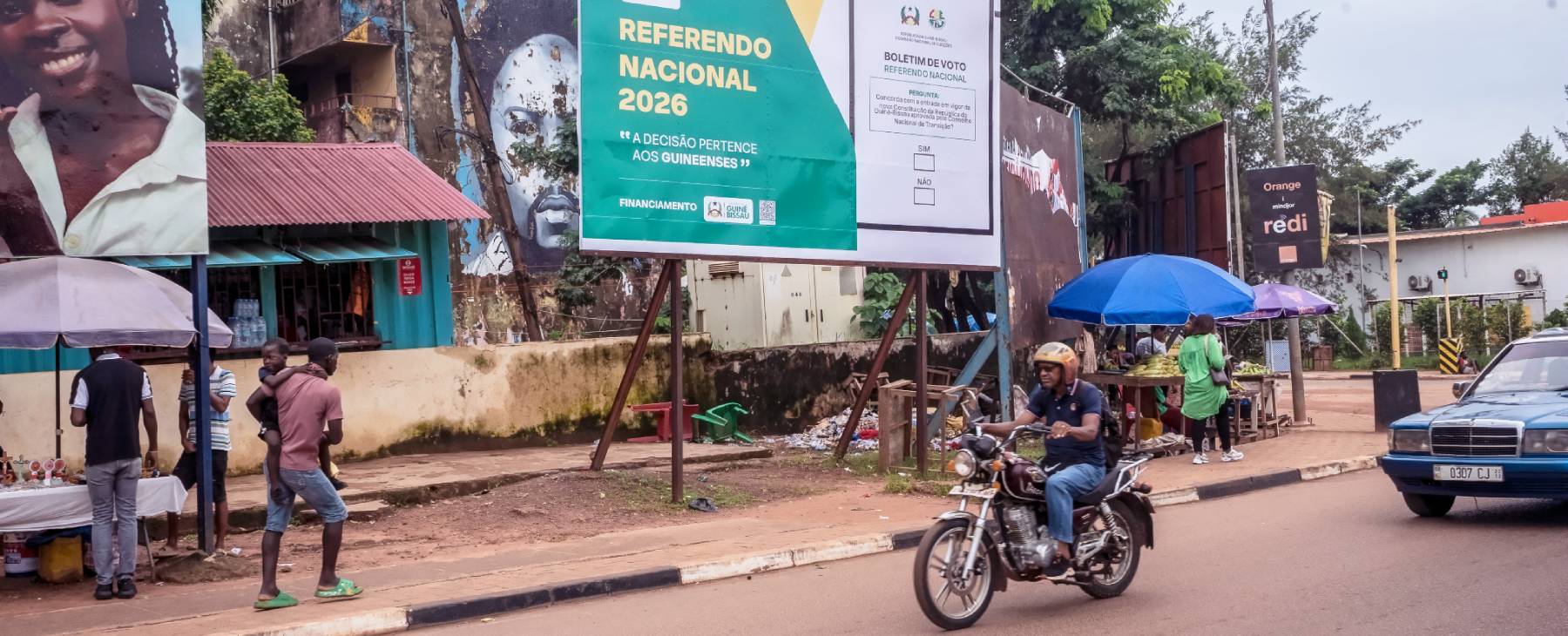
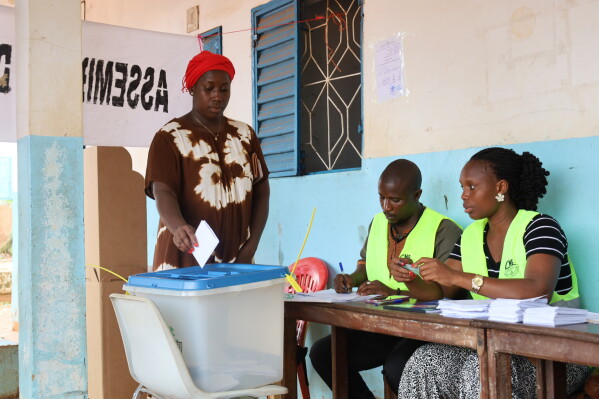
The most consequential move came at the end of August, when Guinea-Bissau's voters went to the polls again — this time in a constitutional referendum rather than a presidential contest. The new charter, approved August 30 and formally announced September 1, converts Guinea-Bissau from its longstanding semi-presidential system, in which power was split uneasily between an elected president and a prime minister answerable to parliament, into a full presidential system. It also shrinks the National People's Assembly from 102 seats to 65, consolidates the country's electoral map from 29 constituencies to 12, and creates a new Constitutional Court, a body Guinea-Bissau has never had and one that, if it functions independently, could give the country a mechanism to referee future electoral and constitutional disputes rather than leaving them to the military to settle by force.
The stakeholders and what they want
For General Horta N'Tam, sworn in for what was billed as a one-year interim term, the December election represents the moment his transitional government either dissolves into an elected successor or entrenches itself further — the pattern seen in Mali and Burkina Faso, where "transitional" military governments have repeatedly pushed back their own promised election dates by years. His government's argument, implicit in the new constitution, is that Guinea-Bissau's chronic instability — the country has seen multiple coups and coup attempts since independence from Portugal in 1974, including as recently as 2022 — stems from structural weaknesses in its old semi-presidential system that pitted presidents against prime ministers and parliaments. Critics counter that a stronger presidency designed and ratified under military rule risks concentrating power in whoever the junta anoints, rather than fixing the instability it claims to address.
For ECOWAS, led on this file by member states wary of yet another coup-installed government operating openly within the bloc — after Mali, Guinea, Burkina Faso and Niger were all seized by juntas between 2020 and 2023 — Guinea-Bissau has become what regional analysts have called the real test of the organization's post-2020 coup doctrine — arguably more consequential than its response to a shorter-lived crisis in Benin, because Bissau's junta has neither been swiftly reversed nor unconditionally accepted. A December 6 election held on schedule, with international observers and genuine opposition participation, would give ECOWAS a rare success story to point to. A slipped deadline or a tightly controlled vote would suggest the bloc's threatened sanctions carry little real deterrent power, further emboldening military governments elsewhere in West Africa.
For Fernando Dias, the opposition figure who appeared to have won the annulled November election, and for Pereira, the detained former prime minister, the calculation is different again: whether to contest an election organized by the same military authorities who ousted the government many of their supporters believe they won power from, or to boycott a process they may see as designed to legitimize the coup after the fact.
What to watch next
Three questions will determine how this story develops between now and December. First, whether the junta publishes an electoral calendar and voter-registration process credible enough to draw genuine participation from Dias, Pereira and other opposition figures, rather than a token field of candidates. Second, whether ECOWAS follows through on its sanctions threat if it judges the process falling short, or whether — as it has with other juntas — it ultimately negotiates a softer accommodation rather than risk pushing Guinea-Bissau toward the kind of exit from the bloc that Mali, Burkina Faso and Niger have already taken. Third, whether the new Constitutional Court and the reduced 65-seat legislature are stood up with enough independence to handle what is likely to be, once again, a close and contested result — the kind that triggered the crisis in the first place.
Guinea-Bissau's history offers little reassurance: the country has endured repeated military interventions in its politics since independence, and transitional governments across the region have shown a strong tendency to extend their own mandates once in power. But the specificity of the December 6 date, the completed constitutional referendum, and the sustained, if unresolved, pressure from ECOWAS and the African Union leave open the possibility — not yet the certainty — that this transition ends differently.
There is also a financial dimension to watch. Guinea-Bissau is among the world's poorest countries and depends heavily on cashew exports and international donor support, both of which are sensitive to prolonged political uncertainty and to any formal sanctions regime ECOWAS might eventually impose. A bloc-wide freeze on financial transactions or travel bans against junta figures — the kind of "targeted sanctions" ECOWAS threatened in December — would compound economic pressure on a government that also has to fund and organize a credible national election within a matter of weeks. That fiscal squeeze could push the junta toward a faster, more genuine handover, or, just as plausibly, give it a fresh grievance to justify delay, framing any external pressure as foreign interference in a sovereign constitutional process. Regional diplomats, who have spent much of the past decade managing an unbroken run of West African coups with steadily diminishing leverage, will be watching Bissau's December vote as closely as anyone in Bissau itself.
Published By | News Editor