Written By | Health News Agencies
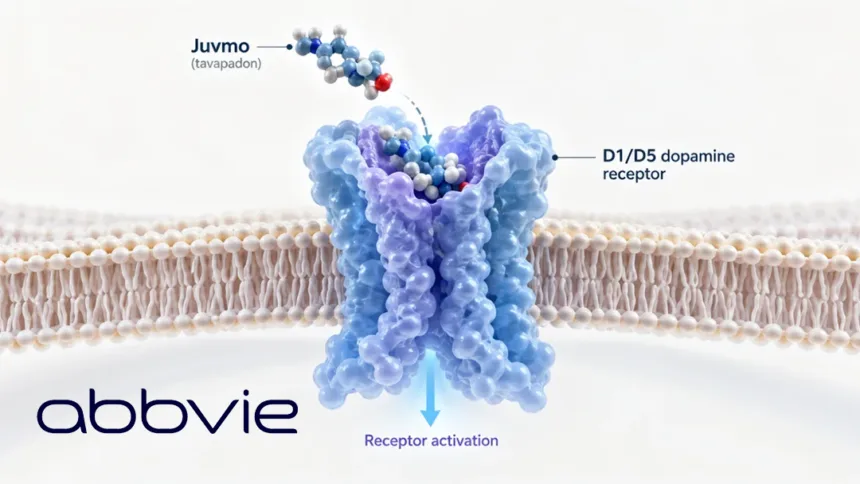
AbbVie's once-a-day Juvmo targets a brain dopamine switch no approved drug has touched before. Patients stayed off extra levodopa for well over a year.
NORTH CHICAGO, Illinois
For the millions of people whose hands shake, whose steps shrink to a shuffle and whose "good hours" slip away a little more every year, Monday brought a headline many had been waiting a lifetime to read: a genuinely new way to treat Parkinson's disease.
The US Food and Drug Administration has approved AbbVie's Juvmo (tavapadon), a once-daily tablet for adults with Parkinson's. It can be taken alone early in the disease, or added on top of levodopa, the decades-old workhorse drug, later on when symptoms start breaking through.
What makes the approval a big deal is not simply that it is another pill. It is how the pill works. Juvmo is the first and only approved drug that selectively switches on a family of dopamine receptors in the brain known as D1 and D5. Every dopamine agonist on the market until now, familiar names like pramipexole and ropinirole, has worked mainly through a different set, the D2 and D3 receptors.
"The approval of JUVMO marks the first dopaminergic breakthrough for Parkinson's disease in decades," said Dr Roopal Thakkar, AbbVie's chief scientific officer. The company says the drug will reach US pharmacies in October.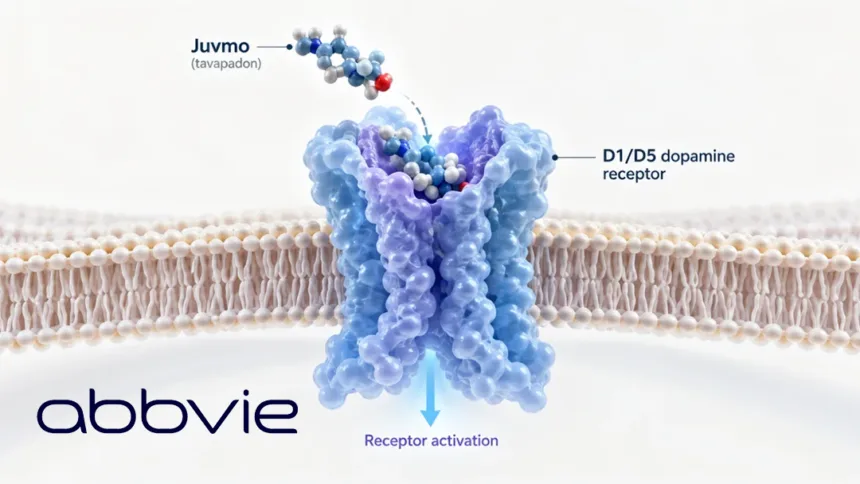
A brain running out of fuel
Parkinson's is, at its heart, a fuel crisis. Deep in the brain, cells that make the chemical messenger dopamine slowly die. According to the US National Institute of Neurological Disorders and Stroke, by the time the classic symptoms of tremor, stiffness and slowness appear, roughly 60 to 80 per cent of those dopamine-producing cells are already gone.
More than 11 million people worldwide now live with the disease, according to figures from the Global Burden of Disease study cited by AbbVie. It is one of the fastest-growing neurological conditions on the planet.
For more than half a century the answer has been levodopa, a drug the brain converts into dopamine. It works, often brilliantly at first. But as the disease advances, patients need bigger and more frequent doses. AbbVie cites its own data showing that about 70 per cent of people have their levodopa dose increased within the first year of treatment.
And more levodopa brings trouble. Many patients start to swing between "on" periods, when the drug is working and they can move, and "off" periods, when the tremor and rigidity crash back. Many also develop dyskinesia: writhing, involuntary movements that can be as disabling as the disease itself.
The older dopamine agonists were meant to ease that burden by mimicking dopamine directly. But they come with their own baggage: sudden sleepiness, swollen ankles, hallucinations and, notoriously, impulse-control problems that have driven some patients into compulsive gambling, shopping and sexual behaviour.
Why D1 matters
Tavapadon was designed to take a different route. It is a "partial agonist" at D1 and D5 receptors, meaning it nudges them on without slamming the accelerator to the floor.
The idea is that the D1 pathway carries much of the motor benefit of dopamine, while many of the unwanted side effects travel down the D2 and D3 routes. "What makes tavapadon unique is its D1 selectivity," Dr Hubert Fernandez, a neurology professor at Cleveland Clinic Lerner College of Medicine and global principal investigator of the trials, told NeurologyLive. "We can stimulate motor pathways effectively, but the hope is to avoid the baggage that comes with D2 stimulation, particularly the nonmotor side effects."
Note that word: hope. As we will see, the trials were not built to prove that part.
The TEMPO trials: what the numbers show
The approval rests on a programme of studies called TEMPO, and the headline results are solid.
TEMPO-1 enrolled 529 adults who had been diagnosed with Parkinson's for less than three years and had barely, if ever, taken dopamine drugs. They were randomly given 5mg of tavapadon, 15mg, or a dummy pill. After 26 weeks, on the standard combined rating scale doctors use to score daily living and motor skills (MDS-UPDRS Parts II and III), patients on tavapadon improved by 9.7 points (5mg) and 10.2 points (15mg). Those on placebo got worse by 1.8 points.
Look just at the everyday-living part of that scale, covering tasks like dressing, eating and washing, and AbbVie says patients on the drug improved by 22 to 23 per cent from where they started, while the placebo group deteriorated by 12 per cent.
TEMPO-2 confirmed it. Among 304 early-stage patients given a flexible dose between 5mg and 15mg, the combined score fell by 10.3 points on tavapadon against 1.2 points on placebo.
TEMPO-3 tested the drug in people further down the road: 507 adults already taking at least 400mg of levodopa a day and suffering motor fluctuations. Adding tavapadon increased their daily "on" time without troublesome dyskinesia by 1.7 hours, compared with 0.6 hours for placebo, a gain of about an extra hour a day. Their "off" time fell by 1.9 hours, against 0.9 hours on placebo.
An extra hour of good time a day may not sound like a miracle. For someone who plans their whole day around when their body will co-operate, it can be the difference between making it to the shops and staying in a chair.
The number AbbVie is shouting about
The company's favourite statistic comes from TEMPO-4, the long-term open-label follow-up. After 85 weeks, AbbVie says, 93 per cent of patients taking tavapadon alongside levodopa (96 of 103) had not needed to increase their levodopa dose. And 94 per cent of early patients on tavapadon alone (257 of 273) had not needed to start levodopa at all.
That is a striking claim, because putting off levodopa and its long-term complications is exactly what many younger patients want.
But there is a catch, and trade publication NeurologyLive spelled it out plainly: these figures come from company "data on file", there was no control group, and they include only the patients who stayed on treatment. People who dropped out because the drug did not suit them are not in that 93 per cent.
The catches you need to know
Here is where excitement needs a dose of realism.
First, side effects. The most common problems on tavapadon alone were nausea, headache, dizziness, fatigue, a changed sense of taste, vomiting, dry mouth and anxiety. When combined with levodopa, patients also reported dyskinesia, hallucinations and dizziness on standing up.
In TEMPO-2, 76 per cent of patients on tavapadon had some kind of side effect, compared with 55 per cent on placebo. More striking still, 24 per cent stopped the drug because of side effects, compared with just 4 per cent on the dummy pill. Most of those exits happened during the early "titration" phase, when the dose is gradually built up, which is why Juvmo comes with a starter pack of tiny 0.25mg and 1mg tablets.
Second, the warnings on the label look familiar. The prescribing information flags low blood pressure on standing, hallucinations, worsening dyskinesia, and, yes, the same "unusual urges" warning attached to older dopamine agonists: gambling, compulsive eating, compulsive shopping and increased sex drive. Whether D1 selectivity really means fewer of these problems in practice is still an open question.
Third, and most important for anyone weighing a switch: none of the TEMPO trials compared tavapadon directly with levodopa or with existing dopamine agonists. Every comparison was against placebo. As NeurologyLive noted, the TEMPO-3 investigators themselves said the programme was not designed to establish whether the drug works better or is better tolerated than current options.
And finally, people over 80, a large slice of the Parkinson's population, were excluded from the pivotal trials. How the drug behaves in the oldest, frailest patients is unknown.
The money behind the molecule
Juvmo is also a very big business story. Tavapadon was invented at Pfizer, spun out into a biotech called Cerevel Therapeutics, and swallowed by AbbVie in an $8.7 billion takeover.
That deal has had a rocky ride. Cerevel's schizophrenia candidate, emraclidine, flopped in a mid-stage trial, triggering a $3.5 billion write-down for AbbVie, according to pharmaphorum. That made tavapadon the jewel AbbVie needed to justify the price tag.
Analysts have suggested Juvmo could earn more than $1 billion a year, pharmaphorum reports, as part of a Parkinson's franchise AbbVie believes could reach $5 billion annually at its peak. AbbVie already sells Vyalev, a 24-hour under-the-skin levodopa infusion for advanced disease. With Juvmo it now has a pill aimed squarely at the huge oral-treatment market, which makes up around 85 per cent of the total.
AbbVie has not yet announced a US price.
What the experts say
Dr Fernandez, who led the global trial programme, framed the approval as giving doctors room to manoeuvre. "Now we have a novel therapy that selectively targets D1/D5 receptors, which addresses a longstanding need for innovation and provides health care providers with greater flexibility to tailor treatment to individual patient needs," he said in AbbVie's announcement.
The Michael J. Fox Foundation, the world's biggest Parkinson's research charity, welcomed the news while keeping its feet on the ground. "For people with Parkinson's and their families, progress means having treatment options that deliver meaningful benefit in everyday life," said Dr Brian Fiske, the foundation's chief scientist. "Each therapy approval is an important milestone in building a diverse treatment pipeline needed to meet the full range of unmet needs across the Parkinson's community."
Neither the drug nor anything else on the market stops Parkinson's from progressing. Juvmo treats symptoms. It does not slow the loss of brain cells.
What this means for you
If you or someone you love has Parkinson's, here is the practical picture.
If you were recently diagnosed and have not started levodopa, Juvmo is a new option to discuss with your neurologist, particularly if you are younger and worried about long-term levodopa complications.
If you are already on levodopa and your good hours are shrinking, it may be worth asking whether an add-on could buy you more "on" time.
If you are currently on pramipexole or ropinirole and struggling with side effects, ask your doctor whether switching makes sense, but know that there is no head-to-head evidence yet.
Expect a slow start. The dose is built up gradually, and nausea, dizziness and headache are common early on. One in four trial patients stopped because of side effects, so tell your doctor promptly if you struggle.
Watch for warning signs. Stand up slowly. Tell your doctor straight away about hallucinations, new or worse involuntary movements, or any urges to gamble, shop, eat or have sex that feel out of character. Family members often spot these changes first.
Never stop or change Parkinson's medicines on your own. Sudden changes can be dangerous.
The bottom line
For the first time in a generation, Parkinson's patients have a dopamine drug that works through a different door in the brain. The trials show clear benefits over placebo, a meaningful extra hour of good time for people on levodopa, and promising signs that it may help some patients hold off stronger treatment.
What they do not yet show is that it beats the drugs people already take, or that its side-effect profile is truly kinder in the real world. Those answers will come from doctors and patients over the months ahead, starting in October, when the first boxes of Juvmo arrive at the pharmacy counter.



