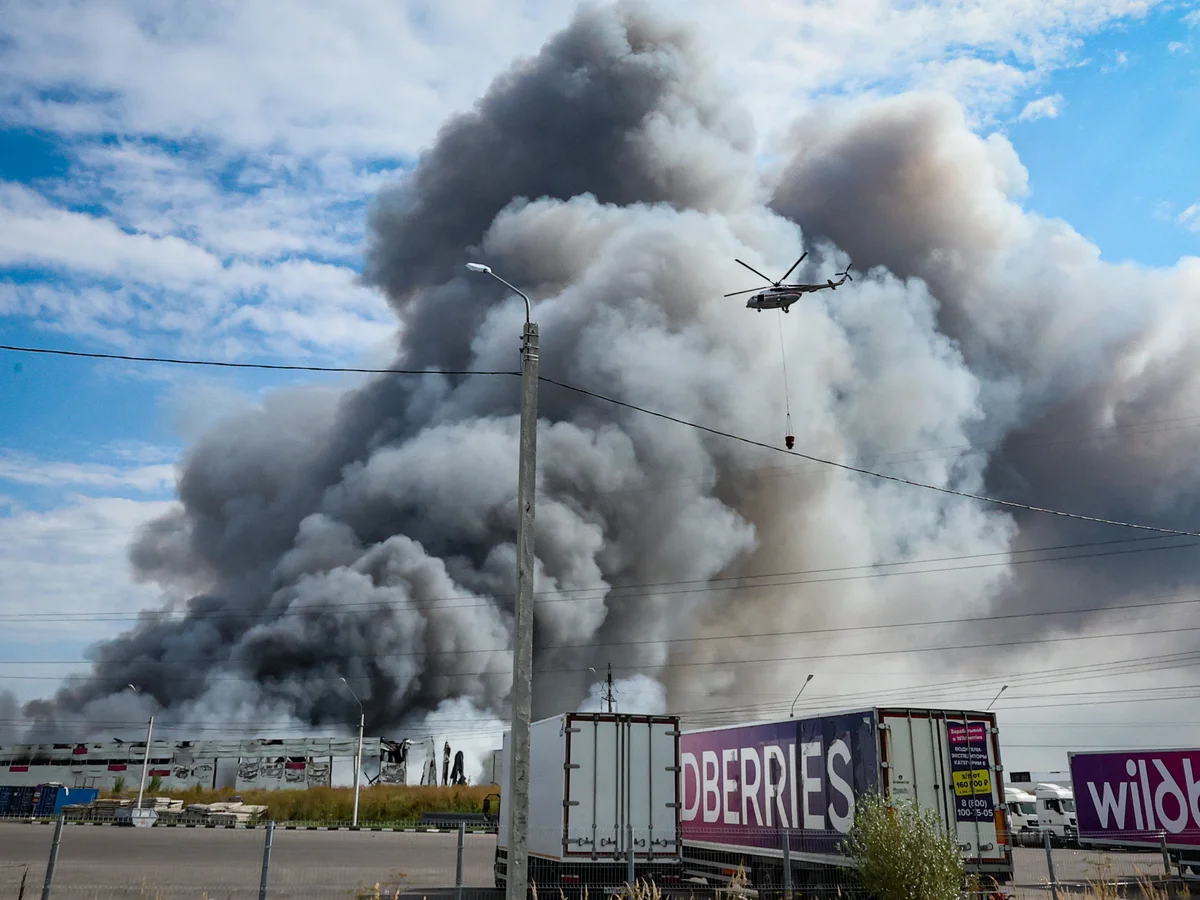
Russia says it faced 613 drones aimed at the Moscow region overnight, while European officials and analysts warn that a Russian campaign of sabotage, airspace probing and assassination plots is escalating on NATO soil.
World Politics
Overview
Two storylines about the war in Ukraine converged on Thursday, October 29, 2026. In the early hours, Moscow Mayor Sergei Sobyanin said that 613 drones had headed toward the Moscow region between 20:30 on Wednesday and 07:00 on Thursday, and that Russian air defenses had destroyed 231 of them as they approached the capital, with the rest neutralized at longer range. Flights were temporarily restricted at three of Moscow's suburban airports. Russian reports cited in the coverage mention no casualties or damage in the city.
On the same day, Al Jazeera published an extensive analysis by John T Psaropoulos arguing that Russia has escalated a shadow war against Europe through 2026, and that European officials fear it will intensify. The catalogue it assembles is long: fighter jets probing Baltic and Polish airspace, drones shot down over several NATO and partner countries, cargo ships sunk near Bulgarian waters, migrant flows manipulated on the Latvian border, an attempt to blow up cargo aircraft in Germany, and plots, according to European intelligence officials, to kill defence executives.
Together, the stories describe a war that is no longer confined to the front lines in Ukraine. Kyiv is striking deep into Russia with drone swarms, and Moscow is accused of retaliating against the European states that supply Ukraine. This article reviews what is known, what is alleged, how the participants are responding, and what the next weeks may bring.
Background: A Stalled Front and a Widening Conflict
According to the Al Jazeera analysis, two Ukrainian counteroffensives have blunted Russia's main push toward Donetsk, leaving Moscow without territorial gains this year. That stalemate on the ground has coincided with a growing reliance by both sides on long-range drones. Since 2023, the analysis notes, Ukraine has developed its own weapons and strategy and has struck Russian oil installations and weapons factories deep inside Russia.
The Moscow barrage fits a pattern. Al Jazeera described the latest attack as one in a series of major drone assaults on the Moscow region, following a record attack in September when Russian air defenses reported shooting down more than 1,600 drones. A photograph accompanying the article showed an apartment building in Kotelniki, in the Moscow region, damaged in a drone attack on September 20, 2026, a reminder that earlier raids did cause harm. Separately, Russia struck Kharkiv, Ukraine's second-largest city, damaging an educational institution, according to Mayor Ihor Terekhov.
The political environment around the war has also shifted. The analysis states that the United States withdrew military and financial support for Ukraine in January 2025 and has recently raised doubts about the reliability of its satellite services, a concern that this month included a reported Starlink slowdown that affected Ukrainian drone operations. In France and Germany, opposition leaders are calling for an end to aid for Ukraine. Ukrainian President Volodymyr Zelenskyy told the European Council that the war will cost 155 billion euros next year, with at least 70 billion euros still needed from Europe.

Key Developments: The Moscow Barrage
The numbers released by Russian officials do not fully reconcile, which is worth stating plainly. Sobyanin's figure of 613 refers to drones headed toward the wider Moscow region over a ten-and-a-half-hour window, while 231 is the number he said were destroyed on the approach to the city itself. Russian media first reported 30 drones shot down, then 10 more, and the state outlet TASS reported that "most of the 613" were downed. Sputnik quoted Sobyanin saying more than 231 drones flew toward the Moscow region. The reporting does not say how many, if any, reached their targets, and Ukraine's government had not commented in the articles reviewed.
The Russian Air Transport Agency said temporary restrictions were imposed overnight at Zhukovsky, Domodedovo and Vnukovo airports. Such closures are now a routine feature of Ukrainian drone raids and are among their most visible effects on Russian civilians and business. Whether a raid of this scale produces strategic effects, such as damage to energy or military facilities, will only become clear if Russian or Ukrainian officials or independent analysts later identify targets that were hit. Until then, the clearest outcome is psychological and logistical: the Russian capital is again forced to absorb hundreds of drones in one night.
Key Developments: Europe's Shadow War
Al Jazeera's account of the alleged Russian campaign in Europe is built from official statements and press reports, and its claims should be read as allegations. It says European officials allege that Russian fighter jets flew into Polish, Lithuanian and Estonian airspace, possibly to test reaction times, and that suspected Russian drones have been shot down over Poland, Finland and the Baltic states. Ukraine accused Russia of using aerial and sea drones to sink four cargo ships just outside Bulgarian territorial waters in two October operations, and the article links to a separate report of Romania blaming Russia after a drone sank a ship. The Black Sea incidents were the subject of a call by NATO's Black Sea members for a response earlier this month.
On land, the article describes accusations that Russia and Belarus are destabilizing Latvia and other Baltic states by manipulating migrant flows. Latvia's ambassador to Greece, Ieva Cesniece, described masked, likely armed people pushing migrants toward the border and threatening soldiers and border guards, along with a sabotage incident that damaged border infrastructure and removed surveillance equipment. In Germany, the analysis cites a failed August operation to blow up cargo planes at Leipzig/Halle Airport that the European Commission later verified as a Russian operation, and a report in the Frankfurter Allgemeine Zeitung that Russia planted incendiary devices at the Munich offices of defence firms Rohde & Schwarz and Helsing.
The most alarming claims concern violence against people. In October, representatives of five EU intelligence agencies told the Financial Times that Russia sought to kill European defence executives and to target their supply chains, and Politico reported that EU security officials believe Moscow plans to move beyond messaging and cause deaths on European soil. Czech spy chief Michal Koudelka warned in September that Russia might attack a NATO member within "months, not years."
Reactions
Moscow has not denied that European defence industries are in its sights. Russian Foreign Ministry spokesperson Maria Zakharova said that European defence companies supplying Ukraine are legitimate targets, a statement the analysis presents as consistent with the pattern of incidents. Russia's response to the drone attacks themselves, as in the Moscow case, has focused on claims of successful interception.
Ukrainian and allied voices argue that Europe is not imposing enough cost. Olena Tregub, who heads Ukraine's Independent Anti-Corruption Commission, argued that deterrence requires making operations costly for Moscow and that Europe has not done enough to trace the financing and command networks behind them. Oleksandr Danylyuk of the Royal United Services Institute recommended more NATO forward troops in the Baltics for "deterrence by denial" and proposed raising aid to Ukraine by 10 to 20 percent for every detected Russian intelligence operation. Minna Alander of the Center for European Policy Analysis listed measures Europe could take immediately: restricting Russian visas, retaliatory cyberattacks, seizing more Russian oil tankers and sanctioning Chinese suppliers of defence goods to Russia. Zelenskyy said on October 16 that Europe would take the threat more seriously once missiles and thousands of drones were involved, and asked how far Putin would go in testing drones against NATO countries.
European governments, by contrast, have so far emphasized defense over retaliation. Officials have focused on protecting data centres, telecommunications and other vulnerable infrastructure but have not announced retaliatory measures, according to the analysis. That caution reflects real constraints: a divided domestic politics over Ukraine aid, uncertainty about American support, and fear that tit-for-tat escalation could draw NATO directly into the war.
Analysis: Why Now?
The timing of both stories reflects a conflict in which neither side can achieve a decisive result on the battlefield. Ukraine's drone swarms are an attempt to impose costs on Russia without relying on scarce ground forces or on American goodwill, and each large raid on Moscow carries a message about the vulnerability of the Russian capital. Russia's alleged sabotage campaign in Europe, on the same logic, seeks to raise the price of supporting Ukraine for European governments and publics, and to test the limits of NATO's response below the threshold of armed attack.
Attribution is a persistent difficulty. Many of the incidents described are attributed by officials or by media reports citing intelligence sources, and Moscow denies or deflects much of it. The Leipzig/Halle case is notable because it was verified by the European Commission, while others rest on anonymous sourcing. Readers should therefore distinguish between incidents that have been officially attributed and those that remain suspected, and should note that the analysis itself is one outlet's synthesis rather than a single official finding.
What Comes Next
In the short term, expect further large drone raids on Moscow and continued Russian strikes on Ukrainian cities such as Kharkiv and Kyiv. Diplomacy may offer limited relief: a localized ceasefire around the Russian-held town of Oleshky runs through November 1, and talks in Abu Dhabi are expected in mid-November, but neither has altered the broader escalation.
The harder question is Europe's response to the shadow war. Proposals now circulating range from visa restrictions and sanctions on third-country suppliers to more forward-deployed NATO forces and aid pegged to Russian intelligence activity. Any of these would require agreement among governments that disagree about how far to go, and each could provoke a Russian reaction. If the alleged plots against defence executives are borne out by an actual attack on European soil, pressure for a firmer response would grow quickly. For now, the picture is of a conflict that is expanding in geography and method even as the front lines in Ukraine hold steady.
Published By | News Editor