Written By | Business Experts
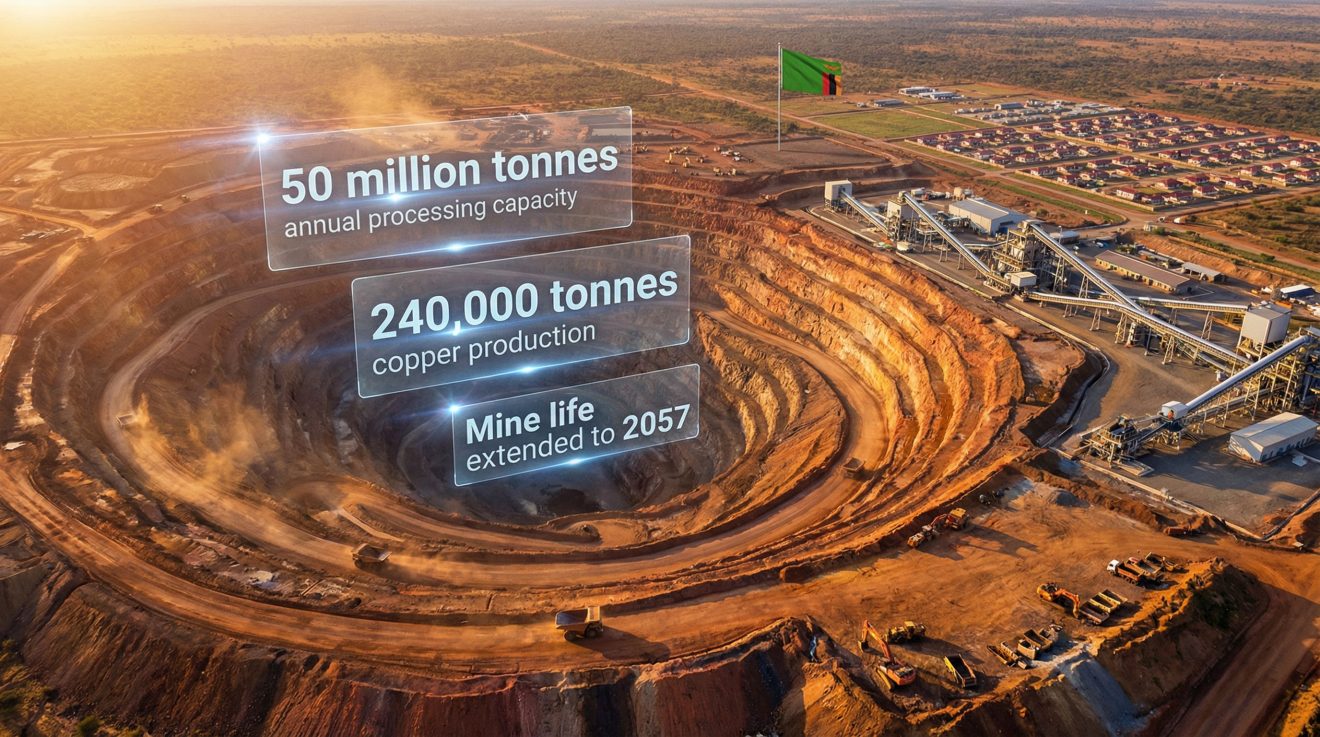
Zambia has spent five years assembling one of the most complete macroeconomic turnaround stories on the African continent.
Economic and Social Transformation
Zambia has spent five years assembling one of the most complete macroeconomic turnaround stories on the African continent. It corrected a default. It restructured the overwhelming majority of its external debt. It brought inflation back inside the central bank's target band. It rebuilt reserves. It ran a primary fiscal surplus. And in January 2026 it closed out an IMF programme that had run its full course rather than collapsing mid-stream — a rarer outcome than the frequency of such programmes might suggest.
What it has not yet done is make the copper arithmetic work. And copper, in Zambia, is not one sector among several. It is the sector that pays for everything else.
A programme that finished
On 27 January 2026, the IMF Executive Board completed the sixth and final review under Zambia's 38-month Extended Credit Facility arrangement, releasing SDR 138.9 million (about US$190 million) and bringing total disbursements under the programme to SDR 1,271.66 million, roughly US$1.7 billion. The completion mattered less for the money than for the signal: Zambia had reached the end of a full reform cycle with the framework intact.
The underlying numbers supported the verdict. By the IMF's May 2026 staff visit, debt restructuring agreements covered approximately 94 per cent of the restructuring perimeter — the near-total resolution of a default that had begun in November 2020, when Zambia became the first African sovereign to fall into arrears during the COVID-19 period. International reserves had been rebuilt to 4.4 months of prospective imports. The primary fiscal balance recorded a surplus of 3.1 per cent of GDP in 2025, achieved through sustained consolidation that the Fund noted had been delivered while protecting social spending. Inflation fell to 6.8 per cent in April 2026, returning to the Bank of Zambia's 6–8 per cent target band, helped by kwacha appreciation and moderating food prices. Other 2026 readings put annual inflation as low as 6.5 per cent, the mildest in eight years.
Voters, for their part, ratified the direction. The Electoral Commission of Zambia declared Hakainde Hichilema president-elect on 18 August 2026 with all 226 constituencies counted, returning him to office with roughly 60 per cent of the vote against approximately 38 per cent for his nearest challenger, Brian Mundubile. It was a decisive mandate for a government whose central economic claim has been that stabilisation would eventually be felt in households.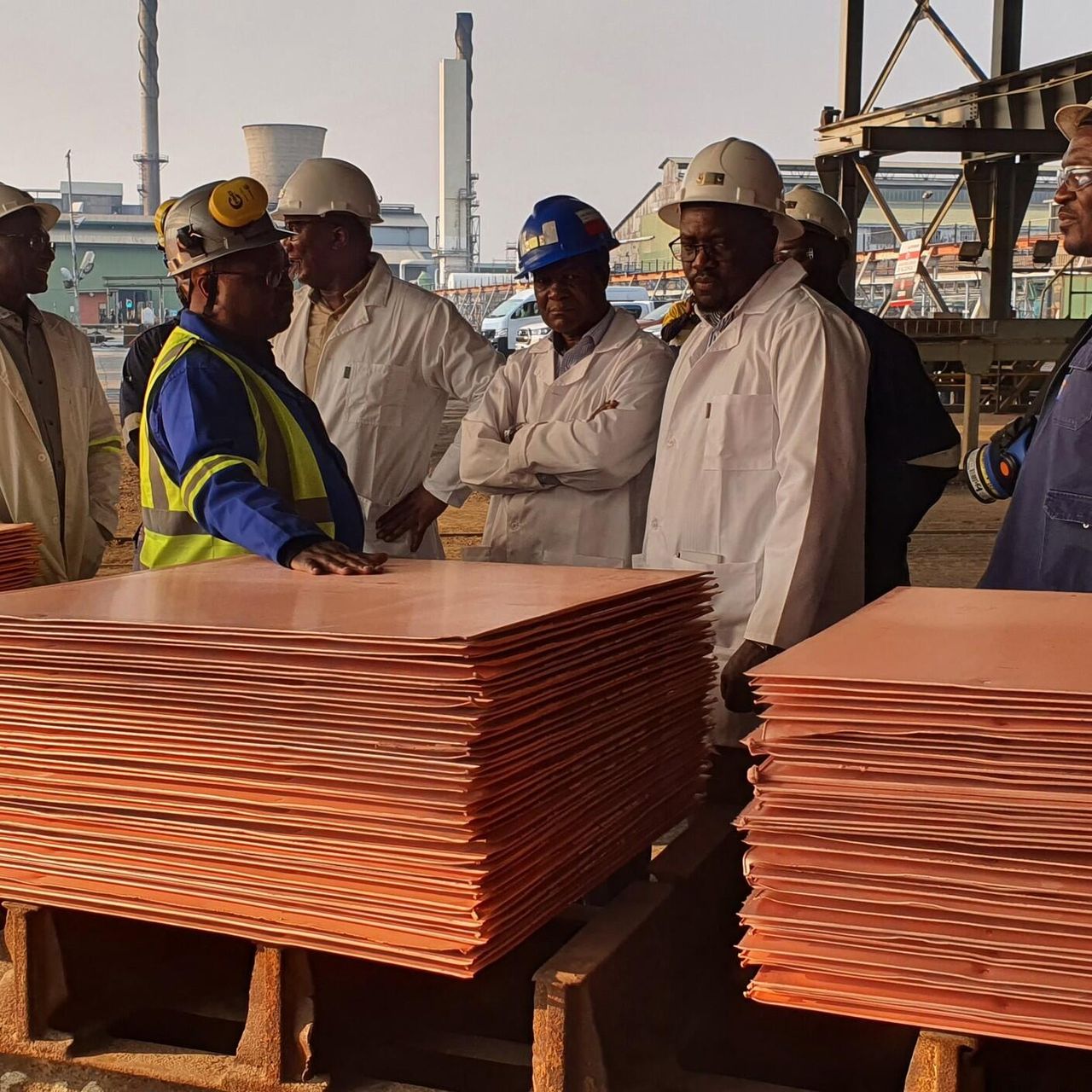
The copper numbers that were supposed to close the loop
Zambia's growth model rests on a single, publicly stated target: three million tonnes of copper a year by 2031. Against 2025 output of 890,346 tonnes — itself an all-time high, up roughly 8 per cent on the prior year — that target requires the country to more than triple production inside six years. Government and industry have repeatedly framed 2026 as the year the trajectory would become visible, with production expected to pass one million tonnes for the first time.
The first half of 2026 did not deliver that inflection. Aggregate output from large-scale and small-scale mines reached 447,181.93 tonnes in the six months to June 2026, against 445,176.59 tonnes in the same period of 2025 — an increase of 0.45 per cent. In practical terms, flat. The first quarter was actually down around 4 per cent year on year before a better second quarter pulled the half-year figure marginally into positive territory.
The flatness is not uniform, and that is the more interesting part. First Quantum Minerals produced 184,929 tonnes in Zambia in the first half, up 5 per cent year on year, with gains at Kansanshi and Sentinel. Barrick's Lumwana, Lubambe and Konkola Copper Mines also posted improvements. The large, well-capitalised assets are growing. The aggregate is not. That gap implies offsetting declines elsewhere in the production base — in older, thinner-margin operations and in the small-scale segment — which means the headline national figure is now being held down by the parts of the industry least able to attract the capital that would fix them.
Reaching one million tonnes in 2026 would require the second half to deliver roughly 550,000 tonnes, about 23 per cent more than the first. Reaching three million by 2031 requires sustained compound growth of a kind that no African copper producer has demonstrated over a comparable period.
The constraint is measured in megawatts
Behind the production arithmetic sits an electricity problem that has become the binding constraint on the entire growth plan. ZESCO, the state utility, has reported a power deficit of around 1,300 MW against installed capacity of roughly 3,356 MW. By November 2025, actual generation had fallen to approximately 1,469 MW against national demand of roughly 2,600 MW, with load shedding reaching twelve hours a day in the worst periods.
The cause is structural rather than cyclical. Hydropower accounts for more than 80 per cent of Zambia's installed capacity, with coal thermal at around 8 per cent and solar at about 5.5 per cent. That concentration was an asset when rainfall was reliable. After the droughts of 2017/18 and, far more severely, 2023/24, Lake Kariba's inflows fell to among the lowest levels on record, and a generation system built on water became a generation system built on weather.
The response has been to diversify away from hydro. Maamba Energy's expansion is expected to add 300 MW, with a further 150 MW from Goli, giving roughly 450 MW of new thermal capacity; combined with solar additions, officials have suggested Zambia could add more than 1,000 MW by mid-2026 — in principle enough to end domestic load shedding and restore export capability. Whether those additions arrive on schedule is the single most consequential operational question in the Zambian economy, because copper concentration and smelting are electricity-intensive processes that cannot be scaled without firm, uninterrupted power.
Capital is arriving; the route out is still being built
Investor appetite for Zambian copper has not been the problem. Abu Dhabi's International Resources Holding acquired a 51 per cent stake in Mopani Copper Mines in a transaction valued at around US$1.1 billion in March 2024, and has remained the leading candidate in negotiations over a stake in Konkola Copper Mines, where Vedanta has been in talks to sell more than 30 per cent directly to strategic investors, targeting roughly US$1.2 billion in proceeds. Vedanta has separately signalled intent to invest US$1.3–1.5 billion to lift KCM output from roughly 140,000 tonnes in 2026 toward 270,000 tonnes on completion of Konkola Deep, with a longer-term ambition of 300,000 tonnes annually by 2031.
The logistics side is moving more slowly than the equity side. The Lobito Corridor — the rail route running west through Angola to the Atlantic — is projected to cut mineral transport costs by up to 30 per cent and compress transit times from around 16 days to seven compared with existing routings. Zambia aims to begin construction of its section by the third quarter of 2026, with financial close targeted for early 2027 and first operations between 2027 and 2028. The transformative element is Phase 2: roughly 800 km of greenfield rail from Luacano in Angola to Chingola in Zambia, with initial sections targeted for operation between 2028 and 2029. On that timetable, the corridor arrives after the period in which Zambia intends to add its first million tonnes, not before it.
What the household ledger says
The gap between the macroeconomic record and the social record remains the central fact about Zambia, and it has not narrowed as quickly as the stabilisation narrative implies. Roughly 60 per cent of the population lives below the World Bank's US$3-a-day poverty line, and 63.1 per cent fall below the US$2.15 line. Extreme poverty stood at around 48 per cent in 2025, down marginally from 49 per cent in 2024. Projections put the rate of decline at roughly one percentage point a year through 2027 — meaning that on current trajectories, a country that has just completed a textbook stabilisation would still have close to half its population in extreme poverty at the end of the decade.
The 2024 drought compounded this directly: around 30 per cent of the population was declared food insecure. And the growth figures themselves have been revised in an uncomfortable direction. Real GDP growth for 2025 was initially estimated at 5.2 per cent, up from 3.8 per cent in 2024; in March 2026, the authorities revised the 2025 estimate down to 3.8 per cent — identical to 2024 — citing underperformance in information and communications technology, wholesale and retail trade, and finance and insurance. The IMF's projection of 5.8 per cent for 2026 therefore rests on an acceleration from a base that turned out to be lower than first reported.
The fiscal position is already loosening
The most immediate risk is that the fiscal discipline which underwrote the stabilisation is eroding faster than the growth arriving to replace it. The IMF noted in May 2026 that fiscal pressures had intensified, reflecting the impact of conflict in the Middle East, pre-election spending, and expenditure overruns at the Food Reserve Agency. Absent corrective measures, the primary surplus is projected to fall from 3.1 per cent of GDP to 1.1 per cent — a swing of two percentage points in a single year. The drivers named were weaker tax collection, including from the suspension of fuel VAT and excise duties; spending in the run-up to the elections; a civil service wage adjustment; and agricultural subsidy overruns of about 1.3 per cent of GDP.
Those are, with the exception of the external shock, domestic choices. They are also the classic post-programme pattern: consolidation holds while the Fund is in the room and relaxes once it leaves. Zambia's election is now behind it, which removes the political rationale for the loosening but not the spending commitments it generated.
What to watch
Three indicators will determine whether the next two years look like continuation or reversal. The first is second-half 2026 copper output: anything materially short of 550,000 tonnes tells the market that the one-million-tonne milestone has slipped and, by extension, that the 2031 target needs restating. The second is installed generation capacity actually commissioned by year-end, since electricity is the physical ceiling on copper. The third is the 2027 budget's primary balance, which will reveal whether the 1.1 per cent projection was a trough or a new baseline.
Zambia has done the difficult, unglamorous work of restoring a broken macroeconomic framework, and it deserves credit for finishing a programme rather than abandoning one. The harder task is the one it now faces: converting a stabilised balance sheet into tonnes in the ground, megawatts on the grid, and income in households where nearly half the population still lives in extreme poverty. Stabilisation was the precondition. It was never the achievement.



