Written By | Fashion and Design Desk
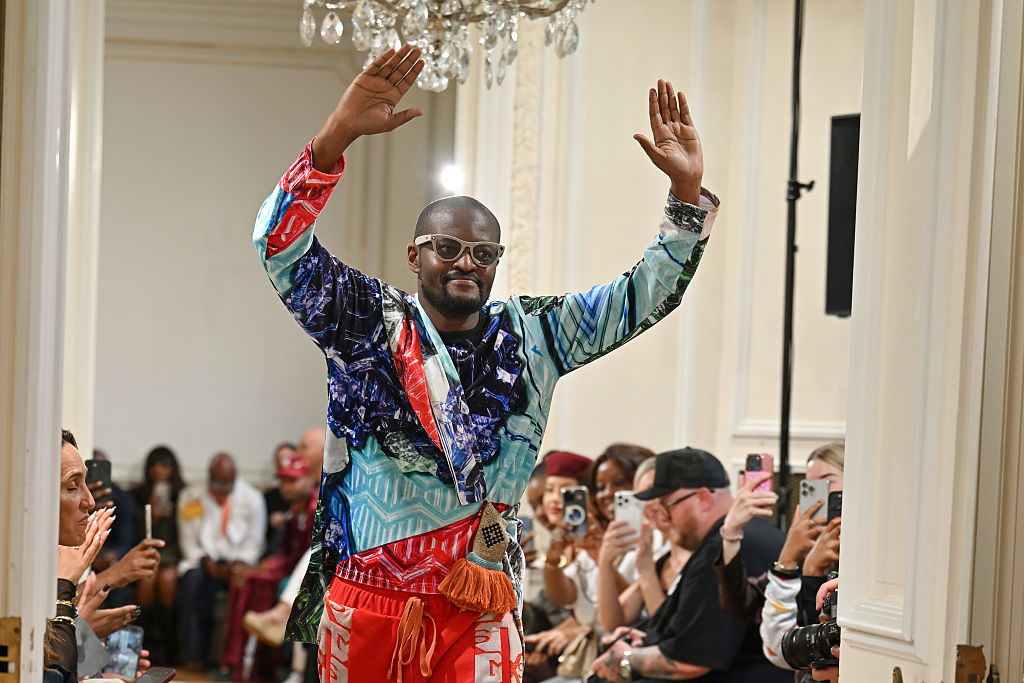
At Paris Fashion Week, the South African designer's debut turned the house's Space Age codes into a playful, optimistic wardrobe.
PARIS
On a Wednesday evening in the Palais de Tokyo's glass-roofed Grande Verrière, 450 mismatched chairs from different eras sat arranged beneath a wall of orange Plexiglas. It was not the usual front-row set-up, and that was the point. Drew Henry, the new artistic director of Courrèges, was making his debut, and he wanted the room to say something about freedom.
A Debut With Everything to Prove
Courrèges was founded by André Courrèges in the 1960s and became shorthand for the Space Age: white minidresses, geometric lines, go-go boots. Henry, a South African designer aged 39 who has worked at Celine, JW Anderson and Burberry, took over the house in May 2026, succeeding Nicolas Di Felice, who spent several years modernizing the brand. The announcement had been met with cautious optimism; the question was whether he could honor the legacy while making it feel alive.
His September 30 show suggests he has a plan. The collection played with the house's signature futurism but pushed it toward the wearable and the cheerful.
The Collection
Henry's palette opened with white, black and navy, then burst into pop color. Silhouettes were voluminous, a gentle rebuke to the sleek minimalism that has dominated recent seasons. Fifty models, men and women, walked through the room.
The accessories stole headlines. Flat-heeled boots reimagined from Courrèges archives arrived in apple green, bright orange and vermilion. Mary Jane shoes appeared alongside handbags featuring the house's snap fastenings, a nod to André Courrèges's love of clean, functional hardware. Henry has described his vision as celebrating "the freedom to wear whatever you want without ever taking yourself too seriously," a refreshingly light brief in a season that has often felt heavy.
The Set as Statement
The runway design by Arnaud Selve deserves its own mention. Those 450 chairs, each a different style and period, stood in for a crowd of individual tastes. Rather than imposing a single look, the space suggested that a Courrèges wardrobe could be assembled piece by piece, mixed with whatever else you own. It is an idea that sits well with how people actually dress today.
The Wider Paris Picture
Henry's debut is one of several this season. The Paris women's calendar runs September 28 through October 6 with 68 shows and roughly 33 to 34 presentations. Kai Nesselrath, formerly head of women's wear at Saint Laurent, made his Carven debut on October 1. Valentino returns to Paris on October 4 after showing in Rome, Sacai rejoins the calendar on October 5, and Louis Vuitton, under Nicolas Ghesquière, closes the month on October 6. Alaïa is presenting without a named creative director after Pieter Mulier's departure, and Rabanne is skipping the season while it awaits Olivier Rousteing's debut.
Elsewhere, Matthieu Blazy delivers his second Chanel ready-to-wear collection, Duran Lantink presents his second Jean Paul Gaultier ready-to-wear show, and Haider Ackermann continues at Tom Ford. Maxhosa Africa, the South African label that has dressed Beyoncé and Michelle Obama, made its first appearance on the official Paris calendar on September 28.
Why Joy Is a Strategy
Fashion is cyclical, and after seasons of quiet luxury and austere tailoring, designers are reaching for color, humor and personality. Henry's Courrèges fits that shift. Pop colors and playful accessories are also commercially smart: a vermilion boot is easier to sell, and to be photographed in, than another beige coat.
It also reflects a broader desire among shoppers for clothes that feel individual rather than uniform. The chairs on the runway said it plainly: many tastes, one house.
Henry's Pedigree
Henry comes to Courrèges with a résumé that includes some of the most closely watched design rooms of the past decade, and observers have described his early direction as wearable design without losing the brand's distinctive edge. That balance is the central challenge for any new creative director: the house needs to feel like itself and yet speak to how people dress now.
Past directors have tended to take one of two routes, pure homage or radical reinvention. Henry's debut sits in between, using archive details such as snap fastenings and flat-heeled boots as raw material for a fresh, colorful wardrobe.
Paris as a Barometer
A season with this many debuts and returns is also a snapshot of the industry's mood. Houses are betting on new voices, and customers are being asked to take fresh looks seriously. Courrèges, a mid-sized house with a distinctive identity, is a useful test case for whether a considered, cheerful approach can cut through a crowded calendar.
The coming weeks of editor reactions, retailer orders and street style will show how much of Henry's optimism translates into appetite.
What This Means for You
You do not need a Courrèges budget to borrow the ideas. Expect to see bold flat boots, rounded Mary Janes and bright accessories trickle into high-street stores over the next year. The easiest way in is to start small: one saturated shoe or bag against a mostly neutral outfit, which is exactly how Henry's palette works.
Voluminous shapes are also back in focus, so look for relaxed, roomy cuts in everyday pieces. Mixing eras and styles, the show's central metaphor, is a free styling tip: pair something vintage with something new.
The Bottom Line
Consider the context, too. Courrèges sits in a competitive middle ground of Paris houses, large enough to matter and small enough to feel personal. A confident first collection gives the brand room to build a signature over several seasons, and the playful tone gives retailers and editors a clear story to tell. Whether that story lasts will depend on follow-up collections, but first impressions in fashion carry real weight, and this one was warm, bright and memorable.
Debuts are difficult, and one show does not make a tenure. But Henry's first outing has given Courrèges a clear voice: optimistic, colorful and unafraid of fun. In a week dense with change across Paris, that may be the most welcome message on the runway.
"The freedom to wear whatever you want without ever taking yourself too seriously." — Drew Henry, on his Courrèges vision



