Written By | Health News Agencies
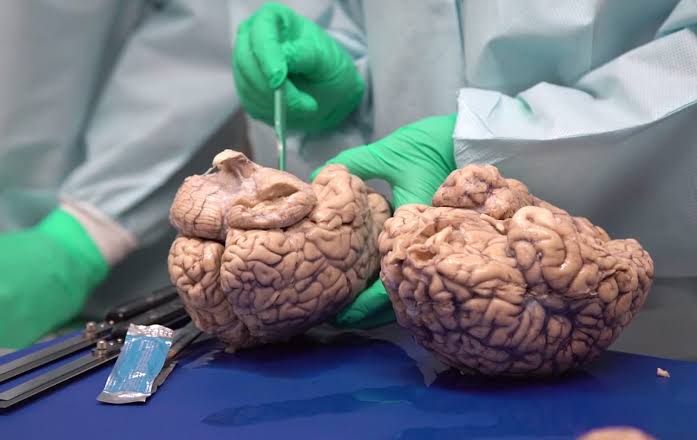
A landmark Mass General Brigham study of 878 former NFL players who died between 2016 and 2021 finds at least a quarter had CTE — and the real number could be nearly four times higher
BOSTON, Mass.
They ran routes, they took hits, they retired, and then — one by one — hundreds of them started to disappear into confusion, rage, and forgetting. Now, for the first time, scientists have put a hard number on just how many former NFL players were quietly carrying a ticking time bomb in their skulls when they died.
At least one in four. Possibly closer to one in every fourteen who escaped it.
A sweeping new study published Tuesday, August 25, in The BMJ — led by Dr. Daniel Daneshvar, chair of Physical Medicine and Rehabilitation at Mass General Brigham and a researcher at Harvard Medical School — has delivered the most statistically rigorous estimate yet of how many former NFL players were living, and dying, with chronic traumatic encephalopathy, the degenerative brain disease linked to repeated head trauma. The findings, researchers say, amount to nothing less than a "wake-up call" for the league, for players, and for the millions of parents still deciding whether to let their kids strap on a helmet.
The Study That Finally Did the Math
For years, the conversation about CTE in football has been haunted by a single, damning statistic: a 2017 Boston University study found the disease in 99% of NFL brains examined. It was a bombshell number — but critics, including the NFL itself, pointed out the obvious flaw. Families don't usually donate a loved one's brain to science unless they already suspect something was wrong. The sample was self-selected, stacked with players whose families had noticed the slurred speech, the explosive anger, the vanishing memories. It could never tell us what fraction of *all* NFL players were affected — only what fraction of the ones already flagged as suspicious turned out to have the disease.
Daneshvar's team set out to fix that. Instead of starting with donated brains, they started with a defined population: all National Football League players who died of any cause between 2016 and 2021 — 878 men in total, drawn from Pro Football Reference records and Social Security Death Index data. That is the entire universe of former players who died in that five-year window, not just the ones whose families suspected brain disease.
Of those 878, only 235 families ultimately donated brain tissue for examination — most of it processed at the UNITE Brain Bank at Boston University, the world's largest repository of football players' brains, with a handful of additional cases from Mount Sinai and the UCSF Alzheimer's Disease Research Center. Of those 235 donated brains, a staggering 215 — 91.4% — were found to have CTE upon pathological examination.
That's where the study gets clever, and where it gets scary. Rather than simply reporting that 91.4% figure (which suffers from the same donation bias as the 2017 study), Daneshvar's team used statistical modeling to estimate CTE prevalence across the *entire* population of 878 deceased players — including the 643 whose brains were never examined. To do that, they built out a plausible range of scenarios: what if none of the undonated brains had CTE? What if all of them did? What's the most defensible estimate in between, based on known referral patterns and donation behavior?
The conservative floor: at least 24.5% of all 878 players — roughly one in four — had CTE. The upper boundary, assuming a much higher hidden prevalence among families who never donated: 97.7%. Researchers stress that neither extreme is likely to be the true number, but that the reality almost certainly sits well above the 24.5% floor, since families of clearly healthy, symptom-free players are far less likely to have donated in the first place.
"Somewhere between 24.5% and 97.7% of NFL players from that era had this progressive brain disease," Daneshvar said. "That range itself is a wake-up call for the NFL and for the scientific community."
The Dementia Connection Nobody Can Ignore
Buried inside the study is a finding that may be even more alarming than the topline CTE number: the tight, brutal link between CTE and dementia in these men.
Among the former players diagnosed with CTE, 61.3% met clinical criteria for dementia before they died — a rate wildly out of step with the general population, where dementia in men of comparable age is far rarer. Flip the analysis around and it gets starker still: of the players who *did* develop dementia, 95.5% turned out to have CTE as the underlying pathology.
A companion analysis from the Boston University CTE Center, released alongside the BMJ paper, drove the point home with blunt force: former NFL players were found to be four times more likely to die of diseases like ALS, dementia, and Parkinson's disease than men in the general population who never played.
"A fourfold increase in dementia rates from a presumed environmental cause is immense," said Dr. Jesse Mez, senior co-author of the study and co-director of clinical research at the BU CTE Center. "Brain bank studies indicate that CTE is the primary explanation."
To put that in perspective: outside of football, community brain bank studies suggest CTE affects less than 1% of the general population. Even at the study's most conservative estimate, former NFL players are being diagnosed with the disease at more than twenty times that background rate.
What CTE Actually Does to a Brain
CTE isn't diagnosable in a living patient — not yet, anyway. It can currently only be confirmed after death, by slicing brain tissue and searching for clumps of an abnormal protein called tau that build up around blood vessels, in patterns distinct from Alzheimer's disease. Those tau deposits accumulate slowly, often over decades, seeded by repetitive subconcussive hits — not just the highlight-reel concussions that knock a player out, but the thousands of smaller, sub-threshold jolts absorbed on nearly every play of every practice and game across a career.
Symptomatically, CTE has been associated with memory loss, impulsivity, depression, explosive aggression, and, in advanced stages, full-blown dementia. It's the disease that was found in the brains of former players including Junior Seau, who died by suicide in 2012, and it has become the grim connective tissue linking a string of former players' post-career struggles with substance abuse, domestic violence, and self-harm to a physical, verifiable disease process rather than simple personal failing.
The 2017 BU study that first shocked the public — CTE in 110 of 111 examined NFL brains, or 99% — was never meant to represent the whole league, and its authors said as much at the time. But the number stuck in the public imagination anyway, becoming shorthand for "football causes brain damage" long before anyone had the population-level data to say precisely how common the disease really was. Tuesday's BMJ study is the first serious attempt to supply that missing denominator.
The NFL Responds — Carefully
The league's public statement on the new findings was notably measured, neither disputing the science nor fully reckoning with its implications.
"The NFL continuously strives to make the game of football safer, including by implementing strategies to reduce concussions and head impacts," an NFL spokesperson said in response to the study. "The NFL remains committed to ensuring that the NFL community has access to a robust — and expanding — set of resources to enhance their physical and mental well-being. We encourage former players to utilize these resources to identify and seek treatment when they are concerned about their health."
The league has, in fairness, made real changes over the past decade: kickoff rule reforms designed to reduce high-speed collisions, stricter concussion protocols, independent neurological spotters at every game, and a 2013 concussion settlement that has paid out more than $1 billion to retired players diagnosed with CTE-linked conditions. Critics argue those measures have chipped away at the margins of a fundamentally violent, high-impact sport rather than addressing its core risk.
Expert Perspective
Researchers involved in the study were careful to note its limitations even as they emphasized its significance. The true prevalence figure remains genuinely uncertain — the gap between 24.5% and 97.7% is enormous, and Daneshvar's team was explicit that both extremes are implausible. What the study does establish with much greater confidence is the *direction* of the bias in earlier research: because brain donation is driven by families who already suspect something is wrong, every prior estimate of CTE prevalence in NFL players was almost certainly an overcount of the disease's severity in donated brains, but very likely an undercount of how many total players are quietly affected without anyone yet noticing.
"This range itself is the headline," Daneshvar told reporters, according to coverage of the study's release. "We now have a defensible floor. The true number is very likely well above it."
Outside researchers not involved in the study noted that its rigor — starting from a fixed, complete population of deceased players rather than a self-selected donor pool — represents a meaningful methodological leap forward for a field that has struggled for over a decade to move past headline-grabbing but statistically fragile percentages.
What This Means for You
If you're a parent of a young football player, a fan who grew up idolizing these men, or a former player yourself, the honest answer is that there is still no way to diagnose CTE while someone is alive, and no cure once it's confirmed after death. That reality hasn't changed.
What has changed is the confidence with which scientists can now say: this is not a rare fluke affecting only the unluckiest, most visibly troubled ex-players. It is common — conservatively affecting at least one in four men who played in the league during this window, and very likely dramatically more. If you have a former player in your life who has been showing signs of memory loss, mood changes, or uncharacteristic aggression, researchers stress those symptoms deserve medical attention and shouldn't be written off as normal aging or unrelated mental health struggles. The Concussion Legacy Foundation and the BU CTE Center both operate helplines and support resources specifically for families navigating suspected CTE in a living loved one, even though a definitive diagnosis can't be made until after death.
For youth and amateur football, the implications are murkier but no less urgent: if a quarter to nearly all professional players who logged a full NFL career show signs of this disease, the question of how much exposure — at what age, over how many years — is "safe" remains wide open, and this study doesn't resolve it. What it does is remove any remaining excuse for pretending the question isn't real.
The Bottom Line
For nearly two decades, the NFL's brain injury crisis has been fought in the court of public opinion using numbers that both sides could poke holes in — either too small a sample, or too skewed a sample, to say anything definitive about the league as a whole. That era just ended. Tuesday's BMJ study gives America its first statistically defensible floor for how many former NFL players were carrying CTE when they died: at least one in four. Everyone from Roger Goodell's office to a father lacing up his eight-year-old's first pair of cleats now has to reckon with a number that isn't going away — and that, according to the researchers who spent years building it, is exactly the point.



