Written By |
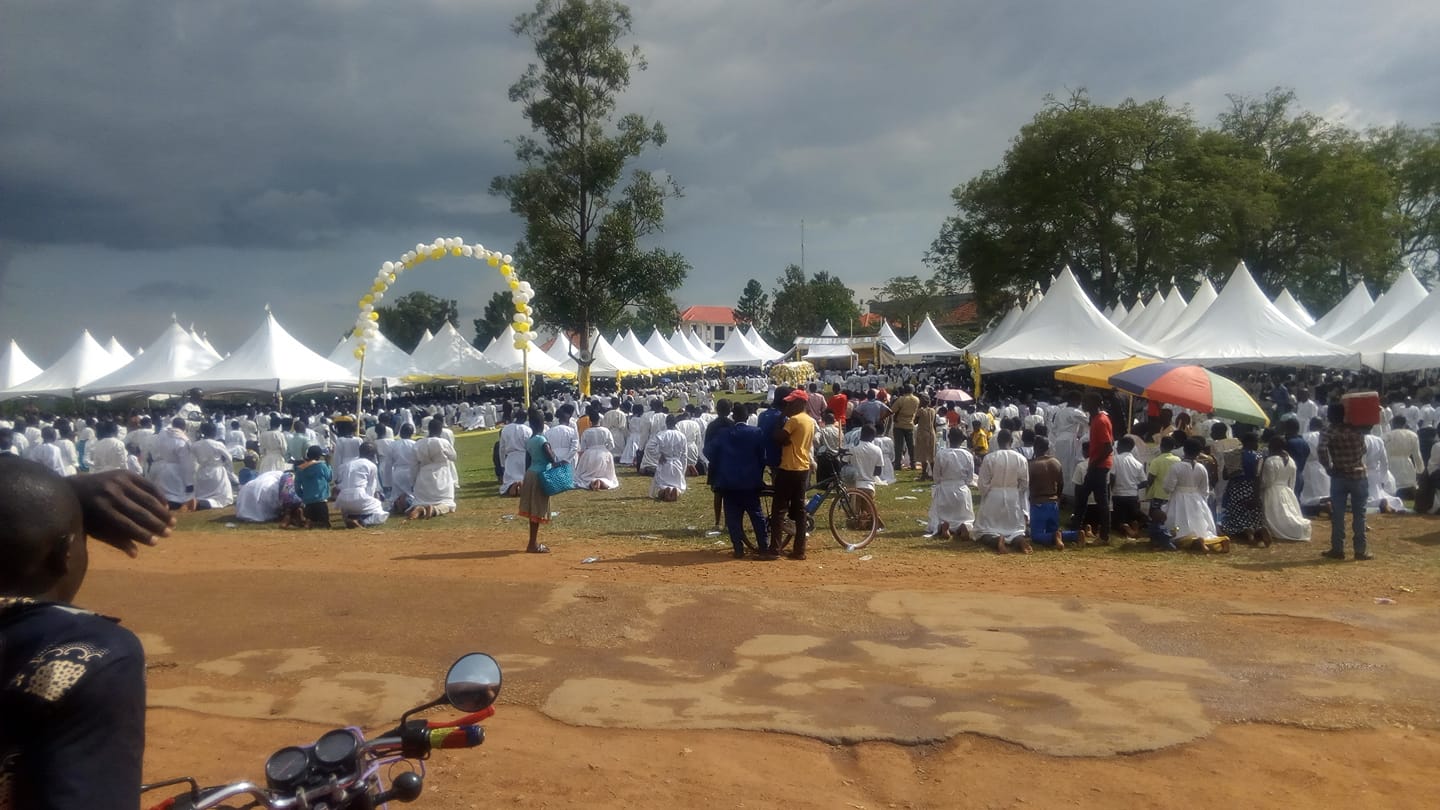
Followers of Desteo Bisaka in Mbarara: Desteo Bisaka who referred to himself as God dies in 2021(Photo by Dickens Tiharihondijo)
By Bosco Bakwatanisa Muto
Religion has been a cornerstone of human civilization since time immemorial, shaping societies, cultures, and worldviews across the globe. Its earliest forms, rooted in ancient rituals and spiritual practices, served to explain the mysteries of life and the cosmos. However, as societies grew and evolved, so too did religion, becoming a tool not only for community building but also for conquest and control. When European colonial powers arrived on African shores in the 15th century, they brought with them not only the Bible and the Quran but also a new social order that would fundamentally alter the continent's trajectory. With the onset of slavery and colonialism, religion became intricately intertwined with Africa's political and economic underdevelopment. Christian missionaries followed the slave ships and colonial armies, establishing churches, schools, and hospitals. Yet, alongside these institutions came doctrines that preached submission and reinforced colonial power structures. Religion, once a spiritual refuge, became a tool of subjugation, shaping the destiny of African nations in ways that would echo for centuries.
In this article, I explore the role religion has played in the underdevelopment of Africa, examining how colonial powers weaponized religious teachings to maintain control and perpetuate dependency. Drawing on the works of key scholars such as Walter Rodney and Ali Mazrui, I investigate how Africans can overcome the harmful legacy of religion and harness its potential for positive societal change. I will also explore how the separation of religion from politics, reforming educational systems, and redefining religious teachings for development can help to reverse the negative impact of religious colonialism.
Religion has played a complex role in shaping Africa’s historical, cultural, and economic landscapes. While it has provided a sense of identity, community, and moral framework, certain scholars argue that religion has also contributed to the continent’s underdevelopment by perpetuating colonial legacies, hindering critical thinking, and promoting dependency. The downside of religion's influence, according to some experts, stems from its instrumentalization by colonial powers and local elites to maintain control, suppress progressive movements, and perpetuate systems of inequality.
Colonialism and religion's role in underdevelopment
Renowned scholars like Walter Rodney, in his seminal work How Europe Underdeveloped Africa, argue that colonial powers used religion to legitimize their domination and exploitation of African resources. Christianity, in particular, was employed as a tool to pacify the African population, encouraging obedience to colonial authorities by promoting virtues like humility, patience, and acceptance of suffering. This undermined resistance movements and diverted focus from structural inequalities that were crucial to African development.
Ali Mazrui, in his work The Africans: A Tripple Heritage illustrated the role that religion played in African underdevelopment, noting how religion, in its colonial form, imposed European cultural hegemony on African societies. This weakened indigenous systems of governance and knowledge, replacing them with foreign ideologies that often failed to address local realities. He argued that colonial-era missionaries, while offering education and healthcare, inadvertently promoted a mentality of dependency, where the African was viewed as subordinate and inferior.
Islam also played a role in shaping power dynamics across regions in Africa. Some scholars, such as Lamin Sanneh a renowned scholar of Islam and Christianity, highlighted that while Islam facilitated trade and learning in parts of Africa, its interaction with politics sometimes reinforced patriarchal systems and feudal power structures that stifled progress and development. Islamic leaders in certain areas used religion to consolidate power and preserve traditional hierarchies, which, in some cases, contributed to social stagnation.
Hindrance to critical thinking and progress
Another area of critique is the impact of religious teachings on critical thinking and intellectual progress. Scholars like Chinua Achebe and Ngugi wa Thiong'o argued that the dominance of religion in African societies, particularly in its dogmatic forms, discouraged critical engagement with societal issues and fostered a mindset that prioritized spiritual salvation over material development. Education systems heavily influenced by religious doctrine often prioritized theological and moral instruction over scientific and technological advancement, slowing down Africa's potential for innovation and growth.
Theologians and religious leaders in some African contexts have also been accused of exploiting their influence to maintain the status quo, reinforcing fatalistic beliefs and discouraging social change. The idea of “divine destiny,” as preached in some religious institutions, leads individuals to believe that their circumstances are predetermined and unchangeable, thereby discouraging personal or collective action to improve living standards.
Overcoming the downside of religion in Africa's development
Religion, deeply rooted in African societies, has historically shaped moral, cultural, and social frameworks. However, colonial and missionary influences have, at times, weaponized religion to maintain control, limit critical thought, and undermine local governance. Overcoming the adverse role religion has played in Africa’s underdevelopment requires multifaceted approaches, grounded in cultural sensitivity, modernization, and empowerment. Here, I outline some strategies that may be resourceful to counteract the downside of religion towards Africa emancipation and development.
Religion, while offering spiritual and moral guidance, has in many cases been a double-edged sword in Africa's developmental trajectory. By perpetuating colonial legacies, discouraging critical thinking, and reinforcing hierarchical structures, religion has played a role in Africa's underdevelopment. However, with reforms in education, politics, and religious institutions, Africans can harness the positive aspects of religion to fuel social and economic development. Emphasizing critical thinking, religious pluralism, and a separation of religion from governance can help create a more progressive and self-reliant Africa.
The writer is a Doctoral student scholar and a Pan-Africanist