Written By | Fashion and Design Desk
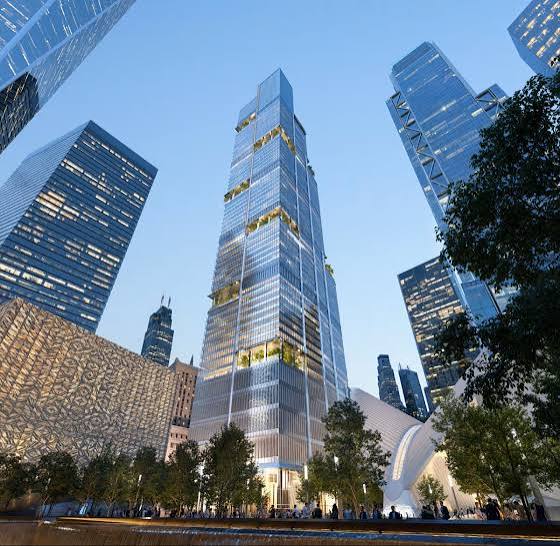
Foster + Partners has unveiled new renderings for 2 World Trade Center, a 1,226-foot supertall that broke ground last month and will complete Lower Manhattan's skyline 25 years after 9/11
NEW YORK
For nearly two decades, one lot at the World Trade Center site has stood as an open question — a gap in an otherwise completed skyline, a placeholder for whatever would finally rise to close the loop on Lower Manhattan's rebuilding. That question now has a definitive answer. Foster + Partners has released updated renderings for 2 World Trade Center, a 55-story, 1,226-foot supertall skyscraper at 200 Greenwich Street that broke ground last month and is set to become the new global headquarters of American Express — a single-tenant commitment that instantly makes it one of the most significant corporate real estate moves in New York this decade.
Closing the Master Plan, Two Decades Later
To understand why this building matters, it helps to remember what it's completing. The original World Trade Center master plan, drawn up in the years following the September 11 attacks, envisioned a cluster of commercial towers surrounding Santiago Calatrava's dramatic Oculus transportation hub and the National September 11 Memorial. One Trade Center rose first, opening in 2014 as the site's anchor. Three and Four World Trade Center followed. But 2 World Trade Center — positioned directly across from the Oculus and adjacent to the Perelman Performing Arts Center — has had a famously turbulent design history, cycling through different architectural visions (including a widely publicized version helmed by Bjarke Ingels Group years ago) before settling, finally, on the current Foster + Partners scheme with developer Silverstein Properties.
Construction resumed with a ceremonial groundbreaking in July, an event that carried unmistakable symbolic weight. "This is an important milestone for our city, for American Express, for Silverstein Properties, but also symbolizes triumph and what can be accomplished in this country after what happened nearly 25 years ago," said Lisa Silverstein, CEO of Silverstein Properties, at the ceremony. She described the project elsewhere as "the capstone for the World Trade Center" and reflected on the two-decade arc that led to this point, calling it simply "a long journey."
What the Building Will Actually Look Like
The newly released renderings show a tower defined by restraint rather than spectacle — a deliberate choice given its context among some of the most architecturally ambitious buildings in the world. The façade combines floor-to-ceiling glass with metal ventilation screens concealing the tower's mechanical levels and setbacks, giving the building a stepped profile as it rises. Notably, the design omits a spire that appeared in earlier iterations of the scheme, instead culminating in a flat roof — a decision that reads as a rejection of the height-chasing instinct that has defined so much of the last generation of supertall design, in favor of a quieter, more corporate-appropriate silhouette suited to its role as a single company's headquarters rather than a mixed-tenant trophy tower.
At 1,226 feet, 2 World Trade Center will still be a formidable presence on the skyline, occupying what planners have long described as the central position within the WTC campus — the piece that visually and functionally links the memorial, the transit hub, the performing arts center, and the surrounding commercial towers into a coherent whole for the first time since the site's rebuilding began.
Why American Express, and Why It Matters
The most consequential detail in this story isn't architectural — it's financial. American Express will serve as the building's sole owner and occupant, consolidating the company's global headquarters into a single, purpose-built tower. That's a significant vote of confidence in Lower Manhattan's commercial future at a moment when office real estate broadly has faced persistent questions about post-pandemic demand, hybrid work, and corporate space consolidation nationwide.
The project's financing structure adds another layer of significance: it is being built with zero public dollars, a detail city and state officials have emphasized repeatedly, framing it as proof that private capital still sees Lower Manhattan as a sound long-term bet without requiring taxpayer subsidy. The construction phase alone is expected to generate more than 2,000 union construction jobs, a substantial economic infusion for the city's building trades at a moment when large-scale commercial construction starts have been relatively scarce nationally.
Governor Kathy Hochul's office marked the groundbreaking as a milestone worth celebrating publicly, underscoring how much political significance New York State attaches to finally filling this particular gap in the skyline — both as an economic development story and as a symbolic completion of the broader post-9/11 rebuilding narrative that has defined the site for a generation.
A Quarter-Century Timeline, Finally Nearing Its End
It's worth sitting with the scale of the timeline here. The attacks that created the need for this entire master plan occurred nearly 25 years ago. Two World Trade Center's path to groundbreaking has spanned multiple economic cycles, multiple design teams, and shifting ideas about what Lower Manhattan even needed as a commercial district. Completion is now scheduled for 2031 — meaning the full arc from destruction to a completed master plan will stretch across three full decades by the time the building opens its doors.
That duration says something honest about how genuinely difficult large-scale urban rebuilding is, even with enormous public attention, political will, and private capital all pointed in the same direction. It also means that when 2 World Trade Center finally opens, it will do so for a workforce and a city meaningfully different from the one that watched the original towers fall — a reminder that architecture at this scale operates on a timeline that outlasts news cycles, mayoral administrations, and even the corporate tenants who might occupy a building decades before ground is ever broken.
What This Means for New Yorkers and Beyond
For New Yorkers, the practical implications are fairly direct: another 2,000-plus construction jobs entering the pipeline, a fully activated WTC campus that finally delivers on two decades of planning promises, and a tangible signal that major corporations still view a purpose-built Lower Manhattan headquarters as a worthwhile long-term investment rather than a liability. For the broader design and architecture world, it's a case study in how even a supertall skyscraper — a building type often associated with maximalist ambition — can be deployed in service of restraint and context, deferring to a site's symbolic weight rather than competing with it.
The Bottom Line
Two World Trade Center has spent more years as an unresolved question mark than most buildings spend standing. With Foster + Partners' renderings now public, construction underway, and American Express committed as its anchor tenant, that question is finally being answered in steel and glass. When it opens in 2031, it won't just complete a skyline — it will close a chapter of the city's history that began on a September morning a full generation ago.



