Kampala
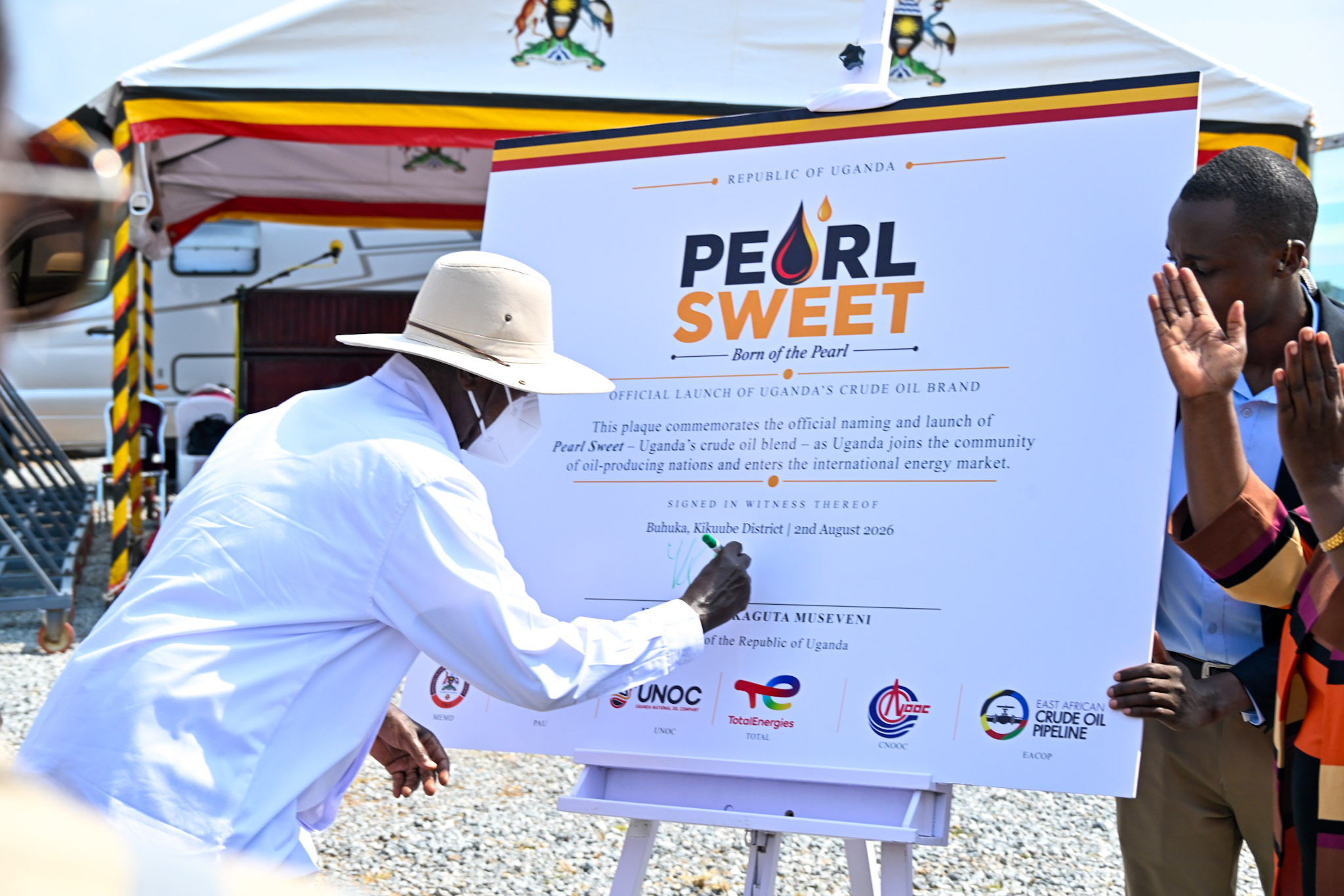
On 2 September, at a ceremony in the Kingfisher Development Area on the shore of Lake Albert, President Yoweri Museveni gave Uganda's export crude a name: Pearl Sweet. It sounds like branding, and in part it is. It is also the administrative moment at which a country's oil stops being a project and becomes a commodity.
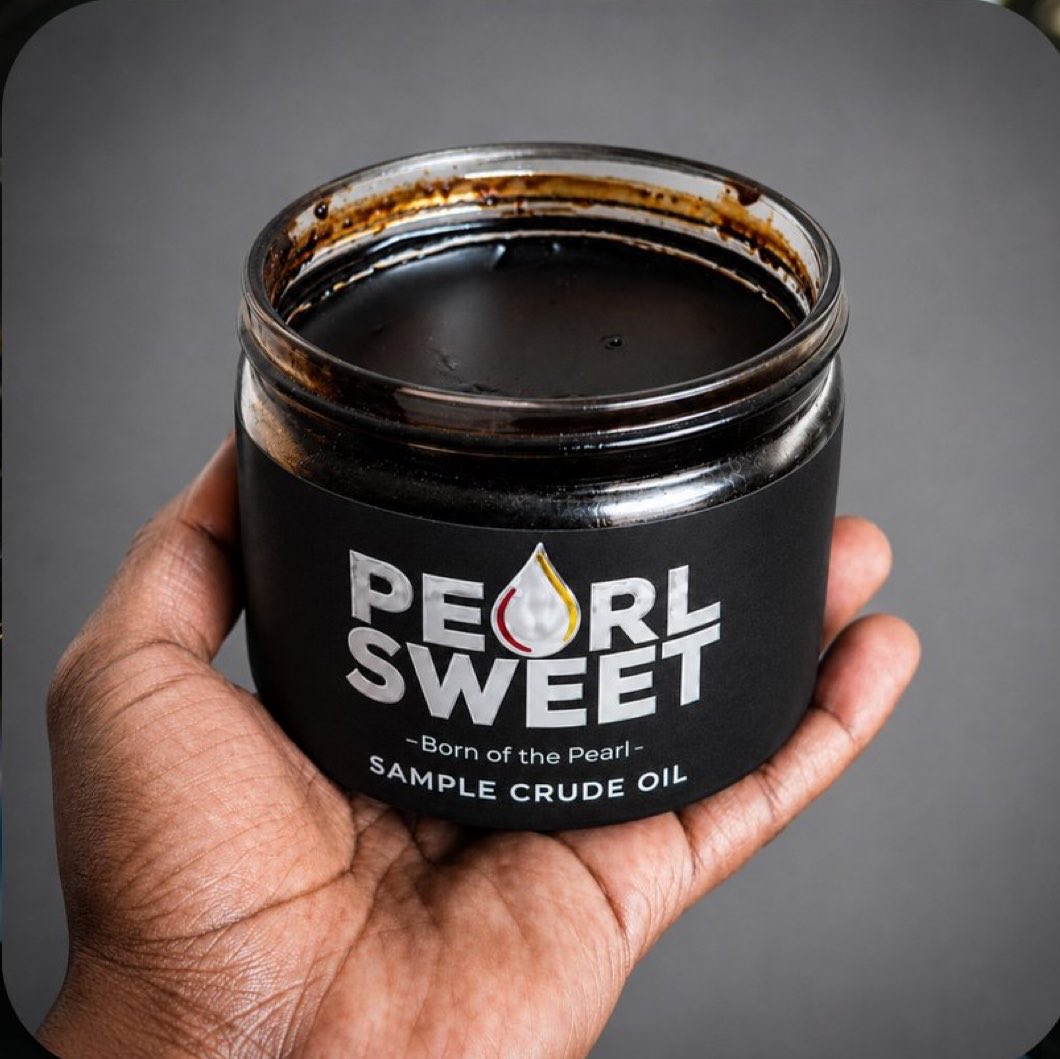
International crude oils trade as identifiable grades. Refiners, traders, shipping companies, price-reporting agencies and analysts need a name to attach to a quality specification, build a pricing history around, and print on cargo documentation. Until last week Uganda had roughly 1.65 billion barrels of recoverable resource and no market identity. Pearl Sweet will now appear in refinery specifications and international trading databases alongside Brent, Murban and Bonny Light.
The name does two jobs at once. "Pearl" invokes Uganda's long-standing description as the Pearl of Africa, a phrase attributed to Winston Churchill. "Sweet" is a petroleum classification: it signals low sulphur content, a property refiners pay up for as fuel specifications tighten worldwide. The blend is medium-light, with API gravity in the 28-31 degree range — a profile that yields a decent share of light products and is comparatively straightforward to refine.
THE ASSETS BEHIND THE NAME
Pearl Sweet is a blend of two upstream developments. Tilenga, operated by TotalEnergies EP Uganda, is designed for about 190,000 barrels per day at peak. Kingfisher, operated by CNOOC Uganda Limited, is designed for about 40,000 barrels per day. Together they should deliver roughly 230,000 bpd at plateau.
Crude from both fields will be processed and commingled at the Kabaale Shared Facilities in Hoima District before entering the East African Crude Oil Pipeline. EACOP runs 1,443 kilometres from Kabaale to a marine export terminal at Chongoleani, near Tanga on Tanzania's coast. Because Ugandan crude is waxy and congeals at ambient temperature, the line is heated and electrically insulated along its length — the longest such pipeline in the world. As of 1 September, the pipeline company reported EACOP at 92.7 per cent overall completion.
The Uganda National Oil Company holds a 15 per cent participating interest on behalf of the government in both upstream developments, and — through its wholly owned National Pipeline Company Uganda Limited — a 15 per cent interest in EACOP alongside TotalEnergies, the Tanzania Petroleum Development Corporation and CNOOC.
The combined investment programme across Tilenga, Kingfisher and EACOP is around $15 billion, of which more than $12 billion had been spent as Uganda approached first oil. That capital expenditure is itself a large part of why Ugandan GDP growth has been strong through the construction phase.

WHAT OFFICIALS SAID
Museveni used the ceremony to defend the government's insistence on domestic refining and its ban on gas flaring. "What you sow is what you reap," he told attendees, arguing that refining at home supports the local economy and that oil, being finite, must be managed for future generations.
Dr Monica Musenero Masanza, Minister of Energy and Mineral Development, framed the naming as a readiness milestone: "The naming of Pearl Sweet marks an important step as Uganda prepares to take its place in the international oil market. The progress at Tilenga and Kingfisher shows that we are ready to produce responsibly, safeguard the environment and build an industry whose benefits are felt across the Ugandan economy."
UNOC Chief Executive Proscovia Nabbanja was the most explicit about the commercial function. "Pearl Sweet gives Uganda's crude what every traded grade needs: a clear identity, a defined quality and a name the market can recognise," she said. "For UNOC, the naming opens the next phase: taking Uganda's barrels to market, building long-term relationships with refiners and traders and capturing maximum value for the country."
Lynda Biribonwa, chairperson of the sector regulator, the Petroleum Authority of Uganda, tied it to the domestic development agenda: converting petroleum resources into "skills, enterprises, infrastructure, technology, industrialisation, energy security, and shared prosperity."
THE NUMBERS THAT WILL DECIDE WHETHER THIS WORKS
Uganda's economy grew 6.7 per cent in 2025, up from 6.0 per cent in 2024, on the strength of services and industry. Forecasts for the oil transition vary in their timing but agree on direction: the African Development Bank projects 6.2 per cent in 2026 and 8.0 per cent in 2027; other outlooks put growth as high as 10.4 per cent in FY2026/27 as production begins, before settling back toward 6 per cent.
The fiscal numbers are more sobering than the growth numbers. Oil revenues are expected to begin flowing in 2027 and to average around 2.2 per cent of GDP a year. Depending on global crude prices, annual receipts could range between roughly $1.5 billion and $2.5 billion once production stabilises. Dr Adam Mugume, director of research and policy at the Bank of Uganda, has confirmed that oil revenues in the 2026/27 financial year will support the government budget.
Two per cent of GDP is real money for a country with Uganda's revenue-to-GDP ratio, but it is not transformative on its own. It is roughly the size of a well-executed tax administration reform. That gap between the political expectation attached to first oil and the actual fiscal magnitude is the single most important thing to hold in mind over the next two years.
The local content picture is more encouraging than the fiscal one. Total employment in the sector stood at 22,234 as of March 2026, with 85 per cent of those jobs held by Ugandan nationals. More than 14,000 Ugandans have been trained and certified in oil and gas disciplines. Local content requirements have retained a meaningful share of project spending inside the country. Those are durable gains in human capital that survive any given year's oil price.
![]()
WHY IT MATTERS
For a landlocked economy, EACOP is the more consequential asset of the two. It converts Uganda from a country with stranded resources into an Indian Ocean crude supplier, and it does so through a route Uganda shares with Tanzania — a structural stake in regional cooperation that outlasts any single administration.
There is also a currency and competitiveness question that Ugandan policymakers have been discussing openly for years. Dollar inflows from oil exports tend to push up the real exchange rate and squeeze non-oil exporters — coffee, fish, horticulture, manufactures. The standard defence is a sovereign fund with credible rules on how much can be drawn in any year, paired with fiscal discipline. Uganda has the institutional architecture on paper. Whether it holds under the political pressure of the first big revenue year is the test.
The transparency question is unavoidable, and last week supplied its own illustration: within days of the Pearl Sweet ceremony, Parliament adopted a report accusing Uganda Railways Corporation of losing wagons, land titles and donor funds. The same public financial management system that produced that outcome will be handling oil receipts.
WHAT TO WATCH
The first marker is first oil itself. Commercial output has been expected by the end of September 2026, after the July target slipped; the projects are in commissioning, and commissioning schedules move. A slip into 2027 would be unremarkable technically but politically noisy.
The second is EACOP's remaining 7 per cent, and specifically the Chongoleani terminal and line-fill. A heated pipeline of that length requires the whole system to work before a single barrel is exported.
The third is the first cargo and the first realised price. Pearl Sweet's differential against Brent — how much more or less than the benchmark buyers will pay — is unknown until real cargoes trade. That differential, not the headline barrel count, determines how much money actually arrives.
The fourth is the FY2026/27 budget execution, and whether oil receipts are treated as recurring revenue or ringfenced. The fifth is the domestic refinery, long promised and repeatedly delayed, which is the difference between exporting a commodity and building an industry.
Uganda has spent two decades getting from discovery to a named export grade. The harder part — converting a barrel count into broad-based prosperity without wrecking the rest of the economy — starts now.
Published By | Business News Editor