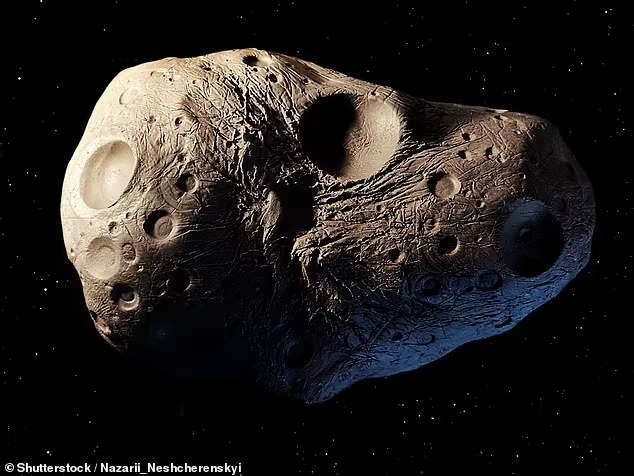
When we think of massive asteroids, the one that struck Earth 66 million years ago and wiped out the dinosaurs often comes to mind. However, this asteroid was small compared to a far more devastating rock that impacted our Solar System about four billion years ago.
Scientists have discovered evidence that an asteroid, 20 times larger than the one that ended the age of the dinosaurs, slammed into Ganymede, the largest moon of Jupiter. This impact was so powerful that it completely shifted Ganymede's axis, according to researchers from Kobe University.
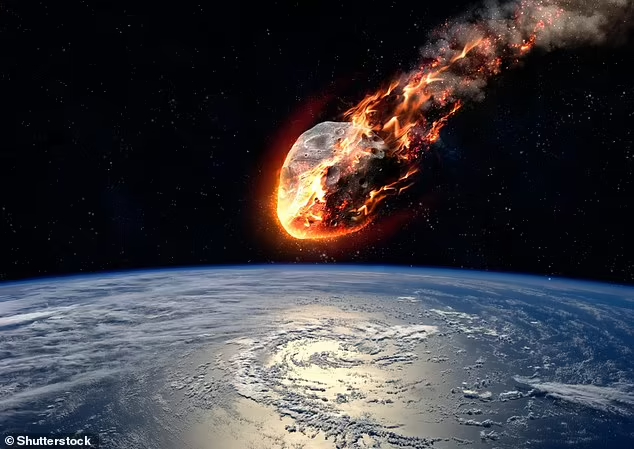
It is well known that the reign of the dinosaurs came to an end when a giant asteroid smashed into Earth 66 million years ago. But until now, the origin of this space rock has remained unclear (artist's impression from shutterstock)
While many questions about this ancient event remain, researchers hope to uncover more details when the European Space Agency's JUICE space probe arrives at Ganymede in 2034.
Ganymede, with a radius of 1,635 miles, is the largest moon in the Solar System. Like Earth's moon, it is tidally locked, meaning it always shows the same face to Jupiter.
In the 1980s, researchers discovered large furrows forming concentric circles around a specific region on Ganymede's surface.
"The Jupiter moons Io, Europa, Ganymede, and Callisto each have fascinating characteristics, but what caught my attention were these furrows on Ganymede," said Hirata Naoyuki, the study's lead author. "We knew that this feature was created by an asteroid impact about 4 billion years ago, but we were unsure of the size of the impact and its effect on the moon."
Ganymede remains largely unexplored, with limited data available. To investigate further, researchers turned their attention to Pluto. Previous studies using data from the New Horizons space probe confirmed that Pluto experienced an impact event significant enough to shift its rotational axis.
By analyzing the location of the furrows on Ganymede—positioned on the meridian farthest from Jupiter—the researchers suggest that the moon also reoriented as a result of its asteroid collision. In their study, the researchers estimate that the asteroid had a diameter of around 186 miles and created a massive crater between 870 and 994 miles in diameter.
"I want to understand the origin and evolution of Ganymede and the other Jupiter moons," Hirata added. "The giant impact must have played a significant role in the early evolution of Ganymede, but the thermal and structural effects of the impact on Ganymede's interior have yet to be investigated."
Hirata believes that future research could focus on the internal evolution of ice moons, shedding light on how such colossal impacts have shaped these distant worlds.
Source: Daily Mail
Published By | Dickens Tiharihondijo