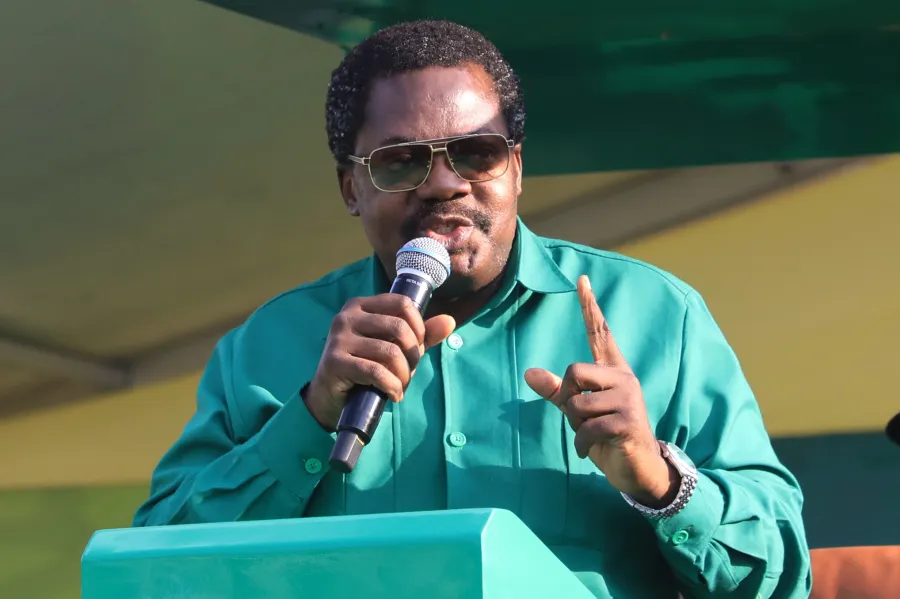
DAR ES SALAAM, Tanzania
Tanzania's former Vice President Emmanuel Nchimbi has not been seen in public since Aug. 20, has not answered calls from friends, family or the country's own former prime minister since Aug. 26, and was conspicuously absent from the swearing-in of his own successor three days later. No Tanzanian official has confirmed he is in custody. None has confirmed he is free. The silence itself has become the story, and it is unfolding just 10 months after an election so violent and so widely condemned that rights groups still cannot agree on how many people died in the crackdown that followed it.
The disappearance of a sitting-turned-former vice president from public view, layered atop his abrupt resignation and his ruling party's swift expulsion of him the following day, has turned what began as an unusual but explicable personnel change into what one prominent domestic commentator has called a "national catastrophe" for a country long regarded, until 2025, as one of East Africa's more stable democracies.

What Happened
On Aug. 25, a resignation letter attributed to Nchimbi began circulating online. Former Prime Minister Joseph Sinde Warioba, who had known Nchimbi's late father and described himself as something of a father figure to the younger man, said he called Nchimbi directly to verify it. "I called Nchimbi, and he picked up. I told him I was calling because there's a letter trending online, and I wanted him to tell me whether it was true that he had written a resignation letter. He said yes, it's true," Warioba recounted in a speech at the Tanganyika Law Society hall on Aug. 28, as part of the Tanzania Democracy Forum. In that conversation, Warioba said, Nchimbi told him President Samia Suluhu Hassan had not yet reacted to the letter.
In his resignation announcement, Nchimbi said he was stepping down, retiring from active politics and leaving public service altogether, with the move set to take effect Sept. 4. He said he believed Hassan wanted a change in the vice presidency and recalled a promise he had made to step aside whenever she wished to appoint someone else to the post.
The response from his own party came fast and was unambiguous. On Aug. 26, the National Executive Council of the ruling Chama Cha Mapinduzi, or CCM, met and voted to terminate Nchimbi's party membership, citing what it described as violations of party ethics, rules and principles. Tanzania's Attorney General subsequently stated that Nchimbi ceased to hold the vice presidency on Aug. 26, the moment his CCM membership lapsed, though local legal commentators have been divided over whether expulsion from the party should, as a matter of constitutional law, automatically terminate a state office. By Aug. 31, CCM officials were citing a more specific justification for the speed of the expulsion: Nchimbi's failure to appear before the party's ethics committee to answer the allegations against him, according to reporting by the Dar es Salaam-based outlet The Chanzo.
Three days after the expulsion, on Aug. 29, Tanzania's Parliament unanimously approved Energy Minister Deogratius John Ndejembi as the country's new vice president, filling the vacancy CCM had just created. Nchimbi did not attend the ceremony.

The Disappearance
What has transformed a party-discipline story into a genuine crisis is the question of Nchimbi's whereabouts. Warioba told his Aug. 28 audience that he had tried repeatedly to reach his protégé and failed. "Then the next day I heard the National Executive Committee was meeting, so I called him but got no answer," he said, adding that when a CCM press conference was called for 9 p.m. that evening, "I called him again; no answer. I sent him a message, no reply, and normally he responds quickly." Warioba noted that such silence was out of character: "In the party, disciplinary action is taken but after that a person is free. So when I was told he might be detained or something, I still didn't believe it, because I don't see any grounds for it."
Unverified reports circulating on Tanzanian social media claim Nchimbi's phones were confiscated and that he is being held incommunicado, though there has been no independent or official confirmation of detention. What is verifiable is the pattern: no public appearance since Aug. 20, no response to a former prime minister's calls since Aug. 26, and no presence at the Aug. 29 inauguration of his own replacement. Tanzanian officials have not issued a statement addressing his location or condition as of this writing.
Warioba's account also sketched a portrait of Nchimbi as an unusually independent-minded figure within a party not known for tolerating dissent. He recalled that during the 2024 civic elections, Nchimbi urged the ministry overseeing elections to halt the disqualification of opposition candidates, and that he had spoken out against the frequent arrests of opposition figures, positions that made him something of an outlier inside CCM's ranks.
The Backdrop: A Contested Mandate
The immediate crisis cannot be understood apart from the election that preceded it by less than a year. Hassan, who assumed the presidency in 2021 following the sudden death of President John Magufuli, sought a full term in the Oct. 29, 2025, general election. The vote proceeded after Tanzania's two most prominent opposition challengers were removed from contention: Chadema, the country's main opposition party, was barred from the ballot entirely, while Tundu Lissu, its leader, had already been jailed and charged with treason, which he denies, after calling for electoral reforms he said were a precondition for a free and fair vote. A second opposition figure, Luhaga Mpina of the ACT-Wazalendo party, was also barred from running, leaving Hassan to face 16 candidates from smaller parties.
The electoral commission declared Hassan the winner on Nov. 1, 2025, with 97.66% of the vote. The scale of the margin, and the exclusion of her most serious rivals that produced it, triggered days of violent unrest in major cities beginning on election day. Demonstrators tore down campaign banners and set fire to government buildings; police responded with tear gas and, according to witnesses cited by international wire services, gunfire. Internet monitoring group NetBlocks reported that access to social media and mobile internet was restricted in several cities during and after the vote.
The human toll of the crackdown remains disputed and unresolved nearly a year later. Chadema spokesman John Kitoka told reporters that the party's own monitoring network, drawing on hospital and clinic records, had documented "no less than 800 people" killed by security forces during the week of unrest, an escalation from an earlier estimate of "about 700." The United Nations human rights office, by contrast, said credible reports indicated at least 10 people were killed across three cities. Tanzania's Foreign Minister, Mahmoud Thabit Kombo, rejected the higher figures outright, telling Al Jazeera that "no excessive force has been used" and that he had "not seen these 700 anywhere," while maintaining the government had no official casualty count of its own. United Nations Secretary-General António Guterres said he was "deeply concerned" about the reports of deaths and injuries, and African Union Commission Chairperson Mahmoud Ali Youssouf, even as he congratulated Hassan, said he "deeply regrets the loss of human life during the post-electoral protests." Alex Vines, Africa director at the European Council on Foreign Relations, described the polls as the product of "a campaign of harassment and intimidation" against the opposition, adding, "It clearly is not a credible election."
The Stakes
Nchimbi's resignation and disappearance land in a political environment already primed for suspicion of the state's institutions. A vice president who by most accounts positioned himself, gently and within the bounds of party discipline, as a moderating voice on the treatment of the opposition has now vanished from public life at precisely the moment questions are being asked about why he left office and who forced the timing. Whether or not any coercion is ultimately confirmed, the optics compound a narrative that has dogged Hassan's government since well before last October's vote: that of a ruling apparatus intolerant of internal dissent as well as external opposition.
The succession itself, moving Energy Minister Ndejembi into the vice presidency within days of the vacancy, suggests a government eager to project stability and continuity rather than allow uncertainty to fester. But the speed with which CCM moved to expel Nchimbi, a day after his resignation and evidently before any meaningful ethics review took place, given the party's own stated justification that he failed to appear before its ethics committee, has raised as many questions as it has answered about due process within the ruling party's internal disciplinary machinery.
Analysis and Outlook
Two things can be true at once: Nchimbi's departure may reflect a legitimate internal political negotiation, of the kind Warioba's account suggests Nchimbi anticipated when he referenced an earlier promise to step aside, and the manner of his disappearance from public contact may nonetheless represent a serious and independently troubling development. Tanzanian civil society, the domestic press, and figures such as Warioba, whose stature as a former prime minister lends weight to his public expression of concern, are now effectively serving as the primary check on a government that controls the flow of official information about one of its own most senior recent officials.
What happens next will likely turn on three factors. First, whether Nchimbi reappears, publicly and verifiably, before his resignation formally takes effect on Sept. 4, a milestone that will concentrate domestic and international attention. Second, whether CCM or the government offers any further explanation of his status beyond the ethics-committee rationale already reported, particularly given that lawyers remain divided over whether party expulsion alone was sufficient to end his constitutional office. Third, and more broadly, whether this episode accelerates the erosion of confidence in Hassan's government among the same international partners, from the United Nations to the African Union to European foreign policy circles, that have voiced concern since the October 2025 election. For a government still working to rehabilitate its democratic credentials after a vote its own foreign minister has had to publicly defend against allegations of mass killings, the unexplained silence surrounding a former vice president is not merely an internal party matter. It is now a test of whether Tanzania's institutions can be trusted to account for the fate of the people who serve inside them.
Published By | News Editor