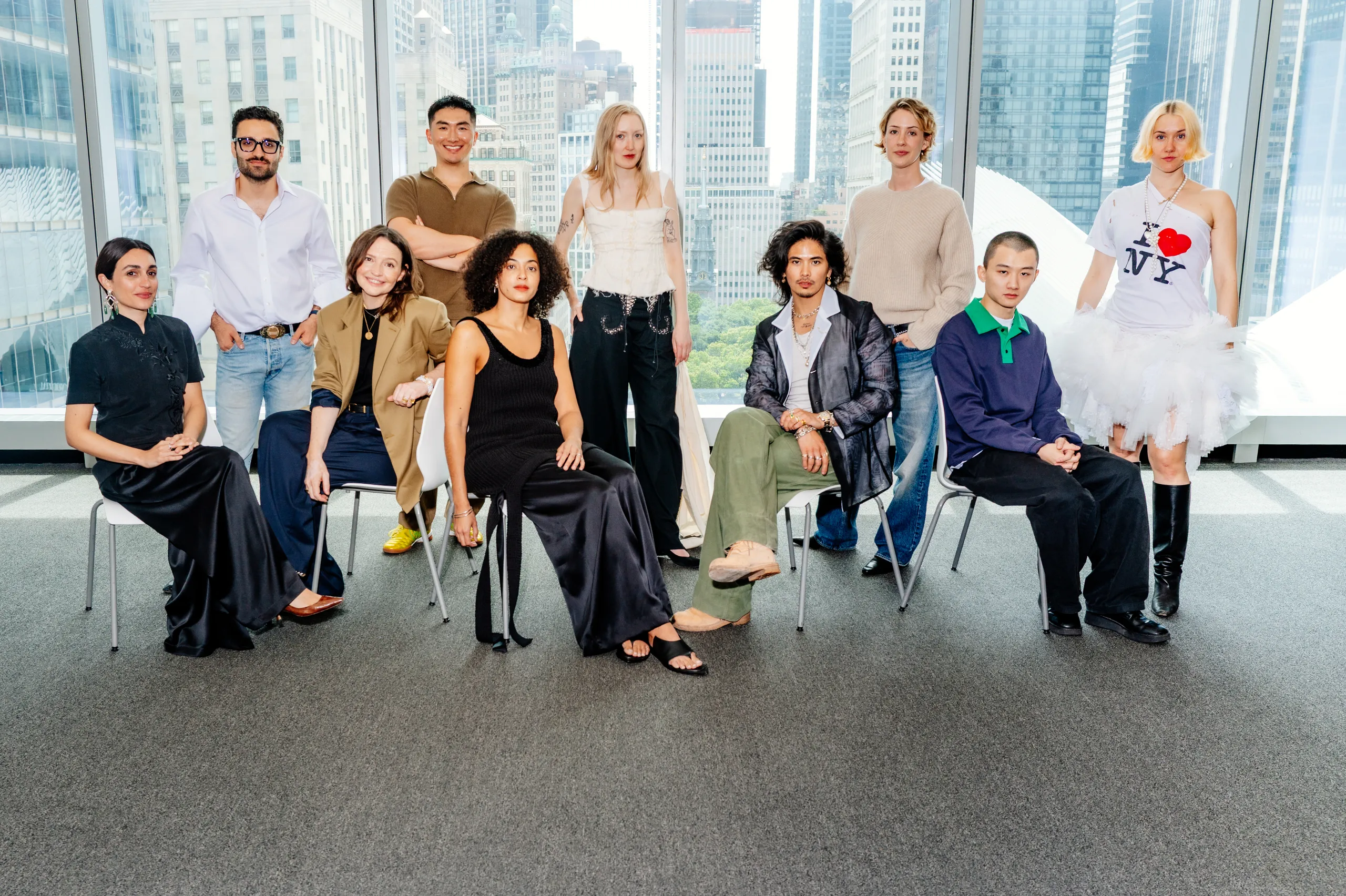
The CFDA and Vogue just revealed the 2026 Fashion Fund finalists—a list ranging from jewelry to genderless tailoring to bridal—and for the first time, the competition is asking entrants to prove their materials can be sustainable as well as beautiful.
NEW YORK
Every June, American fashion runs a quiet experiment: take ten designers nobody outside the industry has fully heard of yet, put them in front of the people who decide what gets sold at Bloomingdale's, worn by Vogue editors, and championed by fashion's most influential names, and see who rises. This week, the CFDA and Vogue revealed this year's contenders for the 2026 Fashion Fund—a snapshot of where American design is actually headed.
Who Made the Cut
The 2026 finalists are Aisling Camps, Amir Taghi, Terrence Zhou (Bad Binch TONGTONG), Emily Dawn Long, Jamie Haller, Julia Ferentinos (Juju Vera), Zane Li (Lii), George Inaki (Milamore), Claire Sullivan (Miss Claire Sullivan), and Zoe Gustavia Anna Whalen. The list spans eveningwear, bridal, fine jewelry, genderless tailoring, and conceptual work—reflecting a fund that has spent two decades identifying commercial viability and creative distinctiveness in the same ten names.
Past finalists and winners include some of the most recognizable names in American fashion over the past twenty years. Being named a finalist alone serves as a credibility stamp that shifts how retailers, editors, and financiers treat a young label.
Who's Deciding, and What's at Stake
The 2026 Selection Committee includes Aurora James (Brother Vellies), Vogue's Chloe Malle and Nicole Phelps, designer Christopher John Rogers, Bloomingdale's Denise Magid, Instagram's Eva Chen, model Paloma Elsesser, designer Thom Browne, and Nordstrom's Yumi Shin—a group built to evaluate from every angle that matters to a young brand's survival.
The financial stakes are significant: the winner receives $300,000, with two runners-up taking $100,000 each—money that can mean the difference between a fourth collection and a forced shutdown. The winner will be named October 20 at a gala in New York.
The New Wrinkle: Materials Have to Answer for Themselves
What's genuinely new this cycle is the addition of Humane World for Animals as the Design Challenge partner, introducing a Material Innovation Challenge that pushes finalists to work with bio-based textiles—an explicit nudge toward materials that don't rely on animal products and have a smaller environmental footprint.
It's a structural change with a larger implication: a high-profile, cash-prize competition is now formally asking young designers to treat material sourcing as a competitive criterion, not an optional virtue. Sustainability is no longer a side conversation.

Why This Particular Crop Matters
Industry observers have noted this year's list captures something true about independent American design right now: less interested in spectacle, more focused on craft specificity—fine jewelry, considered bridal, tailoring that resists rigid gender categories. None of these names are household names yet. That's the point. The Fund exists to catch designers in the narrow window after they've proven they can make something good and before they've figured out how to scale it.
What This Means for You
This is the closest thing American fashion has to a farm system. The names on this list are a reasonable bet for whose pieces will be showing up in stores and on red carpets over the next several years. For shoppers who want to support designers before they become inescapable, a finalist list is a genuinely useful shopping guide—current collections are still attainable in ways they won't be once retail buyers finish circling.
It's also a window into how the industry is policing itself on sustainability without waiting for regulation—tying bio-based materials to real prize money is a more credible signal than another "conscious fashion" campaign.
Conclusion
Ten designers now have four months to make their case to a committee of the most consequential taste-makers in American retail and media, with $300,000 on the line. Whoever wins on October 20 will join a list of past honorees that has shaped what "American fashion" has meant for two decades. For now, the ten finalists are the industry's most interesting bet all year—and this time, the materials they use will be part of how that bet gets graded.
Published By | Features Editor