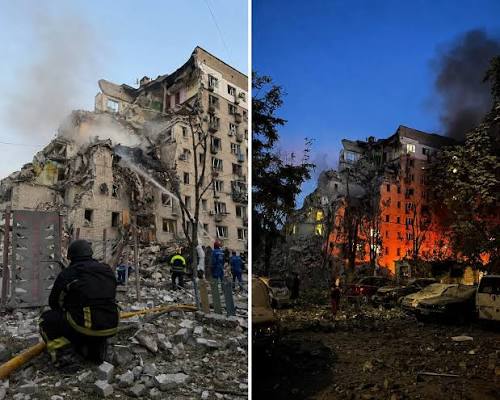
Kyiv awoke on Thursday, July 2, to one of the most destructive nights it has endured since Russia’s full-scale invasion began in 2022. In an assault that Ukrainian officials described as “massive” and that stretched across roughly eleven hours, Russian forces battered the capital with a combination of ballistic and cruise missiles and swarms of attack drones, killing civilians in their homes, collapsing part of a residential tower and leaving rescue crews digging through rubble well into Friday. By Friday morning local time, Ukrainian authorities had confirmed at least 27 dead and more than 90 injured, with the toll expected to rise as emergency workers reached people trapped beneath debris. The strike lands at a delicate diplomatic moment, arriving just a day before President Volodymyr Zelensky and U.S. President Donald Trump were scheduled to meet in Florida to discuss the prospects for ending the war.
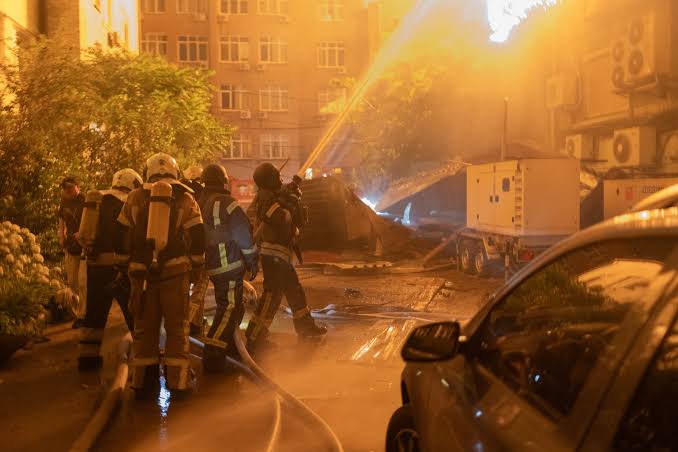
Background
The attack did not occur in a vacuum. Over the preceding months, Ukraine has dramatically intensified its long-range campaign against Russia’s oil and energy infrastructure, using domestically produced drones to strike refineries and fuel depots hundreds and in some cases more than a thousand miles behind the front line. That campaign has bitten hard. Russia has been gripped by its worst fuel crisis of the war, with rationing spreading across large swaths of the country, long queues forming at filling stations, and President Vladimir Putin publicly acknowledging a “temporary deficit” in fuel supply for the first time in late June. Ukrainian strikes on major refineries in the Krasnodar and Yaroslavl regions in the final days of June underscored how deeply Kyiv had managed to reach into Russia’s economic core.
Moscow framed the Kyiv barrage explicitly as retaliation. The Russian Defence Ministry said it had carried out a “massive attack” using long-range, high-precision air, land- and sea-launched weapons together with drones, and characterized the operation as a response to Ukraine’s strikes on Russian oil facilities. The escalation reflects a grim tit-for-tat logic that has come to define this stage of the conflict: as Ukraine degrades Russia’s ability to fund and fuel its war effort, Russia answers by inflicting mass casualties on Ukrainian cities, betting that pressure on civilians will erode Kyiv’s resolve and its Western support.
The pattern is a familiar one in a war now well into its fourth year, but its intensity has ratcheted upward. Ukraine’s pivot toward deep strikes reflects a strategic calculation that it cannot match Russia soldier for soldier along the eastern front, and must instead impose costs on the Russian economy and war machine far from the trenches. Russia, for its part, has increasingly leaned on saturation attacks that combine cheap Iranian-designed Shahed-type drones with more expensive ballistic and cruise missiles, seeking to overwhelm Ukrainian air defences by sheer volume. The result is a war in which the front lines have moved little in recent months, even as the destruction inflicted on cities and infrastructure hundreds of miles from the fighting has grown steadily more severe.

Key Developments
According to Kyiv Mayor Vitali Klitschko, the city came under sustained fire from ballistic missiles and unmanned aerial vehicles overnight, with damage reported in every district of the capital. The worst-hit area was the Darnytskyi district on the left bank of the Dnipro, where part of a nine-storey apartment building collapsed, leaving residents trapped inside. AFP journalists reported hearing more than a dozen explosions across central and eastern Kyiv as air-defence crews worked through the night to intercept incoming weapons.
Casualty figures climbed steadily through Thursday and into Friday. Early counts of around 18 to 22 dead gave way to a confirmed toll of at least 27 killed and more than 90 wounded by Friday morning, making it the deadliest single assault on the capital so far in 2026. The scale of the strike — involving hundreds of drones and dozens of missiles by Ukrainian accounts — also had effects well beyond Ukraine’s borders. Poland scrambled fighter jets as a precaution, and Finland moved to restrict airspace near its eastern frontier, illustrating how the reverberations of the attack rippled across NATO’s eastern flank.
The timing was politically loaded. The bombardment came a day before Zelensky and Trump were due to sit down in Florida to discuss a possible path toward peace, and many observers read the strike as a deliberate signal from the Kremlin — a demonstration of leverage and resolve on the eve of high-stakes diplomacy. Whether intended to strengthen Moscow’s hand or simply to punish Kyiv for its refinery campaign, the assault ensured that the two leaders would meet against a backdrop of fresh civilian graves.
![]()
Reactions
President Zelensky reacted with a mixture of grief and defiance, declaring that Moscow “will receive a response” and that Ukrainian forces would “definitely” retaliate for the pummelling of the capital. He used the moment to press his central strategic argument to Western partners: that air defence remains, in his words, “an absolute and critical priority,” and that agreements on anti-ballistic capabilities must be implemented rapidly. Zelensky also emphasized that continued American support was “absolutely necessary,” framing the strike as evidence of why Ukraine cannot be left to face Russian firepower alone.
European leaders responded with renewed threats of economic pressure. Officials signalled that fresh sanctions would follow, with one European leader announcing plans to propose sanctioning additional entities that support Russia’s military-industrial complex specifically in response to the strikes. “The more Moscow attacks civilians, the more sanctions must be imposed,” a European official said, capturing a hardening mood across the continent. The attack strengthened the hand of those in Europe arguing for accelerated deliveries of air-defence systems and interceptor missiles to Ukraine, and for tightening the financial screws on Moscow’s war economy.
In Washington, the strike complicated the diplomatic choreography around the planned Trump-Zelensky meeting. Coming immediately before talks billed as a chance to explore peace, the bombardment sharpened questions about Russia’s willingness to negotiate in good faith and put pressure on the U.S. administration to clarify how much military and diplomatic backing it is prepared to offer Kyiv. For a Ukrainian leadership that has spent months lobbying for stronger air defences, the images of collapsed apartment blocks provided a stark and immediate illustration of the stakes.
What’s Next
In the immediate term, attention turns to the Florida meeting between Trump and Zelensky, where the fresh bloodshed will loom over every exchange. Zelensky is expected to press for expanded air-defence support and to argue that Russian conduct demonstrates the futility of concessions made under fire. How the U.S. administration responds — whether by hardening its posture toward Moscow, pushing both sides toward a ceasefire, or seeking to broker terms — will shape the trajectory of the war in the coming weeks.
The strike also raises the prospect of a further escalation in the strike-counterstrike dynamic. Zelensky’s promise of a response suggests Ukraine may intensify its deep-strike campaign against Russian energy and military targets, which in turn risks provoking additional Russian bombardments of Ukrainian cities. Each cycle deepens the humanitarian toll and complicates the diplomatic picture. Europe, meanwhile, appears poised to expand sanctions and accelerate military assistance, though the practical impact of new measures will depend on unity among member states and the pace of weapons deliveries.
For ordinary Ukrainians, the more immediate reality is the grinding vulnerability of life under sustained aerial assault. The collapse of a residential building in Darnytskyi is a reminder that, whatever happens at the negotiating table, the war continues to be fought most brutally in the country’s cities. Whether the July 2 strike becomes a turning point toward diplomacy or simply another marker in an escalating spiral will likely become clearer only after the Florida talks and the response that Zelensky has vowed to deliver.
Published By | News Editor