World Politics
Background
Since Ukrainian airspace closed to civil aviation in February 2022, the railway running west out of Kyiv through Volyn Oblast and into Poland has been the safest corridor in the war and the way every visiting head of government, foreign minister and parliamentary delegation has entered and left the country. Ukrainian Railways — Ukrzaliznytsia — turned that necessity into a point of national pride, running what officials call "iron diplomacy" on a timetable kept through blackouts and missile barrages.
Yahodyn sits at the far western end of that line, on the Ukrainian side of the Yahodyn–Dorohusk crossing, roughly two kilometres — about 1.2 miles — from Polish territory. It is the last station before the European Union, and the geography of the war has crept steadily toward it. On 30 July a Russian Kh-101 cruise missile crashed in Poland's Lublin region carrying what the defence ministry confirmed was a "significant amount" of explosive material; in September 2025 around twenty Russian drones crossed into Polish airspace; on 8 September this year a suspected Shahed-type drone violated Moldovan and Romanian airspace. Each incident was absorbed and filed away. The events of 13 September are harder to file away, because of who was standing on the platform.
What Happened at Yahodyn
Overnight into Sunday 13 September, Russia launched a mass drone assault against western Ukraine — an unusual direction of attack, following a rare barrage of hundreds of petrol-powered drones against the north-west the day before. Ukraine's Air Force reported 108 drones in the twenty-four hours to 14 September, of which 85 were shot down or intercepted, with strikes recorded at seven locations. Nationwide over the same period, Russian attacks killed six people and injured 43.
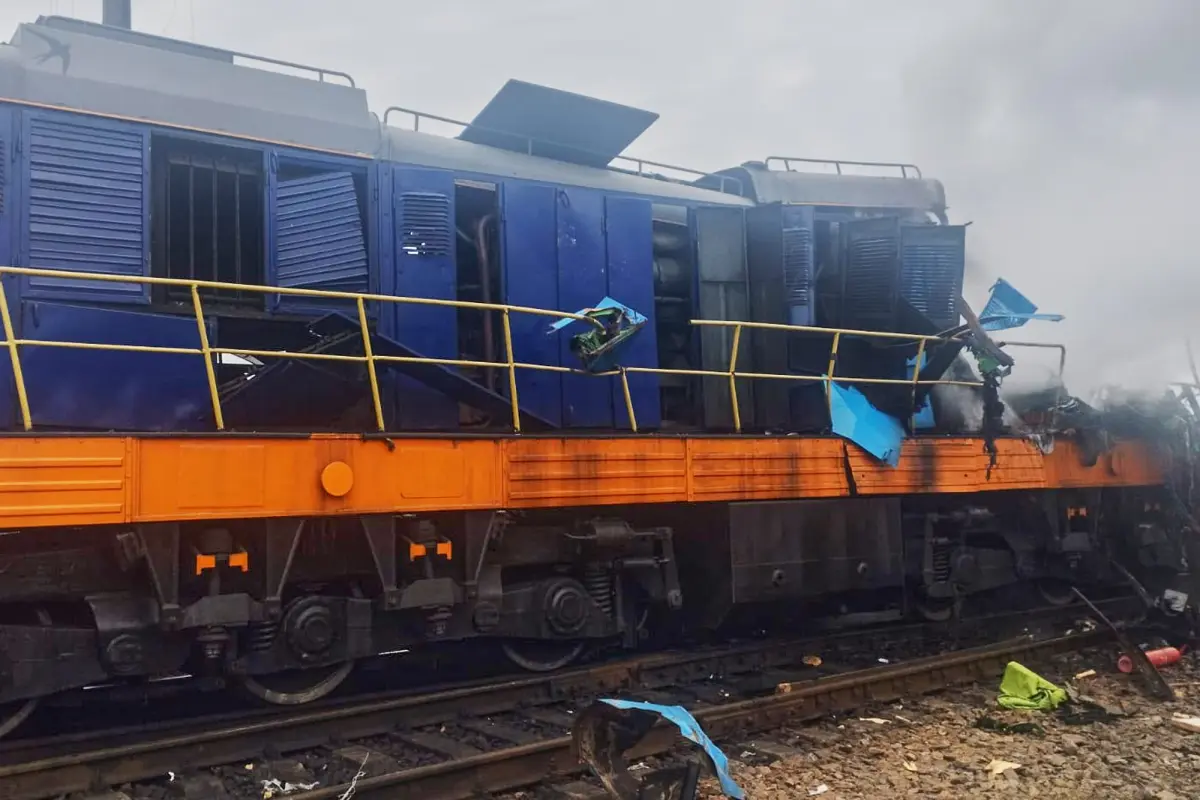
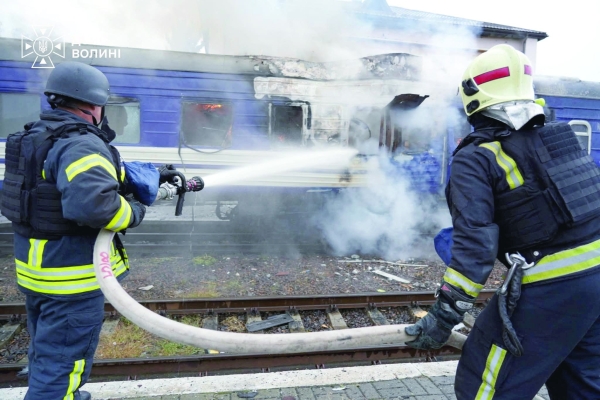
In Volyn, a drone struck the locomotive of a passenger train standing about two kilometres from the Polish border. "A monitoring group warned the train crew of the threat in advance, ensuring that no one was injured," Ukrainian Railways said; UPI, citing the operator, reported passengers were cleared with roughly fifteen minutes to spare. A separate drone hit a target about 800 metres from the crossing itself. Early reports described a petrol station on fire; Poland's border guard said a truck had been struck, and Volyn Customs said falling debris ignited fires at the station and among parked cargo lorries. Karolina Gałecka, spokeswoman for Poland's interior ministry, said no injuries were reported on the Polish side. Andrii Demchenko of Ukraine's State Border Guard Service said the crossing was not hit and remained operational, but warned it could close temporarily if the security situation required it.
The Question of Intent
The 23rd Yalta European Strategy conference had just concluded in Kyiv, and its foreign participants were travelling home by rail. A Warsaw-bound train carrying former British prime minister Boris Johnson, British national security adviser Jonathan Powell and security officials from several EU member states — with NBC News and others also placing former Swedish prime minister Carl Bildt in the party — had passed through Yahodyn ahead of schedule and already crossed into Poland when the drone arrived. Former CIA director David Petraeus, on what was reported as his eleventh wartime visit to Ukraine, was aboard a second train still standing at the station at the moment of impact; he reboarded and crossed safely. Estonia's foreign minister Margus Tsahkna and a ministry delegation were stranded at the crossing, unable to leave.
Ukrzaliznytsia went further than describing a coincidence. "It is quite likely that the target of this Russian drone could have been the diplomatic train, which departed from the station earlier than its scheduled time, as part of a review of train schedules in real-time due to the constant threat of Russian attacks," the operator said. That is the railway's inference, not an independently verified finding: no Western government has publicly confirmed the diplomatic train was the target, and the schedule change that supposedly caused Russia to miss is routine practice rather than a specific counter-measure. Russia's defence ministry, quoted by TASS, said its forces were striking "railway infrastructure facilities in western Ukraine that are used to transport military cargoes from European countries" — a formulation that neither confirms nor rules out Kyiv's reading.
Johnson was blunt. "I don't know what warped logic drove [Russian President Vladimir] Putin to blow up a stationary Ukrainian locomotive on the Polish border this morning," he said, calling it "the kind of random and senseless attack Ukrainians are enduring every day — even on civilian railways," and urging allies to supply "the air defenses they need" urgently. Petraeus called the attack "terrifying" and "the act of a truly barbaric leader trying to terrorize Ukrainian civilians."
Poland Moves to "Maximum Preparation"
Polish Prime Minister Donald Tusk convened ministers, military commanders and intelligence chiefs. "The escalation of actions of the Russian Federation is becoming a fact and its examples are getting closer and closer to our borders," he said. "What can be expected is that the next weeks and months will be a period of very intensive actions from the Russian side. Unfortunately, we cannot rule out that this escalation will also concern our territory." Moscow, he said, was "ready to use more dangerous equipment than ever before," and the strikes appeared designed to "disorganize, paralyze, and perhaps also destroy Ukrainian border crossings." He called for "maximum preparation" and added that "we must be prepared together with our allies for a joint reaction if such a need arises."
Tusk also appeared to reference intelligence reporting, circulating for months, that Russia could stage a limited provocation against a NATO member as early as this autumn: "the events so far confirm the information that we have been receiving for many months, that also the worst variants are possible." In August he had pledged to build Poland's armed forces into the largest army in Europe.
Interior Minister Marcin Kierwiński condemned what he called two "Russian terrorist attacks" near the border and declared that "Russia is an enemy of the free world." Jacek Goryszewski, spokesman for the Polish Armed Forces' Operational Command, said the threat had been "real": drones were "operating and even striking targets located very close to the Polish border — just a few to several dozen kilometers away." Polish air defence and reconnaissance systems were activated and no airspace violations were recorded; the Government Security Centre alerted residents of two border provinces and sirens sounded in frontier areas. Deputy defence minister Cezary Tomczyk drew the operational conclusion: "Every missile destroyed and every drone shot down [in Ukraine] is a threat that doesn't fly any further."

Reactions Across the Alliance
At NATO headquarters in Brussels on 14 September, Secretary General Mark Rutte said the strikes "close to NATO territory" demonstrated Putin's "desperation" and that Russia was "growing increasingly reckless." Putin's "desire to sow fear and terror," he said, was aimed at halting Western support for Ukraine and undermining allied unity. "He is wrong." EU foreign policy chief Kaja Kallas, at a summit in Finland, made the same argument in the opposite register: "We should show that we are there for Ukraine and we are not scared."
Ukraine's foreign minister Andrii Sybiha used the incident to press for tougher sanctions. "This is Putin's terror 'knocking' directly on the doors of the EU and NATO. Russian barbarians are at your gate, dear partners," he wrote, demanding a "full trade embargo," "full entry bans" and "full sanctions on the military-industrial complex." The episode also entered France's presidential campaign ahead of April's election. Édouard Philippe said it "once again proves that Vladimir Putin believes he is answerable to no one," while Gabriel Attal turned it on the race's front-runner, far-right leader Marine Le Pen, whose party has said it would "turn off the taps" on Ukrainian aid: "as Russia now strikes just a few hundred meters from the European Union, do you still want to 'turn off the tap' to Ukraine?"
And Then Lithuania
Overnight into 15 September the pattern repeated several hundred kilometres north. NATO fighter jets shot down a drone that entered Lithuanian airspace from Belarus, flying over Lentvaris near Vilnius before being destroyed near Kaunas; sirens sounded and airspace was briefly closed. President Gitanas Nausėda thanked "Allied personnel for their swift response." Lithuanian officials said the drone's type and intended target were still being determined — a day after Ukrainian officials said Russia was likely using Belarusian mobile networks and repeater stations to keep Shahed-type drones on a stable signal.
The Diplomacy Running Alongside
All of this unfolded against a negotiating track producing announcements faster than agreements. On 14 September Trump posted that "Ukraine has agreed not to hit Russian Energy Targets. Russia has agreed to do, likewise!" Kyiv said it was unaware of any such deal. President Volodymyr Zelensky said he was "not sure" Russia wanted to stop, while stating Ukraine was "open to a maritime ceasefire, as well as an energy ceasefire" given reciprocity, and that he would press both at a possible Trump meeting in New York. Sergey Lavrov has said Russia will not stop attacking during negotiations; Jared Kushner has said Ukraine's refusal to cede territory is stalling a deal. Overnight into 15 September Ukrainian forces reportedly struck the Syzran oil refinery in Samara Oblast, suggesting the announced energy truce is not yet operative on either side.
What's Next
Three things are worth watching. The first is whether Poland and its allies revisit rules of engagement over Ukrainian airspace near the border — Tomczyk's line about threats that "don't fly any further" is an argument for intercepting drones before they reach NATO territory, a step the alliance has so far declined to take. The second is the EU's sanctions calendar: the bloc has until 22 September to renew restrictions on some 2,600 Russian entities and individuals, a decision delayed amid French pressure to delist certain Russian billionaires, prompting Zelensky's rejoinder that this is "not the time to shield Russian oligarchs." The third is whether any of this reaches NATO's Article 4 consultation mechanism; as of 15 September no ally had sought consultations over the Yahodyn strikes, and Polish statements have stopped at national measures and allied coordination.
What has changed is less the legal position than the psychological one. A drone landing 800 metres from an EU border crossing, and a locomotive destroyed within sight of Poland minutes after a train carrying a former British prime minister and a former CIA director pulled out, is the kind of event alliances absorb until, one day, they do not. Tusk's warning that escalation may "also concern our territory" was not a prediction; by his own account it was the reading of intelligence Poland has been receiving for months.
Published By | News Editor