Written By | Sports Desk
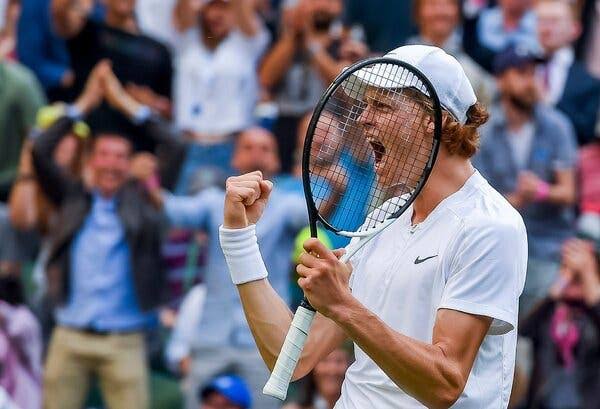
A rematch, a revenge tour, and a shot at back-to-back titles: why today's men's final between Jannik Sinner and Alexander Zverev is the most-watched two hours in tennis this year
LONDON
The grass at the All England Club has been trampled by two weeks of five-set marathons, rain delays, and a few genuine shocks, but by Sunday evening it will belong to just two men. Jannik Sinner, the imperious world No. 1, and Alexander Zverev, the towering German who has spent a decade chasing his first Grand Slam trophy, walk onto Centre Court this afternoon to decide the 2026 Wimbledon Championship — and with it, a good chunk of the storyline for the rest of the tennis season.
For Sinner, it is a chance to do something only a handful of men have managed this century: defend a Wimbledon title while still in his early twenties, cementing a stretch of dominance that increasingly looks less like a hot streak and more like an era. For Zverev, now 29 and a fixture in the sport's final four for the better part of ten years, it is something starker and more personal — a last, best chance to answer the question that has trailed him since his teens, the one about whether he can actually win the biggest match of his life.
The Road to the Final
Sinner arrived at this final in ruthless form, but the manner of his semifinal win is what has the tennis world buzzing. On Friday, he dismantled seven-time Wimbledon champion Novak Djokovic 6-4, 6-4, 6-4, a scoreline that undersells just how comprehensively he controlled the match. It was Sinner's latest, and perhaps most emphatic, chapter in what has become the sport's defining rivalry-in-transition: the ascending world No. 1 methodically overtaking the greatest player of his generation.
"It's the most special tournament we have, and it means a lot to me," Sinner said afterward, addressing the Centre Court crowd. "Of course, playing against Novak and what he has been showing, it's a true inspiration." He was candid, too, about the mental shift the match required. "I knew mentally that today I had to raise my level, which I've done," he said, crediting his team for putting him "in the position to be as competitive as possible."
Djokovic, for his part, offered a rare and blunt admission in defeat, saying he felt a "level or two" below his opponent — a startling concession from a man with 24 major titles to his name, and a signal of just how far Sinner's game has climbed.
Zverev's path to the final was less dramatic but no less decisive. He swept past British wildcard Arthur Fery 7-6(0), 6-2, 6-4, a performance built on the towering serve and increasingly assured net play that have quietly retooled his game over the past eighteen months. Where Zverev has historically wilted in the biggest moments — three previous major finals, three losses — this Wimbledon run has had a different tenor: calmer, more clinical, less haunted by the moments that got away in New York, Melbourne, and Paris.
What's at Stake
For Sinner, a win would make it back-to-back Wimbledon crowns and further extend a résumé that already includes multiple major titles won before his 25th birthday. It would also all but seal his position atop the men's game for the remainder of the season, with the hard-court swing and the US Open still to come. Tennis historians have already begun drawing comparisons to the sport's great peak-dominance stretches — the kind that redraw the record books rather than simply add to them.
For Zverev, the stakes are almost the inverse: not about extending a dynasty, but about finally, after a decade of near-misses, silencing the doubts. A first Grand Slam title on the lawns of the All England Club — arguably the most prestigious stage in the sport — would be a career-defining, narrative-flipping moment, transforming him overnight from "best player never to win a major" to Wimbledon champion.
Bookmakers and pundits alike have installed Sinner as the clear favorite, citing his semifinal demolition of Djokovic and his superior head-to-head record against Zverev on grass. But finals carry their own gravity, and Zverev's serve — one of the best in the men's game — gives him a puncher's chance against anyone, including the world No. 1.
Why It Matters Beyond the Scoreline
Grand Slam finals tend to function as checkpoints for how a sport is evolving, and this one is no exception. Sinner's rise represents the clearest changing-of-the-guard moment tennis has had since the early days of the "Big Three" era gave way to newer faces. Djokovic, now well into his late thirties, remains a threat deep into majors — but Friday's semifinal was as clear a passing-of-the-torch moment as the sport has produced in years.
Zverev's story, meanwhile, resonates well beyond hardcore tennis circles. It's a familiar sports narrative: immense, obvious talent, repeatedly falling just short at the very last hurdle. A win today would be as much a psychological triumph as an athletic one, the kind of result that reshapes how an athlete is remembered.
For casual fans tuning in for the spectacle of Wimbledon's whites-and-strawberries pageantry, today's final offers something rarer than a coronation: genuine uncertainty at the top of men's tennis for the first time in years, playing out in real time on the sport's most storied court.
The Bigger Picture
Win or lose, both men now turn toward a long hard-court season, with the US Open looming as the next major test. But for one Sunday afternoon in southwest London, the sport's attention narrows to a single patch of grass, two players, and a trophy that has crowned champions since 1877.
Play begins this afternoon on Centre Court. However it ends, tennis will wake up Monday with a slightly different shape to its hierarchy — either a young dominant force further entrenched, or a longtime near-miss finally, deliriously, a Grand Slam champion.




