Background
The alliance that produced the current Philippine government lasted barely two years. In 2022, Ferdinand Marcos Jr. and Sara Duterte ran as a joint ticket — the "UniTeam" — fusing the two most formidable political dynasties in the country: the family of the late dictator Ferdinand Marcos Sr., who ruled from the 1960s through the 1980s including a period of martial law and repression, and the family of Rodrigo Duterte, the strongman former president whose anti-drug campaign left thousands of mostly poor suspects dead. The ticket won overwhelmingly. The partnership then collapsed into open hostility, and by 2024 the two camps were conducting their feud in public.
The specific remark at the centre of this week's events was made during an online news conference in November 2024. Sara Duterte, then 46 and already estranged from the president, said that if she were killed she had arranged for a hitman to kill Marcos, his wife Liza Araneta-Marcos, and his cousin Martin Romualdez, then Speaker of the House of Representatives. Asked whether she was joking, she said she was not. She has since maintained that she was expressing fear for her own safety rather than issuing a threat. The remark triggered a criminal investigation and, according to officials at the time, a national security review.
The feud has also had a geopolitical dimension. Marcos has expanded defence cooperation with the United States and pushed back against Chinese coercion in the South China Sea, where Chinese vessels have used water cannon against Filipino ships and fishermen. Sara Duterte has been criticised for declining to condemn those actions. And in March 2025 her father was arrested on an International Criminal Court warrant and flown to The Hague; she has attacked the Marcos administration ever since for handing a former Philippine president to a court she says has no jurisdiction over the country. Rodrigo Duterte's trial on crimes-against-humanity charges is scheduled to begin in late November.

Key Developments
On Friday, September 4, a regional trial court in Quezon City, in Metro Manila, issued a warrant for the vice president's arrest on three counts of grave threats. The judges had first rejected a bid by her lawyers to defer the warrant. Her legal team had argued that she could not be criminally prosecuted while the same conduct was being examined in her impeachment trial; a Department of Justice spokesman confirmed the warrant and rejected that argument.
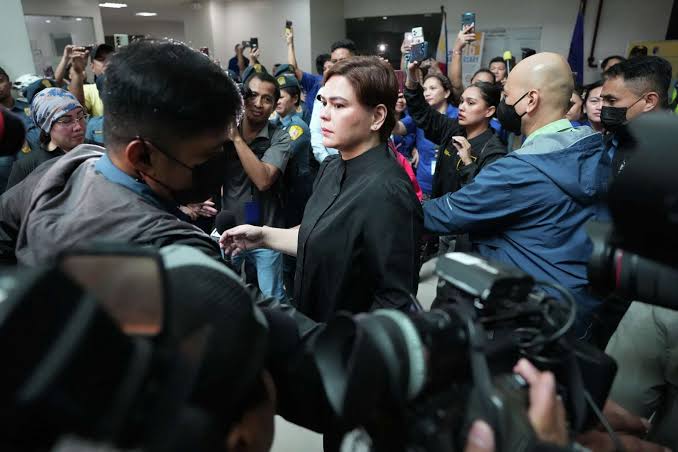
Duterte presented herself at the Quezon City justice hall the following morning, Saturday, September 5. Court staff took her fingerprints. Her attorney, Paul Lawrence Lim, said she posted 360,000 pesos — roughly $5,740, or about $1,900 per count — and the court lifted the warrant. She emerged in black to a crowd of supporters chanting her name, embraced a woman who was weeping, and displayed the court order lifting the warrant, saying her lawyers had instructed her to keep a copy on hand at all times.
She then made the case political. "If possible please go with me, because I do not feel safe with all these police personnel who are harassing those at my home, harassing me since 2023," she told reporters, asking them to surround her as she walked to her car. "What does this administration really want to do with me?" Lim said in a separate statement that she had "no intention of evading the law and will continue to exercise all her legal remedies."
The criminal exposure is modest. Grave threats under Philippine law carries a maximum of six months in jail. The political exposure is not modest at all, and it runs through a separate proceeding.
The Impeachment Track
Duterte is the first Philippine vice president to be impeached, and the first to be impeached twice. The first attempt, in February 2025, was voided: the Senate convened as an impeachment court in June 2025 only to remand the articles, and the Supreme Court subsequently ruled the complaint unconstitutional because earlier filings had triggered the constitutional one-year bar on successive impeachments.
Once that bar lapsed, new complaints were filed and formally initiated in February 2026. On May 11, 2026, the House of Representatives — dominated by Marcos allies — voted 257 to adopt articles of impeachment alleging betrayal of public trust, culpable violation of the Constitution, graft and corruption, and bribery, arising principally from the alleged misuse of confidential funds at the Office of the Vice President and the Department of Education, where she previously served as secretary. The threats against Marcos are also among the charges. The articles were transmitted on May 14; the Senate convened as an impeachment court on May 18 and opened the televised trial on July 6. It has now been running for roughly nine weeks, and Philippine reporting suggests it may extend beyond September.
A conviction in the Senate would remove her from office and — this is the decisive part — could permanently disqualify her from holding public office, ending her ambition to succeed Marcos when his single six-year term expires in 2028. A criminal conviction on the grave-threats charges could carry a similar disqualifying effect. Duterte denies all of the allegations and her office has said she will not appear in person at the Senate trial.
![]()
Reactions and the Political Backdrop
Duterte's camp casts the entire sequence as persecution by an unpopular president using the machinery of state against his most likely successor. That argument has real traction, because the polling is lopsided in her favour. Pulse Asia surveys through 2026 have shown her consistently ahead of Marcos on both approval and trust: 55 percent approval to his 36 percent in March, and around 56 percent to his 29 percent by July, when his disapproval reached 50 percent and distrust 51 percent. A Pulse Asia survey found that in a hypothetical 2028 presidential vote, 51 percent would choose Duterte against 41 percent for former vice president Leni Robredo.
The Marcos camp's position is that the vice president is being held to ordinary legal standards for extraordinary conduct — that a sitting official who publicly announced a contingency plan to assassinate the president and the first lady cannot simply be left unexamined, and that the corruption allegations concerning confidential funds are independently serious. The House's overwhelming impeachment vote in May reflects how firmly the legislature has aligned behind that view.
The confrontation is unfolding against an ugly economic backdrop. The peso hit successive record lows through early September, closing at 62.59 to the dollar on Friday, September 4 — its fifth record low in six sessions, with an intraday low reported around 62.71. Analysts attribute the slide to a strengthening dollar, rising US Treasury yields, expectations of a Federal Reserve rate move, and higher oil prices driven by the Strait of Hormuz crisis. A currency in free fall does not help an administration already polling at 29 percent.
What's Next
Three proceedings now advance in parallel, and they interact. The criminal case in Quezon City will move to arraignment and trial, with Duterte's lawyers continuing to argue that it should be suspended while the impeachment court examines the same conduct. The Senate impeachment trial continues, with a verdict expected to determine whether she can stand in 2028. And in November, her father goes on trial in The Hague — a proceeding certain to reactivate the Duterte base and to give her a platform to argue that both Dutertes are being destroyed by the same political project.
Two structural features make this dangerous for the Philippines. The first is that the country's institutions are being asked to adjudicate a dynastic power struggle in which almost every participant has an interest in the outcome: a House controlled by the president's allies, a Senate whose members have their own 2028 ambitions, and courts operating under intense public scrutiny. The second is that the more successful the legal campaign against Duterte becomes, the more plausible her narrative of persecution looks to the majority of Filipinos who already trust her more than they trust the president.
There is no obvious off-ramp. Marcos cannot run again. Duterte is the front-runner to replace him and is facing removal and disqualification. Whichever way the Senate votes, roughly half the country will regard the verdict as illegitimate — and the fingerprinting of a sitting vice president in a Quezon City courthouse on a Saturday morning will be remembered as the moment the feud stopped being rhetorical.
Published By | News Editor