Background
On May 31, 2026, Colombians went to the polls in a first-round presidential election that produced no outright winner and set up one of the most consequential runoffs in the country's recent history. Abelardo de la Espriella, a combative criminal defense lawyer and political outsider with no prior experience in elected office, topped the first round with roughly 43.7 percent of the vote, edging out a fractured field of candidates from the traditional left and center-right. His opponent in the June 21 runoff was Iván Cepeda, a veteran leftist senator and the political heir apparent to outgoing President Gustavo Petro. Cepeda carried deep symbolic weight of his own: his father, Manuel Cepeda, a senator for the leftist Unión Patriótica party, was assassinated by paramilitary forces in 1994, and the younger Cepeda built his career investigating state and paramilitary violence and advocating for victims of Colombia's decades-long armed conflict.
The runoff was framed by nearly every outlet covering it as a referendum on Petro's presidency and, more broadly, on the future of Colombia's fraught relationship with the United States. De la Espriella campaigned as a hardline law-and-order candidate, promising to abandon Petro's strategy of negotiating with armed groups such as the ELN guerrilla movement and the Gulf Clan drug-trafficking organization, and to replace it with aggressive military and prison-based responses modeled loosely on El Salvador's mass-incarceration approach to gang violence. When the votes were counted, de la Espriella narrowly prevailed, winning about 49.7 percent to Cepeda's 48.7 percent — a margin of roughly 250,000 votes out of more than 25 million cast. International observers, including missions from the Organization of American States and the European Union, found no evidence of major irregularities, but Petro and his allies have continued to dispute the result in the weeks since, alleging fraud and, at times, suggesting the vote was influenced by foreign actors.
The weeks between the runoff and the August 7 inauguration were unusually tense even by Colombian standards. Petro, in the final months of his term, repeatedly clashed with the incoming administration over the handover of power. He ordered that no military installation be used to host the inauguration, forcing organizers to relocate the ceremony away from a planned military-base venue. De la Espriella's transition team pressed ahead regardless, ultimately settling on Arena USC, an indoor sports venue on the campus of Universidad Santiago de Cali, as the site for the swearing-in — a choice announced days before the event.
Key Developments
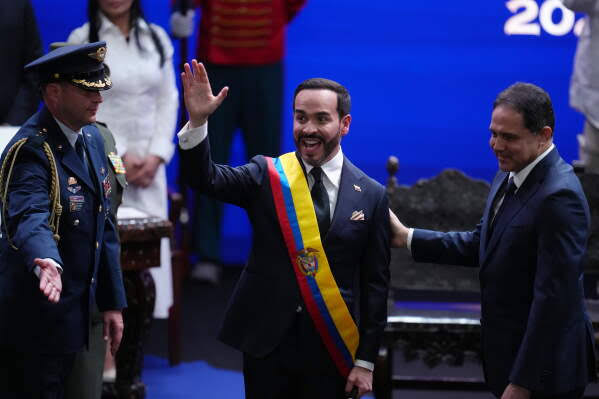
Abelardo de la Espriella took the oath of office at 3:00 p.m. local time on Friday, August 7, becoming Colombia's next president and, with running mate José Manuel Restrepo, beginning a four-year term. The ceremony's location alone made history: it was the first time in more than a century that an elected Colombian president was sworn in outside the capital, Bogotá. Organizers and de la Espriella's team framed the choice of Cali — Colombia's third-largest city and the historic capital of the country's southwest — as a deliberate symbol of decentralization and a break from what the incoming administration described as an out-of-touch Bogotá political establishment, even as critics suggested the move was as much a political statement aimed at Petro as it was a substantive governing choice.
Security for the event was extraordinary. Colombian authorities deployed roughly 11,000 soldiers and police officers to secure Cali by land, sea and air, reflecting both the volatile political atmosphere surrounding the transfer of power and a bombing days earlier near a police station elsewhere in the country that injured eleven people and heightened fears of violence timed to the inauguration. Guerrilla factions that had been in talks with the outgoing Petro government issued public warnings to de la Espriella in the run-up to the ceremony, underscoring the stakes of his promised reversal of Petro's negotiated-peace approach.
In his early remarks and in policy moves rolled out in the days before taking office, de la Espriella signaled a sharp break from his predecessor. He announced the elimination of the Office of the High Commissioner for Peace — the institutional centerpiece of Petro's efforts to negotiate ceasefires and demobilization agreements with the ELN and the Gulf Clan — and said it would be replaced by a new High Commissioner for Security. He has described Petro-era negotiations as a “false peace” and has instead promised a law-and-order campaign built around expanded military operations against armed groups and the construction of large-capacity prisons modeled on El Salvador's mega-prison system. He also ordered the closure of fourteen Colombian embassies and fifteen consulates around the world, including missions in Cuba, Nicaragua, Algeria, Hungary, Romania and several African and Caribbean nations, and confirmed that Colombia would formally sever diplomatic relations with Cuba and Nicaragua, both of which he has labeled dictatorships. His government has framed the closures as a fiscal austerity measure intended to redirect spending toward domestic security, health, education and infrastructure priorities.
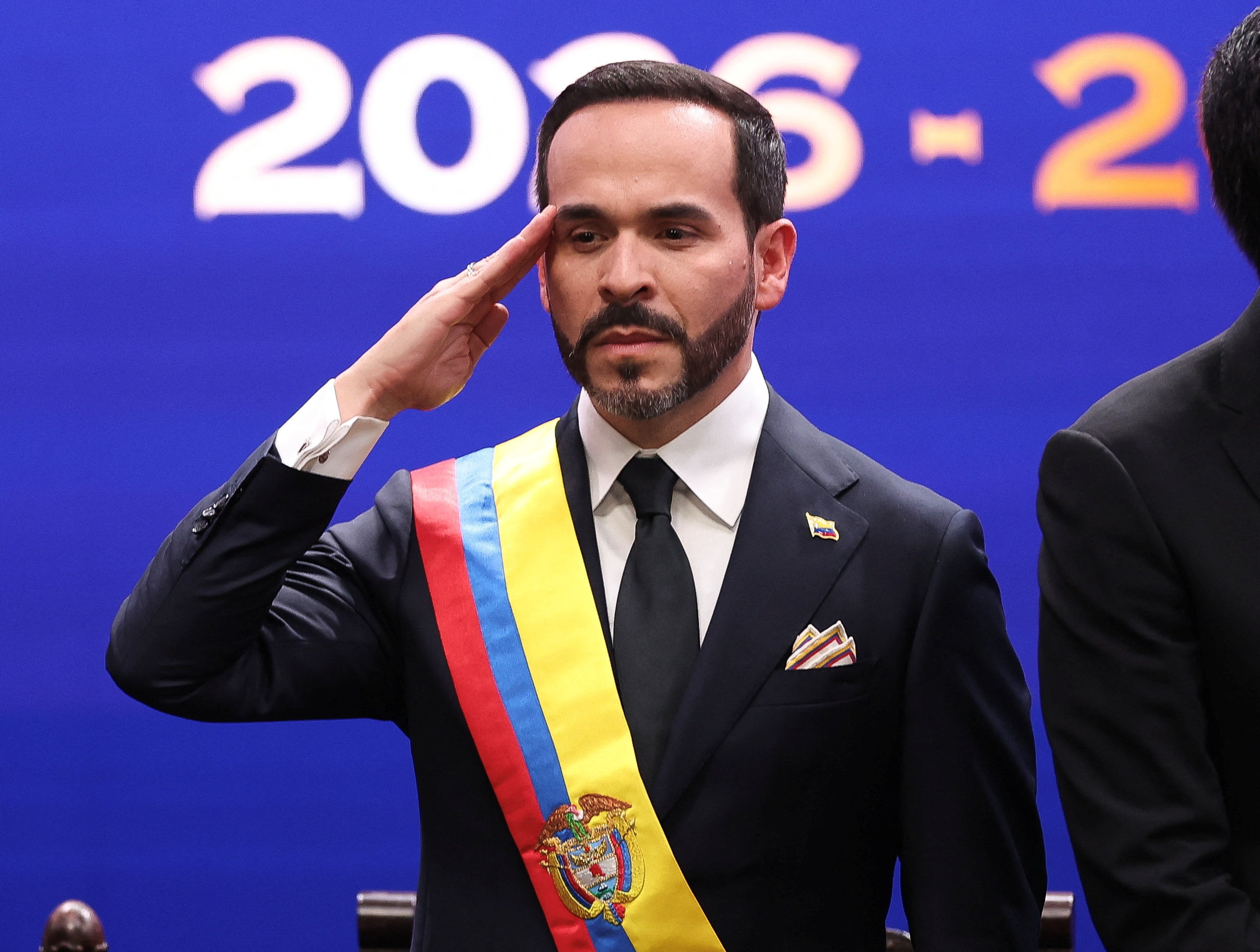
The inauguration drew one of the largest gatherings of foreign dignitaries in Colombian history, reflecting a broader realignment among Latin America's right-leaning governments. Attendees included Ecuadorian President Daniel Noboa, Argentine President Javier Milei, Paraguayan President Santiago Peña, Peru's newly inaugurated President Keiko Fujimori, Chile's José Antonio Kast, and Spain's King Felipe VI. Notably absent were both U.S. President Donald Trump and Secretary of State Marco Rubio, who cited commitments in Washington; the United States instead sent a delegation reportedly including the U.S. attorney general, the director of the Drug Enforcement Administration, and Senator Bernie Moreno.
Reactions
Outgoing President Petro has been the most vocal critic of the transition, repeatedly branding de la Espriella's government “illegitimate” and alleging that the election was marked by foreign-backed fraud. In the days before the inauguration, Petro issued what several regional outlets characterized as warnings — and what his critics called thinly veiled threats — about the potential for civil unrest during the handover of power, statements that alarmed observers given Colombia's history of political violence. De la Espriella's camp, for its part, has accused Petro loyalists of attempting to orchestrate a “coup” against the incoming government, though it has offered little detailed evidence for the claim, leaving competing, unresolved allegations hanging over the transition.
Regional allies were considerably more welcoming. Argentina's Javier Milei, who has positioned himself as the standard-bearer of a new Latin American right, declared that “the region wants to return to the path of freedom and security” and framed de la Espriella's victory, alongside Fujimori's in Peru days earlier, as evidence of a coordinated ideological shift across the continent. Colombian officials close to de la Espriella have signaled that the incoming government intends not merely to join this emerging right-leaning bloc but to serve as one of its most assertive members, a stance likely to reshape Colombia's role in regional forums such as the Organization of American States and its bilateral relationships with left-led governments in Venezuela, Cuba, Nicaragua and, until recently, Colombia itself.
Human rights organizations and some regional analysts have voiced concern over the practical implications of dismantling Petro's peace architecture. Advocacy groups that supported the ELN and Gulf Clan negotiations warn that abruptly ending talks and pivoting to a purely militarized strategy risks reigniting violence in rural regions where armed groups have significant territorial control, while proponents of de la Espriella's approach argue that years of negotiation produced few durable security gains and that a harder line is overdue.
What's Next
De la Espriella now faces the difficult task of translating an aggressive campaign platform into governance, starting with the practical unwinding of Petro-era institutions such as the peace commissioner's office and the redeployment of security forces against groups that, until Friday, had been in active negotiations with the state. How the ELN, the Gulf Clan and other armed factions respond to the collapse of those talks — with renewed violence, a wait-and-see posture, or attempts to negotiate with the new administration on different terms — will be an early test of his security strategy. His government's mega-prison plans, modeled on El Salvador's controversial approach, are also likely to draw scrutiny from human rights groups and could face legal and logistical obstacles well before any new facilities are built.
On the diplomatic front, the closure of fourteen embassies and the formal rupture with Cuba and Nicaragua will reshape Colombia's foreign service and its posture in multilateral bodies, while his emerging alignment with Milei, Fujimori, Kast, Noboa and Peña points toward a more consolidated right-leaning bloc in Latin American diplomacy — one that is likely to find a receptive partner in the Trump administration even as Trump and Rubio's absence from the inauguration itself raised some questions about the immediacy of that relationship. Domestically, Petro's unresolved fraud allegations and warnings of unrest mean the political temperature around the transition is unlikely to cool quickly, and how de la Espriella manages relations with a Petro-aligned opposition — including in Colombia's Congress — will shape his ability to govern in his first months in office.guration/
Published By | News Editor