World Politics
Background
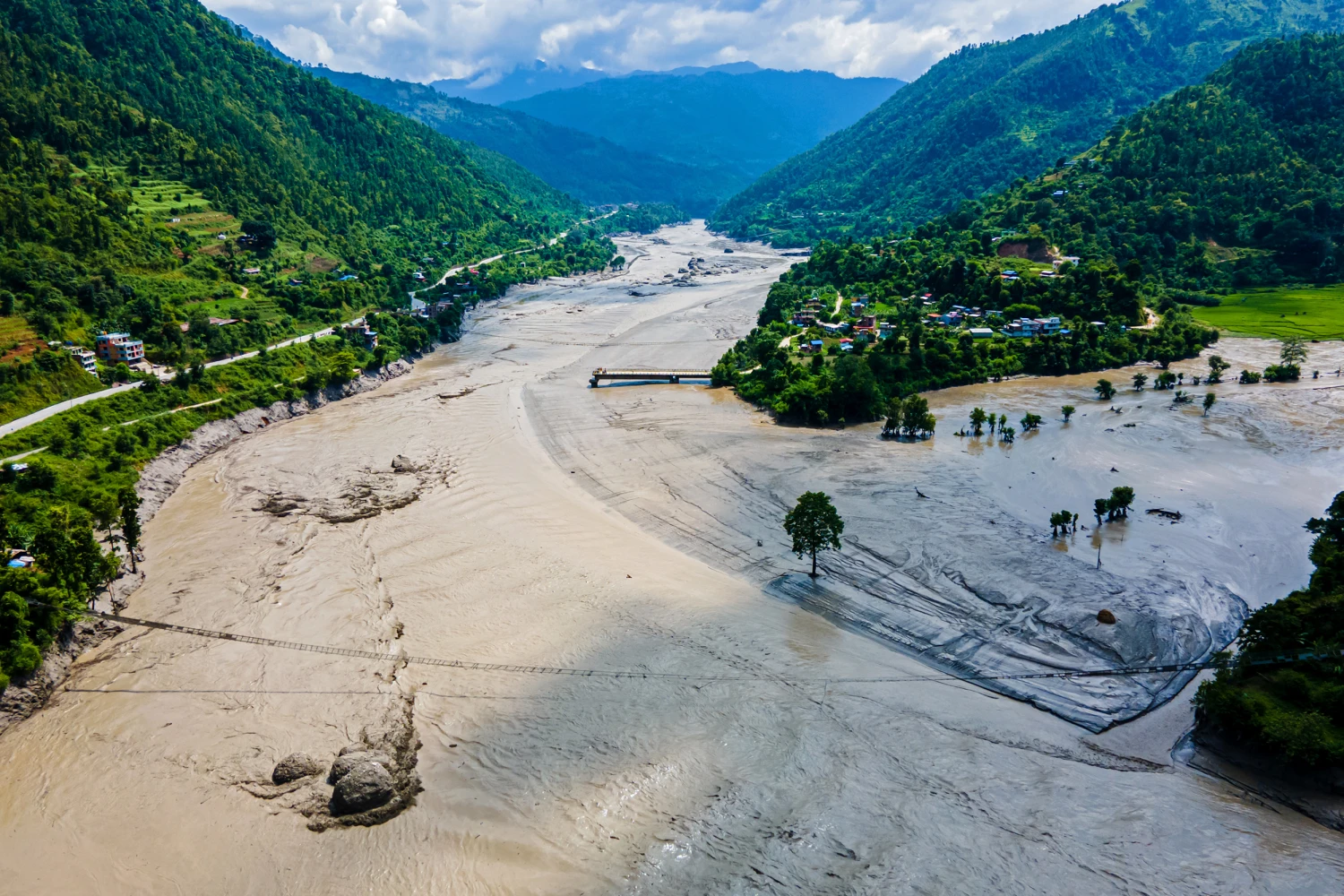
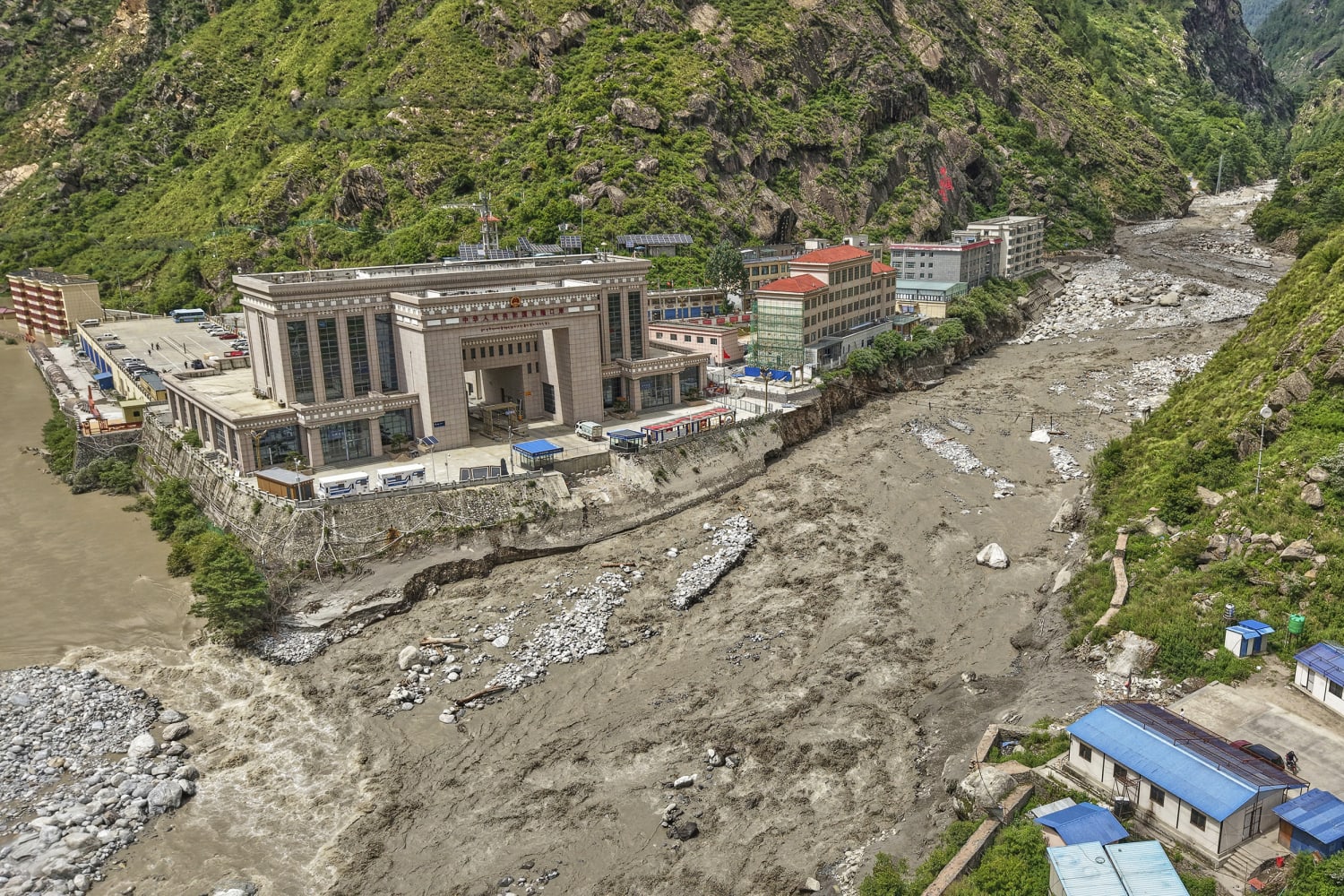
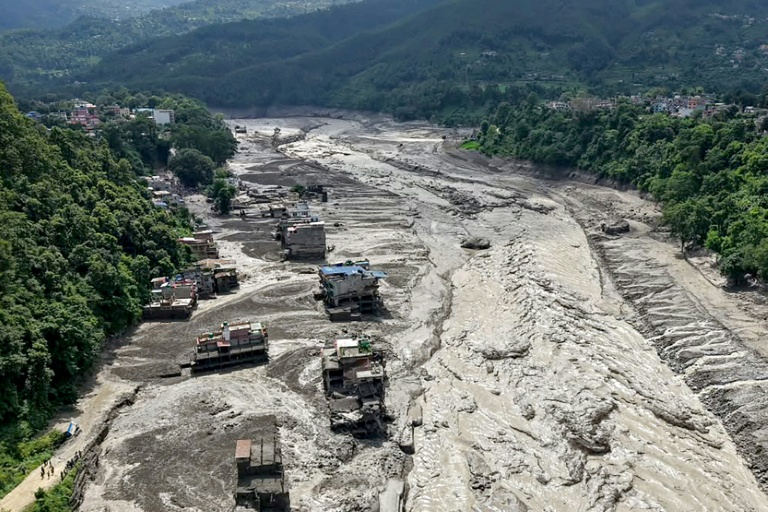
On the morning of August 26, 2026, part of the glacier sitting on the northern slopes of Langtang Lirung, a 7,200-metre peak inside Langtang National Park, broke away. The collapse triggered a debris avalanche that funnelled into the Bhotekoshi river valley and accelerated into a high-velocity flood carrying ice, mud, boulders and shattered forest tens of kilometres downstream through the districts of Rasuwa and Nuwakot. Settlements including Betrawati and Syabrubesi were partly erased. Bridges, roads, hydropower intakes and whole terraces of farmland went with them.
The human toll has been counted slowly and upward. As of Friday, September 11, Nepal's government reported 1,385 bodies recovered and 5,130 people still missing — among them roughly 600 foreign nationals from about 35 countries, a reflection of how many trekkers and workers were in the Langtang corridor at the height of the season. Figures published on different dates by different agencies differ: earlier tallies gave 1,341 recovered and 4,044 missing on September 6, while other reporting has cited 1,367 or 1,377 dead and 5,326 missing, alongside nearly 6,800 injured and more than 9,000 rescued. The discrepancies reflect the mechanics of a disaster in which bodies are still being recovered from mud and river channels weeks later, rather than any dispute about scale. Twenty of the first 669 victims had been identified before the government began preparing mass burials in late August. Survivors were pulled alive from the Trishuli 3A hydropower tunnel nine days after the flood.
A Rapid Damage and Needs Assessment carried out jointly by the National Planning Commission and the National Disaster Risk Reduction and Management Authority put the cost of rebuilding at Rs723.31 billion, roughly US$4.7–5 billion. Infrastructure accounts for the bulk of it — about Rs473.57 billion — with energy and roads the worst affected. Thirteen hydropower projects with a combined capacity of 759 megawatts were damaged, along with five solar plants totalling 24 MW. Rebuilding the flood-hit education sector alone is estimated at Rs2.34 billion. For a country whose entire annual national budget is a fraction of the reconstruction bill, the arithmetic is not survivable through domestic resources.
Key Developments
What makes this a political story rather than only a humanitarian one is the argument Nepal has chosen to make with it. Rather than framing the flood purely as a natural disaster requiring charity, Kathmandu is framing it as a climate harm requiring compensation — and has taken that claim to the United Nations mechanism built for exactly this purpose, the Fund for responding to Loss and Damage.
The fund, agreed at COP27 in 2022 and operationalized over the following years, was the product of three decades of pressure from developing countries for a facility that would address damage already done rather than emissions still to be avoided. It is running an initial trial phase known as the Barbados Implementation Modalities: an envelope of roughly US$250 million, disbursed as grants of US$5–20 million to country-led proposals, with an application window that opened on December 15, 2025, closed on June 15, 2026, and approvals beginning in July 2026. The fund's board comprises 26 members — 12 from developed countries and 14 representing developing-country constituencies — and currently holds about US$342 million in deposits.
Nepal has two separate claims in play, and conflating them has produced some confusion in international coverage. The first is a US$20 million approval under the Barbados modalities, confirmed in early September on the basis of three proposals Nepal submitted earlier in 2026 — before the Bhotekoshi flood happened. Maheshwar Dhakal, an alternate member of the fund's board and the climate change focal point at Nepal's Ministry of Forests and Environment, confirmed the figure, adding that the fund has asked the Alternative Energy Promotion Centre to address reviewers' comments before money is released. The second is an urgent, separate request sent to the board on August 31, specifically seeking emergency financing for the Bhotekoshi disaster. That request is still pending.
The politics around the pending request are revealing. According to Dhakal, the appeal has drawn formal expressions of support from country groupings representing Asia, Africa, Latin America, the least developed countries and small island developing states, which have jointly pressed the developed-country members of the board from Asia and Europe to convene promptly and decide. On September 8, board members and alternates representing small island developing states wrote to Adao Soares Barbosa, chair of the Least Developed Countries Group and a board member, backing Nepal's call. The Group of Latin American and Caribbean Countries wrote in similar terms. In other words, the Global South bloc has decided to make Nepal a test case, and is treating the board's speed of response as a measure of whether the fund is real.
Nepal's moral case is the one climate-vulnerable states have made for years, stated in unusually stark numbers. The country is responsible for less than 0.1 per cent of global greenhouse gas emissions. It has more than 46 per cent forest cover, an extensive river system, and a Himalayan cryosphere that is warming faster than the global average. Glacial retreat and the proliferation of unstable moraine-dammed lakes are among the best-documented consequences of warming anywhere on earth. Scientists who examined the Rasuwa event have described a complex chain of triggers rather than a single cause, and formal attribution studies take time — a caveat that matters, because the fund will have to decide how much causal proof it requires before paying out.
Reactions
Prime Minister Balendra Shah has made the claim personal. Shah, the 35-year-old rapper-turned-mayor who became Nepal's youngest-ever prime minister in March 2026 after the Rastriya Swatantra Party's landslide election win — itself the product of the Gen Z uprising that brought down K.P. Sharma Oli's government in September 2025 — had originally planned to send Foreign Minister Shisir Khanal to the United Nations General Assembly. After the flood he decided to go himself. He will travel to New York on September 22, address the 81st General Assembly on September 24, and attend a high-level climate meeting convened by Secretary-General António Guterres.
Foreign Secretary Amrit Bahadur Rai said on Friday that Shah will press the case for climate justice directly, calling on wealthy countries to make technology and climate finance available to Nepal on affordable terms for climate-resilient infrastructure, climate-smart agriculture and institutional capacity, and to ensure that Nepal receives "immediate and appropriate compensation" through mechanisms including the loss and damage fund. Nepal will host a side event on September 25 titled "Sagarmatha to the Sea: A Call to Action for a Climate-Resilient Future," led by Khanal, since Shah leaves New York that day. Rai also framed the trip as a chance to brief the world on the Gen Z movement, the election that followed, and the mandate of the new government.
The diplomatic thinness of the visit is itself notable. Beyond the meeting with Guterres, Nepali diplomats in New York report no confirmed bilateral meetings; requests have come in, but the government has not prioritized them. The leaders of both of Nepal's giant neighbours, India and China, are not attending. Shah may also miss the reception hosted by President Donald Trump on the evening of September 22, because his flight lands that day. A small state is arriving to make a large claim with very little bilateral scaffolding behind it.
Domestically, the pressure runs in the other direction. Nepal is looking for grants rather than loans for reconstruction, but officials have conceded that borrowing may be unavoidable — precisely the outcome climate-justice advocates warn against, since debt-financed recovery from a harm you did not cause compounds the original injustice. Kathmandu is meanwhile dealing with an LPG supply crisis caused by transport disruption, a ruined education sector, and survivors with disabilities for whom, as one local report put it, surviving the flood was only the beginning.
What's Next
Three things are worth watching. The first is whether the fund's board convenes and rules on Nepal's emergency request before the General Assembly, or lets it drift. The fund has no rapid-disbursement policy and no small-grants window yet; those instruments were still under negotiation at COP30, with the G77 and China, the least developed countries and the Alliance of Small Island States pushing to accelerate them. Nepal's request is arriving through a door that has not been built. A decision within weeks would suggest the mechanism can respond to an actual disaster; silence would confirm the critique that the fund is symbolic.
The second is the gap between the ask and the architecture. Even if Nepal received the maximum single grant under the current modalities, US$20 million, it would cover well under one per cent of a US$4.7 billion reconstruction bill. The entire trial envelope of US$250 million is roughly five per cent of the damage from one flood in one river valley. That arithmetic is the strongest argument Global South negotiators have going into COP31, and Shah's General Assembly speech is likely to deploy it directly.
The third is precedent. If the board grants emergency financing on the basis of an event whose attribution to warming is scientifically plausible but not formally quantified, it establishes a threshold that other claimants will use. If it declines, or insists on rigorous attribution first, it signals that the fund will operate more like an insurer than a compensator. Either way, a glacier that broke in Langtang on an August morning has become the case on which the world's newest piece of climate governance will be judged.
Published By | News Editor