Written By | Health News Agencies
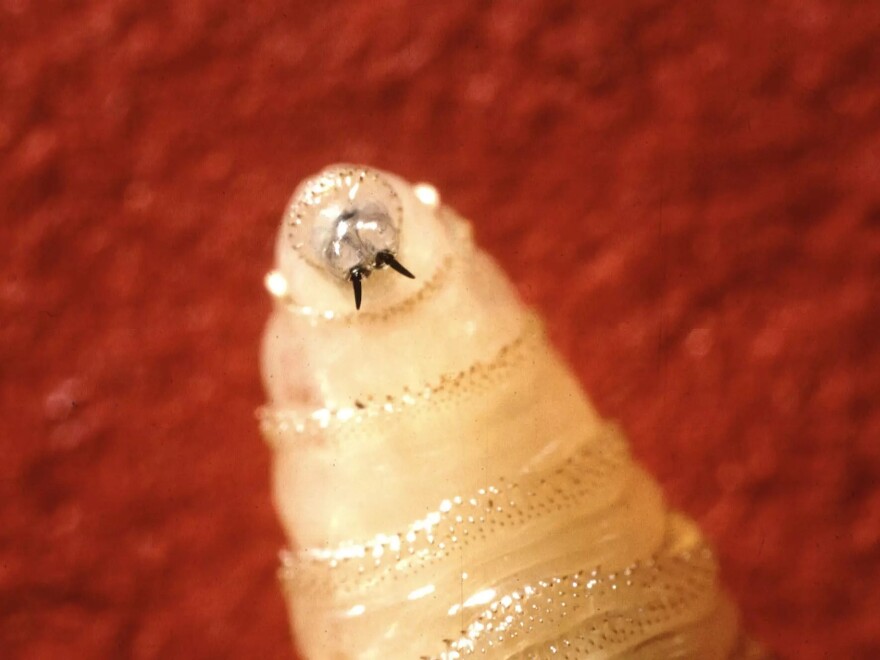
That parasite, the New World screwworm (Cochliomyia hominivorax), is back
MISSION, TEXAS
The wound on the calf's hindquarters looked, at first, like nothing more than a bad scrape. Within days, Texas Animal Health Commission inspectors found it crawling — writhing with hook-mouthed larvae that had bored straight into living muscle. The calf, grazing in Zavala County, had become the first confirmed U.S. case in six decades of a parasite so feared that American and Mexican governments spent half a century and billions of dollars trying to erase it from the Western Hemisphere.
That parasite, the New World screwworm (Cochliomyia hominivorax), is back. In the two weeks since its June 3 confirmation, it has triggered a scale of emergency response rarely seen outside a human pandemic: a Level 3 CDC activation, a Texas statewide emergency declaration, a shuttered southern border for livestock, and an FDA scrambling to authorize new drugs to keep pace.
A Monster America Thought It Had Killed
Most maggots eat dead tissue. New World screwworm larvae do the opposite. Armed with sharp internal hooks, they tunnel into living, healthy flesh and feed on it while the host is still alive, enlarging the wound as they grow. Left untreated in livestock, an infestation can kill an animal within one to two weeks. In humans, the condition — called myiasis — is rare but documented and can be fatal without medical intervention.
The United States eliminated the screwworm domestically in 1966 using a technique that still sounds like science fiction: breeding hundreds of millions of sterilized male flies and releasing them by air across infested zones. Because females mate only once, every sterile male that won a mate effectively removed her from the breeding population. Generation by generation, the species collapsed across the U.S. and most of Central America, pushed back to a permanent "barrier zone" in Panama maintained jointly under a program called COPEG.
How It Slipped Back In
That barrier held for nearly three decades — until it didn't. Screwworm cases in Panama spiked from roughly 25 a year to more than 6,500 in 2023, and the parasite began marching north through Central America faster than officials could contain it. By late 2024, it had reached Mexico; Mexican authorities have now logged more than 26,000 cases since November 2024.
The USDA shut down livestock imports across the entire southern border — a closure still in effect today. Despite that, the parasite found its way in. APHIS confirmed the Zavala County calf case on June 3, and within days had confirmed additional infestations across four Texas counties. A case initially attributed to Texas was later traced to Lea County, New Mexico — handing New Mexico its first confirmed case and expanding the outbreak to a second state. As of the most recent federal count, 12 confirmed cases have been logged in domestic animals.
Three Agencies, One Emergency
The response has moved with unusual speed. On June 11, the CDC activated a Level 3 emergency operations center to support the USDA and Texas health officials. Governor Greg Abbott activated the State Emergency Operations Center, and state officials drew a 20-kilometer quarantine zone around Zavala County, restricting the movement of warm-blooded animals in and out of the infested area.
USDA has assembled an Incident Command Team and is expediting the release of sterile flies into the newly infested zones. A new facility under construction at Moore Air Force Base in Texas is designed to produce up to 300 million sterile flies a week, on top of the 100 million already produced at the COPEG facility in Panama, which the USDA estimates has saved the U.S. cattle industry roughly $2.3 billion annually.
Congress has poured emergency money into the fight, with $109.8 million allocated in 2023 and another $165 million in 2024 — funding that now looks prescient.
The FDA Joins the Fight
On June 11 — the same day the CDC activated its emergency center — the FDA issued an emergency use authorization for a generic, over-the-counter version of nitenpyram tablets to treat screwworm infestations in dogs, cats, puppies, and kittens. It's the first generic animal drug ever authorized specifically against this parasite, following a string of emergency authorizations issued over the past year. A Federal Register notice in April 2026 had already authorized emergency use of four separate animal drugs, underscoring how seriously federal regulators have been taking this threat even before the first U.S. case.
Armed with sharp internal hooks, they tunnel into living, healthy flesh and feed on it while the host is still alive, enlarging the wound as they grow
Should You Be Worried?
For now, federal health officials emphasize that the danger to ordinary Americans remains low. "Currently, there are no reported human cases in the United States, and the risk to the public remains low," the CDC has stated.
But veterinary parasitologists who have tracked the outbreak's march north are far less reassured. They caution that the Texas and New Mexico detections are unlikely to be the last — the underlying drivers of the parasite's resurgence haven't gone away just because a border is technically closed.
What This Means for You
If you live in or near affected counties: check livestock and outdoor pets daily for open wounds, and report any maggot-infested wound to the Texas Animal Health Commission or USDA immediately.
If you own dogs or cats in the Southwest: ask your veterinarian about the newly authorized generic nitenpyram treatment, and keep wounds clean and covered.
If you're traveling to Mexico, Central America, or the Caribbean: treat any wound immediately and seek medical attention if it develops unusual swelling, visible movement, or a foul odor — the hallmark signs of myiasis.
If you work in the cattle industry: expect continued disruption at the southern border, with no timeline set for reopening livestock imports from Mexico.
The Bottom Line
The New World screwworm's return marks the first time in 60 years that this particular nightmare has laid eggs on American soil. The eradication campaign that beat it the first time took decades, cost hundreds of millions of dollars, and depended on sustained cross-border cooperation that is now being tested all over again. Whether the current outbreak stays confined to a handful of counties or becomes the opening chapter of a longer fight depends on how quickly the sterile-fly pipeline can be scaled back up — and how much further the parasite has already spread before anyone noticed.
Sources: CDC; USDA APHIS; Texas Animal Health Commission; FDA; Congressional Research Service; CIDRAP; Newsweek; Fox4 News




