Written By | International News Agencies
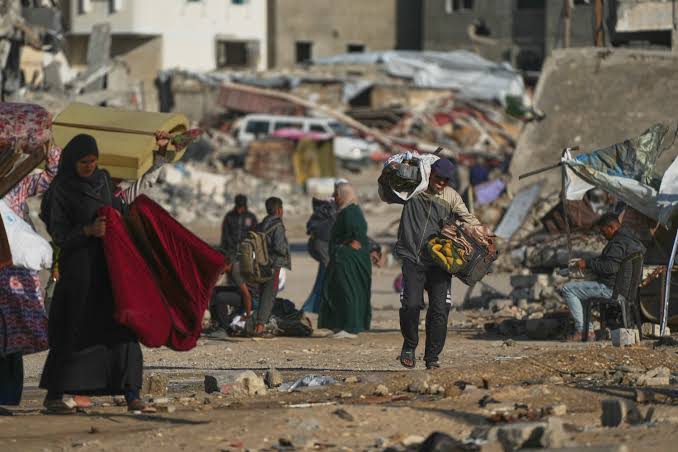
Officials say prospective residents of the pilot zone would undergo security screening before being allowed to move in
World Politics
Background
The move traces back to November 17, 2025, when the United Nations Security Council adopted Resolution 2803, endorsing the U.S.-brokered "Comprehensive Plan to End the Gaza Conflict." That plan established the ceasefire that has held, with periodic violations, since October 2025; secured the release of all remaining hostages; created the Board of Peace, a transitional governance body chaired by U.S. President Donald Trump, to oversee Gaza's postwar administration; and authorized the deployment of an International Stabilization Force tasked with monitoring the ceasefire, overseeing the withdrawal of Israeli forces, and supervising the disarmament of Hamas.
Nine months on, implementation has lagged far behind the plan's ambitions. As of mid-July, Israeli forces controlled roughly 70 percent of the Gaza Strip, up from about half at the ceasefire's outset, and reconstruction work had barely begun. The Board of Peace has struggled to secure meaningful concessions from either side: Hamas has refused to disarm, while Israel has continued near-daily strikes inside Gaza and restricted humanitarian aid and reconstruction material, according to assessments from groups tracking the ceasefire's implementation. Trump's board has also significantly scaled back its reconstruction ambitions, moving from an original vision of placing the entire territory under a Palestinian-run administration to a far more modest pilot project centered on temporary housing.
It is against this backdrop of stalled progress and mutual distrust that Israel's security cabinet took up the question of the stabilization force's actual deployment in late July, a step that, if implemented, would represent the first real test of the plan's central security mechanism. The force itself had existed largely on paper since it was authorized last November, with troop-contributing countries slow to commit personnel absent clarity on rules of engagement, legal protections, and how far Israel would allow the mission to operate independently of its own military. Diplomats involved in the process have described the intervening months as a prolonged negotiation over sovereignty in all but name, with Israel insisting on retaining final say over where and when foreign troops could deploy.
Key Developments
On July 26, Israel's security cabinet voted to approve the legal framework allowing the International Stabilization Force to begin entering Gaza. The vote was not unanimous: National Security Minister Itamar Ben-Gvir voted against the move, arguing that Hamas had failed to meet its own commitments under the ceasefire and that Israel was therefore not obligated to proceed with the force's entry. Foreign Minister Gideon Sa'ar voted in favor.
Under the approved framework, an initial contingent of roughly 200 personnel would deploy from what officials described as "friendly countries," with Uganda and Morocco named as the first contributors; Kosovo, Albania and Kazakhstan have also been named among the countries expected to contribute troops, and Morocco is ultimately expected to send roughly 500 soldiers, the largest single national contingent. Each country's contingent reportedly requires separate, individual Israeli approval before it can enter Gaza, a mechanism that gives Israel effective veto power over the pace and composition of the deployment.
The plan's first concrete test is expected to be a pilot humanitarian zone in the Rafah area of southern Gaza. Under the arrangement, Israeli troops would withdraw from a defined area, to be replaced by stabilization force personnel, while the Board of Peace's reconstruction effort begins with the construction of temporary, portable housing intended to accommodate tens of thousands of displaced Palestinians — a fraction of Gaza's roughly two million residents, most of whom remain displaced. Officials say prospective residents of the pilot zone would undergo security screening before being allowed to move in. A senior Israeli official cautioned, however, that the military intends to continue holding the so-called "yellow line" marking the boundary of Israeli-controlled territory and will not withdraw further unless and until Hamas disarms — a condition Hamas has consistently rejected. No firm timeline has been set for when the first units will actually arrive on the ground. Officials familiar with the planning say the Board of Peace views the Rafah pilot as a proof of concept: if the zone can demonstrate that Palestinian civilians can live under joint international-Israeli security arrangements without a resurgence of violence, planners hope it could be used to justify expanding the model to other parts of Gaza still under Israeli military control.
Reactions
Reaction inside Gaza has been cautious rather than celebratory. Conflict researchers cited by regional outlets suggest that after nearly two years of war, trust in nearly all parties to the conflict — Israel, Hamas, and international mediators alike — has "largely collapsed," leaving many residents focused less on the political architecture of any peacekeeping arrangement than on basic survival, meaning a foreign force capable of reducing violence and enabling reconstruction could find grudging acceptance regardless of its provenance.
Hamas's position has been more openly ambivalent. The group formally rejected the terms of the underlying UN Security Council resolution when it was adopted, and it has said explicitly that it will not accept foreign interference in Gaza's "internal affairs." At the same time, Hamas officials have signaled some openness to the presence of an international peacekeeping force more narrowly focused on monitoring the ceasefire, suggesting the group's objections center on sovereignty and governance rather than a peacekeeping presence per se. Most Arab states that have engaged with the plan have expressed broad support for both the stabilization force and the wider peace framework, even as Palestinian political factions remain divided over its terms. Within Israel, the cabinet vote exposed familiar fault lines, with Ben-Gvir's hardline coalition partners continuing to argue that any concession to the international force rewards Hamas's refusal to disarm, a critique likely to resurface as further contingents seek approval to deploy. In Washington, the Trump administration has publicly welcomed the cabinet's vote as evidence the broader peace framework is still advancing, even as officials privately acknowledge that the scaled-down scope of the initial deployment falls well short of what was originally envisioned when the plan was unveiled.
What's Next
The coming weeks are likely to focus on the practical mechanics of deployment: which countries' contingents receive Israeli approval first, how quickly the Rafah pilot zone can be stood up, and whether the promised temporary housing construction can begin on any meaningful timeline. Given that each national contingent needs individual sign-off from Israel, analysts expect the rollout to be gradual and closely managed by Jerusalem, with the pace likely to become a barometer of how much genuine latitude Israel is prepared to grant the international force.
The larger and more consequential question is whether the force's arrival can break the impasse over Hamas's disarmament, which both the Board of Peace and Israel have identified as the central precondition for any broader Israeli withdrawal and for the reconstruction effort to scale beyond its current pilot phase. Nine months of stalled implementation have left both outside observers and Gazans themselves skeptical that this latest step will fundamentally change the trajectory of the conflict, particularly given Israel's continued military operations and its retained control over the bulk of the territory. Continued attention is also expected on the Trump administration's Board of Peace, which faces mounting criticism over the gap between its original, sweeping reconstruction vision and the far more limited pilot project now underway. How the force's early performance in Rafah is judged — by Gazans, by Hamas, and by the international community — is likely to shape whether the broader peace plan gains momentum or continues to drift, as it largely has since the ceasefire took hold last October.



