Written By | Business Experts
Museveni Commissions NEC Meat and Beans Processing Factory in Gomba
Kisozi, Gomba
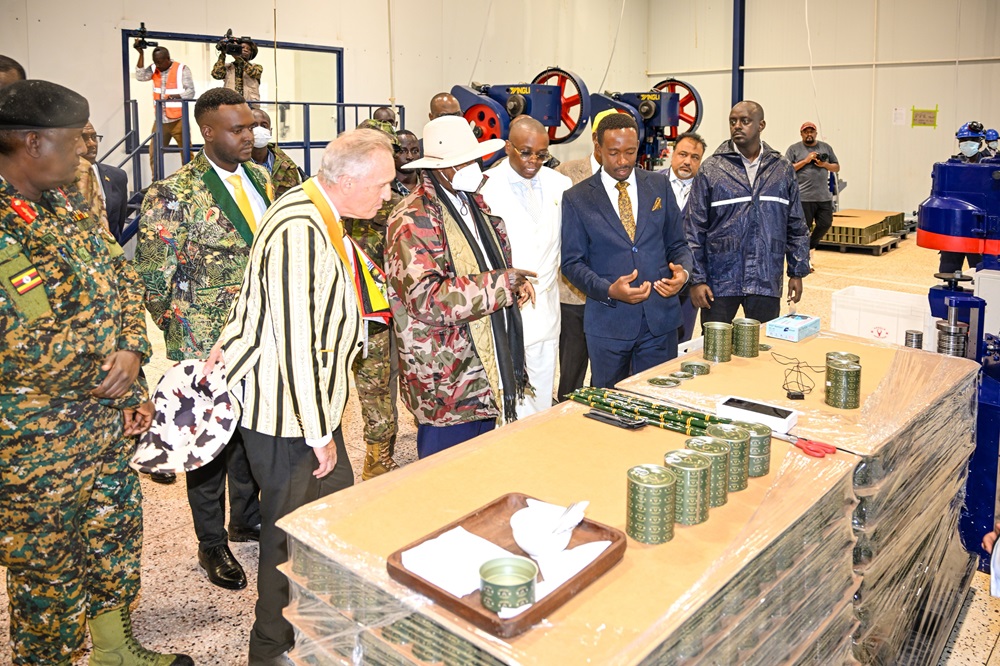
On a dusty stretch of Katonga ranchland in Kisozi, Gomba District, a tin-roofed processing hall that has waited seven years for its first can of beef finally started running. On July 15, 2026, President Yoweri Museveni commissioned the National Enterprise Corporation (NEC) Meat and Beans Processing Factory, a joint venture between the commercial arm of the Uganda People's Defence Forces (UPDF) and Kenyan investor Francis Ragwa, in a ceremony that doubled as a pointed lecture on why Uganda still imports the very foods its pastures could supply.
The facility, which will can beef and beans for the UPDF and other institutional buyers before targeting regional and export markets, is modest in headcount for now — about 100 workers, according to Ragwa, who serves as its managing director. But its symbolism is larger than its payroll. It is the latest attempt to answer a question that has trailed Uganda's livestock sector for decades: the country has one of Africa's largest cattle herds, yet it still spends foreign exchange importing canned beef and beans, some of the latter historically sourced from as far away as Brazil.
“First of all, I want to congratulate Mr. Ragwa for taking the initiative. Yes, NEC has given you the land, but the ideas were yours and I thank you and congratulate you,” Museveni told the gathering, which included Defence Minister Kiryowa Kiwanuka, Finance Minister Henry Musasizi, Trade Minister Sanjay Tanna, Permanent Secretary and Secretary to the Treasury Ramathan Ggoobi, and senior UPDF officers.
A Long Wait for a “Multi-Billion” Plant
Lt. Gen. James Mugira, NEC's managing director, told the ceremony that the project was first agreed in 2019 but was delayed by the COVID-19 pandemic before construction resumed. That seven-year gestation mirrors a familiar pattern in Uganda's agro-industrial push: ambitious joint ventures announced with fanfare, only to stall on financing, logistics or, in this case, a global pandemic, before finally breaking ground years later.
Now operational, the factory's stated purpose goes beyond commerce. Kiwanuka framed it explicitly as a security and logistics project as much as an economic one. “The UPDF is not only a fighting force but also a productive force. This factory is not just about business; it is about strategic logistics, troop welfare and national economic transformation,” he said, pledging that the Ministry of Defence and Veteran Affairs would prioritise procurement from the plant and pressing other government institutions to buy locally manufactured canned food instead of imports.
That import-substitution logic — replacing tinned beef and beans bought abroad with Ugandan-processed equivalents — is central to what officials are calling the “tenfold economic growth strategy.” Mugira said the plant would cut government spending on imported canned goods while creating jobs for engineers, food scientists and technicians.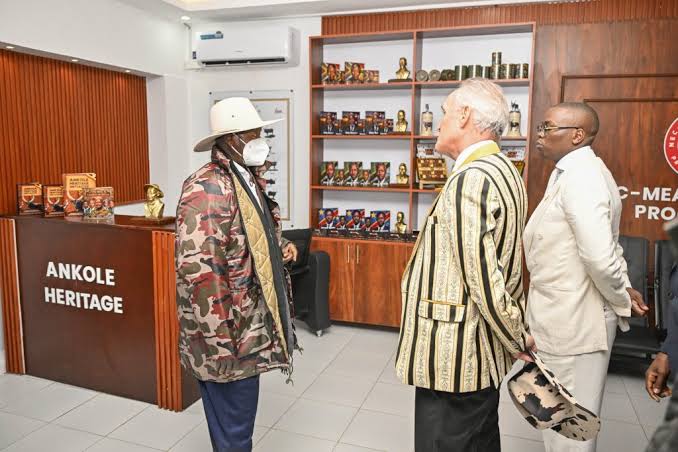
The Numbers Behind Museveni's Confidence
Museveni used the podium to make a broader case about Uganda's agricultural trajectory, citing figures he has increasingly leaned on this year: national dairy production has grown from 200 million litres annually in 1986 to about 5.4 billion litres today, while the cattle herd has expanded from roughly three million animals in 1986 to approximately 16 million now. He drew a parallel with coffee, whose output he said has grown from three million 60-kilogramme bags to about nine million, with a government target of 12 million bags and eventually 20 million.
“Once I got the economics right, I realised our small-scale farmers could earn good money even from one acre of land,” Museveni said, arguing that Uganda's constraint has never been production capacity but organisation — specifically, the absence of reliable, large-scale buyers capable of absorbing what farmers can produce. “The issue of the supply of the required raw materials is just organisational,” he said.
That claim will now be tested directly. With a guaranteed institutional buyer in place at Katonga, the government must decide how to supply it. Museveni described the choice as unresolved: rely on a small number of large commercial ranchers, or mobilise many smallholders. “We have to decide whether to rely on intensive farming or extensive farming. If we decide to use large-scale farmers, even 100 farmers producing about 300 cattle annually can sustain this factory. If we choose to involve peasants, we shall mobilise them once we know exactly what is required,” he said.
The distinction matters enormously for who benefits. A large-farmer model would concentrate the plant's economic upside among a small number of established ranchers in the cattle corridor — many already well capitalised — while a smallholder model would spread the income across thousands of pastoralist and mixed-farming households, at the cost of far more complex logistics: aggregation points, transport, veterinary certification and quality-grading systems that Uganda has historically struggled to build at scale.
A Bid for the Global Beef Market
Mugira used the commissioning to make a case that Uganda has left money on the table by exporting live cattle and raw hides rather than value-added beef products. He pointed to Botswana, a country with a far smaller herd than Uganda's, as proof of what disciplined disease control and export certification can achieve. “Uganda has a better climate, abundant pasture, sufficient labour and our Ankole cattle are internationally recognised for producing quality beef with low cholesterol. If the Ministry of Agriculture strengthens disease control, vaccination and export certification systems, Uganda can become a major player in the global beef market,” he said.
That is not an idle comparison. Uganda has taken tentative steps in that direction this month: on July 2, a presidential adviser on agricultural value addition flagged off the first consignment of processed Ugandan beef to Ethiopia under the “Ranchers Finest” brand, a sign that export-grade processing capacity is beginning to come online in more than one part of the country. But the gap between ambition and infrastructure remains wide. Uganda's livestock sector has been repeatedly disrupted this year by outbreaks of Foot-and-Mouth Disease across cattle-corridor districts including Sembabule, Ntungamo and Isingiro, which triggered government-ordered suspensions of cattle movement and sales. Export markets for meat products typically demand disease-free zone certification, traceability and consistent veterinary oversight that Uganda's decentralised, largely pastoralist herd management system does not yet reliably provide.
Infrastructure and Accountability
Museveni also used the event to needle his own government, questioning why licensed factories still struggle with basics like electricity supply after receiving Uganda Investment Authority approval. “Once the Uganda Investment Authority licenses a factory, the government should already know where it is going to operate and ensure all the necessary infrastructure is available,” he said, describing cabinet ministers as “pastors” responsible for shepherding their sectors and expressing hope that the new government team would eliminate coordination bottlenecks that have slowed projects like this one.
Ragwa, for his part, framed the factory's completion as proof of concept for private investment in Uganda's agro-industrial sector, thanking NEC for providing the land and crediting Uganda's political stability for making the investment possible. “This factory is proof that Africans can invest, create industries and employ themselves,” he said.
What It Means for Farmers and the Wider Economy
For livestock keepers in Gomba and the surrounding cattle corridor, the factory's immediate significance is the promise of a guaranteed, formal buyer — a rarity in a sector where farmers often sell cattle through informal markets and middlemen at unpredictable prices. If the smallholder-inclusive model favoured rhetorically by officials materialises, it could offer thousands of pastoralist households their first stable link to a processing and export value chain, mirroring what happened in Uganda's coffee sector over the past decade.
But the factory's success is not guaranteed by its opening. Its long, pandemic-interrupted road to commissioning is a reminder that capital-intensive agro-processing ventures in Uganda often outpace the surrounding ecosystem — disease control, farmer organisation, cold-chain logistics and export certification — needed to keep them running profitably. Whether Katonga becomes the anchor of a genuine Ugandan beef export industry, as Mugira envisions, or a modestly sized cannery serving mainly UPDF and domestic institutional demand, will depend on decisions the government says it has not yet made: how farmers are organised, how disease is controlled across the cattle corridor, and whether the infrastructure gaps Museveni himself flagged at the ceremony are closed quickly enough to matter.



