Written By | International News Agencies
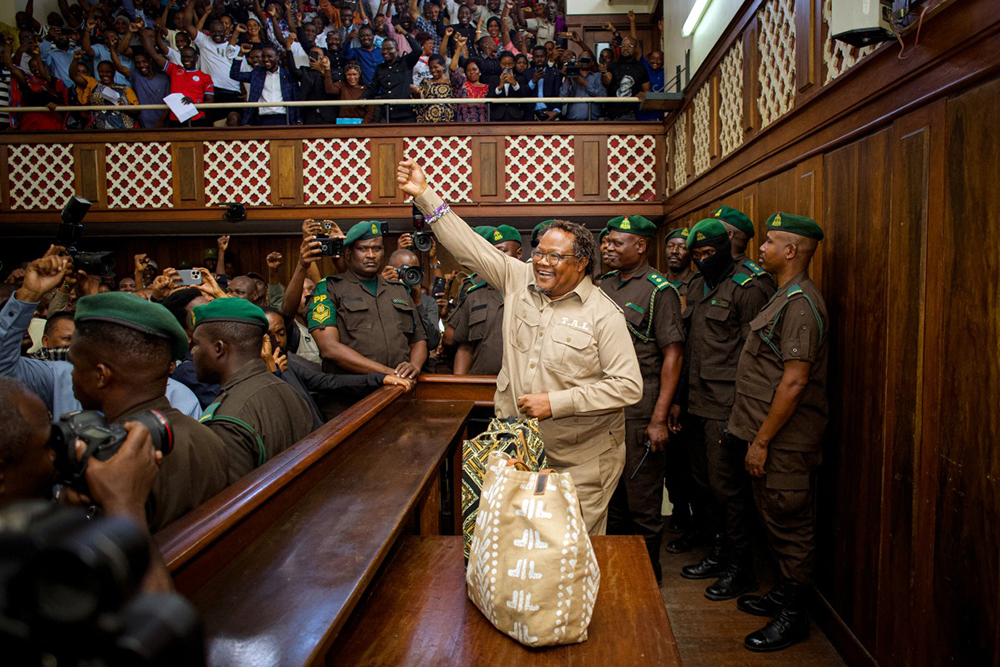
On Friday, Aug. 21, after months of delay, the High Court rejected the defence's submission of no case to answer and ruled that Lissu must present a formal defence.
Dar es Salaam
Twenty-six seconds of speech are the whole of the case against Tundu Lissu. That, at least, is the argument his defence spent this week putting on the record at the High Court in Dar es Salaam — and in doing so it has turned a treason prosecution into the only forum in Tanzania where the conduct of the October 2025 general election is being examined in public, under oath, with international observer findings read into evidence.
The prosecution began cross-examining Chadema's deputy secretary-general for Mainland Tanzania, Amani Golugwa, on Friday morning, after two days in which he told the three-judge panel that African Union, Southern African Development Community, European Union and Thabo Mbeki Foundation observers had all concluded that last year's vote fell short of democratic standards. Whether or not the judges accept a word of it, that testimony is now part of a court record in a country where the election's legitimacy has otherwise been effectively closed to challenge.
The charge
Lissu, the chairman of Chadema, Tanzania's principal opposition party, is charged with treason under Section 39(2)(d) of the Penal Code. Prosecutors allege that on April 3, 2025, at a Chadema meeting in Dar es Salaam, he incited the public to prevent the 2025 general election by making and publishing statements online intended to exert pressure on the country's most senior government leader.
He was arrested on April 9, 2025, after addressing a party rally, and charged with treason the following day, alongside a separate charge of publishing false information online. He has denied the allegations from the outset, framing the prosecution as a political dispute arising from his campaign for constitutional and electoral reform. Under Tanzania's Penal Code, treason carries a maximum penalty of death.
The remarks at issue came out of Chadema's "No Reforms, No Election" campaign, a nationwide push for changes to the electoral system before the October 2025 vote. Chadema was subsequently disqualified from contesting that election.
The ruling that changed the trial's shape
On Friday, Aug. 21, after months of delay, the High Court rejected the defence's submission of no case to answer and ruled that Lissu must present a formal defence.
That ruling is routinely misreported as a finding of guilt. It is not. At that stage a court decides only whether the prosecution has produced evidence which, left unanswered, could support a conviction; it makes no final determination of guilt and no detailed assessment of witness credibility.
The Tanzanian lawyer Alphonce Lusako, speaking to BreakThrough News, set out what the defence had argued. "This is a capital offense case, a very significant one here in Tanzania," he said. "The prosecution set out what are called the 'issues', or the ingredients of the case, because in a treason charge there are specific elements that must be established." Treason, he added, is not established merely by showing that an opposition politician made controversial statements; the prosecution must demonstrate the specific conduct and intention the statute requires. The defence's central contention was that "no intent to commit treason was established." The court disagreed that the threshold had gone unmet, and the trial moved into its defence phase.
Lissu is conducting much of his own defence. The court allowed him to re-examine himself on Aug. 28, when Chadema secretary-general John Mnyika opened the defence case. Golugwa is the third defence witness. Lissu has said he intends to call further witnesses, reportedly including President Samia Suluhu Hassan, former Vice-President Philip Mpango, former Prime Minister Kassim Majaliwa and the heads of the police and intelligence services — a list that, if even partly granted, would be extraordinary in any jurisdiction.
What the defence put on the record this week
Golugwa's evidence ran along two tracks: the words in the charge sheet, and the political environment around them.
On the words, he told the court that the passage cited in the charge takes about 26 seconds to read, while the portion of the April 3 meeting covered by journalists ran between 90 minutes and two hours, out of a meeting lasting roughly three hours. The rest, he said, dealt with electoral laws, past commissions, domestic and international observers, previous local and general elections, and Chadema's history of candidate disqualifications.
Asked by Lissu to examine the quoted terms, Golugwa said they named neither the Government of the United Republic of Tanzania, nor the President, Vice-President, Prime Minister, Cabinet, Attorney General, Director of Public Prosecutions, police, armed forces, prisons service nor intelligence services. "The word 'government' is not there," he told the court. "That word is not there at all," he said of the President.
Much of the argument turned on the Kiswahili verb kukinukisha, which appears in the alleged statement. Golugwa described it as making something emit a smell — a pleasant fragrance or a bad odour. "Words about producing a good smell or a bad odour cannot threaten it," he said. "I do not see at all where the government could be frightened."
On the publication charge, Golugwa was dismissive. Journalists from several outlets, including Jambo TV and The Chanzo, attended the April 3 meeting, and two broadcast part of it live but not its full duration; the party, he said, imposed no conditions on them. "That is false in broad daylight," he said of the allegation that Lissu published the words on Jambo TV. "How could Lissu publish on Jambo TV when he is not a journalist and does not work for Jambo TV?" He added that he was aware of no action taken against Jambo TV, The Chanzo or their journalists for reporting the event.
On the environment, Golugwa attributed criticism of the 2025 election to the SADC, EU, Commonwealth, African Union and Thabo Mbeki Foundation. Asked by Lissu what SADC observers had said, he replied: "They said Tanzania's election did not meet the standards of democratic elections. There were threats and mistreatment of opposition party leaders, the competition was not level, and there was no transparency in the whole process." He said EU observers had raised concerns about violence, killings, abductions and disappearances before the vote and about conditions favouring the ruling Chama Cha Mapinduzi, and that the Thabo Mbeki Foundation had concluded the announced presidential and parliamentary results did not reflect voters' will. He said he had not personally seen the Commonwealth report but had heard its secretary-general express concern over violence and deaths.
His summary of the prosecution's approach was the sharpest line of the week: "If someone brings you a few words from the charge sheet after all that speech, I see it as something manufactured with bad intent against you — to oppress you and our party so that we cannot conduct politics permitted by law."
Golugwa also gave the court an account of two of his own arrests. He said that on May 13, 2025, while travelling to Belgium to represent Chadema at an International Democracy Union meeting, he was stopped after receiving a boarding pass, detained by men who did not identify themselves, and had two pages of his prepared speech seized. He testified that one of them put a gun to his right ear and said: "You fools are the ones planning trips to go and smear the country abroad. Today you will understand." He said he was taken to Stakishari Police Station, told he was suspected of cybercrime and money laundering, and later released; the trip did not take place. He said he was arrested again on Nov. 8, 2025, at his parents' home in Arusha, on allegations of terrorism and conspiracy, and released without making a statement. Asked what the repeat arrests meant, he answered: "Its purpose was to intimidate me and my fellow leaders so that we would not do our party work."
State Attorney Nassoro Katuga objected that a witness's personal account of travel and arrest fell outside the proper scope of evidence-in-chief. Lissu replied: "My evidence and Mnyika's evidence concern a campaign of government oppression against us and our party. This case is oppressive, false and political." Justice Dunstan Ndunguru urged both sides to stay focused, observed that the prosecution bears the burden of proof and that the defence — unlike the prosecution — does not normally file advance witness statements, and noted that the prosecution retains the right to cross-examine as part of a fair trial. The evidence was not excluded.
The panel comprises Justices Ndunguru, James Karayemaha and Ferdinand Kiwonde, sitting at the High Court's Dar es Salaam sub-registry. 
Why it matters
Samia Suluhu Hassan was declared the winner of the Oct. 29, 2025 presidential election with 97.66 percent of the vote. The poll was accompanied by severe restrictions on opposition activity and by violence in which security forces were reported to have used lethal force against protesters. A government-appointed commission later put the death toll at 518 across 11 regions, while cautioning that the figure might not be conclusive.
That combination — a near-unanimous official result, a disqualified main opposition party, and a state-commissioned death toll in the hundreds — has left Tanzania without a functioning venue for adjudicating what happened. The courtroom in Dar es Salaam has become the substitute. Every observer finding Golugwa reads into the record is a fact the state must now respond to under cross-examination rather than by press statement.
There is an obvious risk in this for the defence, and the prosecution began exploiting it on Friday. Cross-examination will test whether Golugwa has read the reports he characterised, whether his summaries are accurate, and whether any of it bears on the elements of treason at all. A witness who overstates is a gift to the state.
The parallel with Zambia, where the runner-up in last month's presidential election is in a maximum-security prison on a treason charge, is not coincidence so much as convergence. Two governments in the same region have found the same statute useful against the same category of defendant. The difference is that Tanzania's case has reached the stage where evidence is tested in open court — and that is the part worth watching.
What to watch next
Three markers will define the next phase. The first is how Golugwa withstands cross-examination, and whether the state succeeds in confining the trial to 26 seconds of speech rather than a year of politics. The second is the court's response to Lissu's stated intention to summon the President and the security chiefs; a refusal would become its own political story, and a summons would be unprecedented. The third is timing — this prosecution has already been paused for five months once, and the pace at which a three-judge panel moves through a defence case of this scope will say a good deal about whether the court intends to resolve the matter or let it run.



