Written By | Entertainment Desk
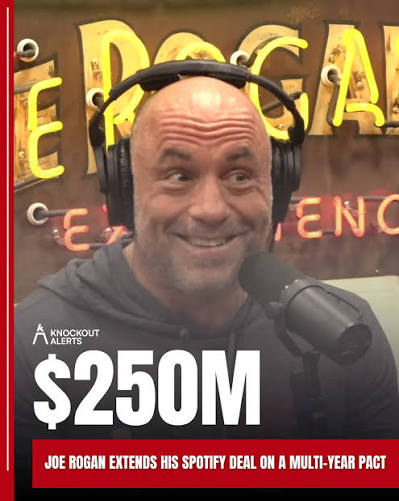
The terms are private, but the reported price tag, around $250 million, says plenty about what audio is worth in 2026.
NEW YORK
There are not many entertainers whose contract renewals make headlines on their own, but Joe Rogan is one of them. On Thursday, October 8, Newser reported, citing the Wall Street Journal, that Spotify has signed a new multiyear agreement keeping The Joe Rogan Experience under its umbrella. The terms have not been made public. According to the Journal's sources, they resemble his prior deal, which was valued at up to $250 million, and Newser's headline put the figure at "around $250M."
We were unable to reach the Journal's original report, so the numbers here come through Newser's summary and should be read as reported rather than confirmed. Neither Rogan nor Spotify has disclosed a figure.
What Spotify keeps
Under the arrangement, Spotify retains licensing rights and ad sales. That is the financial engine of the deal. The show is no longer a Spotify exclusive and is distributed across platforms, including YouTube, where Rogan has more than 21 million followers, but the company that sells the ads and holds the license sits at the center.
In a statement, Rogan said: "The partnership with Spotify has been an amazing fit, and they're incredible to work with." He added: "I'm extremely happy and excited to continue with them for years to come." It is the language of a mutual renewal rather than a negotiation under pressure, though of course statements of this kind rarely show the hard bargaining behind them.
How we got here
The first Spotify deal arrived in 2020 and was worth around $100 million. At the time it was a statement of intent: the streaming service wanted to turn a music app into a home for talk, and it was willing to spend heavily to prove it. The show itself began in 2009 and has topped U.S. podcast rankings since 2019. According to Edison Research, it reaches nearly 30 million Americans every week.
Those are the sorts of numbers that make advertisers and platforms pay attention, delivered through long, unhurried conversations that listeners treat as a habit rather than an appointment.
The controversy question
Any story about Rogan and Spotify carries a second thread, and Newser notes it plainly: Spotify has taken a largely hands-off editorial approach, including during controversies over medical misinformation. Critics have long argued that a platform paying this much for a show owns some responsibility for what is said on it. Supporters respond that open conversation is the product and that a platform that edits a long-form interview show would quickly lose the audience that makes it valuable.
Spotify's own argument, as Newser summarizes it, is practical: guests routinely see gains across music, books, and other media after appearing on the show. For artists, authors and comedians, a Rogan appearance is a marketing event. That promotional reach is part of what Spotify is buying, and part of why it keeps the relationship alive.
Why the money makes sense
The economics of podcasting have shifted since 2020. Exclusive deals once looked like land grabs; today the dominant logic is reach. Distributing the show on YouTube while keeping licensing and ad rights at Spotify is a hedge: the audience can find the show wherever it likes, and the company still controls the monetization.
If the reported figure is accurate, the renewal says that top-tier audio talent has held its value even as the early frenzy cooled. A flagship show that reportedly still commands a deal of this size suggests the category's leader remains in a league of its own.
What it means for the rest of the industry
The renewal also arrives with the show at a particular point in its life. Fifteen-plus years in, it remains a fixture at the top of the charts, which is rare in a medium where audiences drift quickly. Longevity of that kind is part of what a platform pays for: predictable reach, a loyal base, and a steady stream of guests that other outlets can clip, discuss and argue over.
For other creators, the lesson is leverage. A show with a proven audience can negotiate for both money and distribution freedom. Rogan's deal, an anchor with non-exclusive reach, is likely to become the template other big names point to at the bargaining table.
For competitors, it is a reminder that talent is scarce. Platforms that want to be destinations for talk and video need franchises, and there are only so many shows that qualify. Losing the biggest to a rival would have been a notable blow to Spotify; keeping him stabilizes its catalog for several years.
What this means for you
For listeners, the practical answer is that nothing changes: the show remains available on Spotify and on YouTube, and you will not be asked to switch apps. If you follow a favorite podcast, though, pay attention to where its ads and licensing live. That is usually the best clue to where the show's future is decided.
For anyone who works in media, the number is a reference point. It shows that spoken-word audio, once considered a niche, now competes in the same financial conversation as scripted television and sports rights. For anyone curious about the debates surrounding the show, the renewal guarantees they will continue.
The bottom line
Spotify has chosen continuity. Joe Rogan gets stability and a platform; Spotify gets its crown jewel. The details, and the exact size of the check, remain private, but the message is public enough: the biggest voice in podcasting is staying put.



