New Delhi
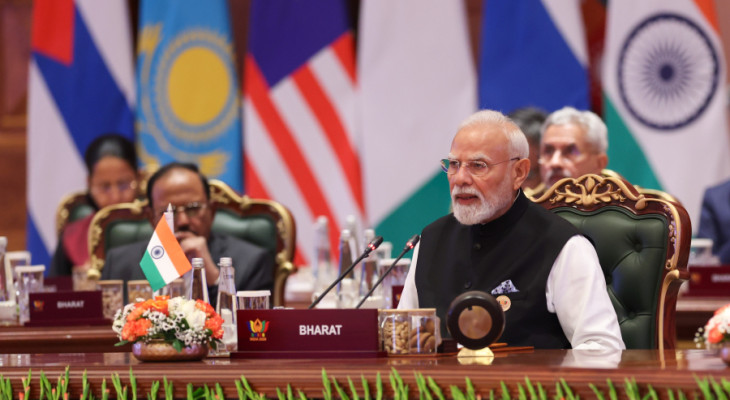
The eighteenth BRICS summit ended at Bharat Mandapam in New Delhi on Sunday having achieved the thing that had seemed least likely when the week began: a single agreed text. The New Delhi Declaration, a roughly 45-page communiqué running to some 140 paragraphs, was hammered out in negotiations that ran until about four o’clock on Saturday morning and adopted on the summit’s opening day. It criticises a war, a tariff campaign and a sanctions policy that every delegation in the room understood to be American, and it does so without using the words “United States” or “Donald Trump” once.
That omission is the story. The grouping now contains countries on directly opposing sides of a shooting war, and the drafting exercise was less about projecting strength than about proving the bloc could still produce a sentence all of its members would sign.
Background
BRICS began in 2006 as an informal conversation among Brazil, Russia, India and China, held its first leaders’ summit in 2009 and added South Africa a year later. The 2023 expansion brought in Egypt, Ethiopia, Iran, Saudi Arabia and the United Arab Emirates; Argentina declined its invitation after Javier Milei’s election, and Indonesia joined in 2025. Sources differ on the current headcount and on Riyadh’s exact standing: Al Jazeera describes an eleven-member bloc covering roughly 49 per cent of the world’s population and about 40 per cent of global GDP, while Bloomberg’s account of the declaration refers to ten BRICS nations and describes Saudi Arabia as “not yet a full BRICS member.” The ambiguity has persisted since 2023 and the summit did not resolve it.
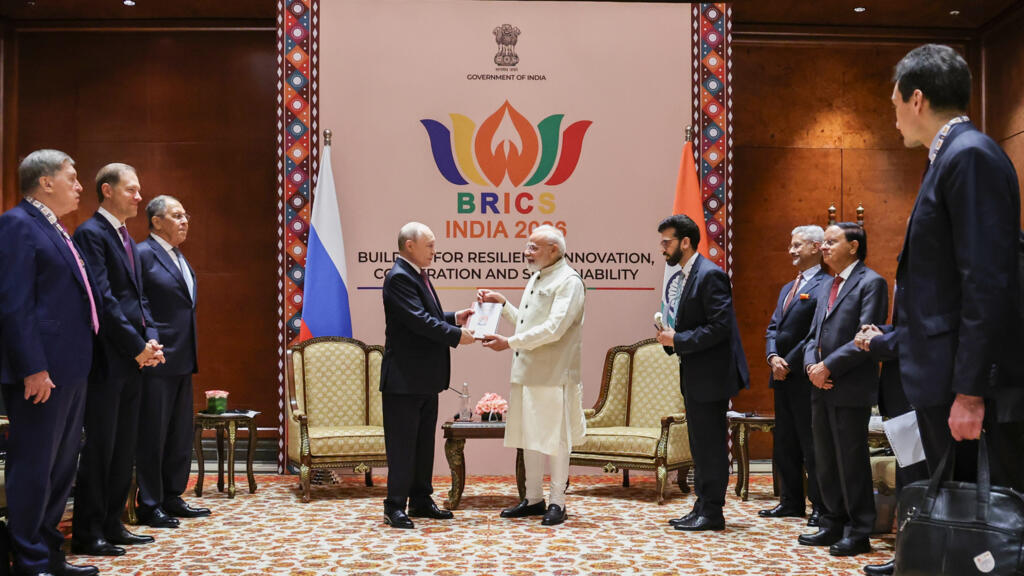
India held the 2026 chairship under the theme “Building for Resilience, Innovation, Cooperation and Sustainability,” and used it heavily: more than four hundred ministerial, parliamentary, official and business meetings across thirty Indian cities fed into the New Delhi text. Some 30,000 additional security personnel were deployed in the capital, and Delhi police closed roads around delegation hotels for the duration.
The context was grim. The summit convened more than six months into the US and Israeli war on Iran, with the Strait of Hormuz effectively closed, Brent crude above $100, Houthi forces having taken Yemen’s Red Sea coast and Saudi Arabia’s East–West pipeline — its principal bypass route for crude — shut after drone strikes launched from Iraqi territory days earlier. Russia’s war in Ukraine continued alongside an active American mediation effort. In May, a BRICS foreign ministers’ meeting in New Delhi had failed to agree any joint statement at all, a collapse India attributed to “differing views among some members” on West Asia.
Key Developments
The declaration’s language on the Middle East is the product of that failure. It expresses “deep concern” at the continued escalation in West Asia, calls for “maximum restraint” and for avoiding actions that could aggravate the situation, and urges protection of civilians and civilian infrastructure, respect for sovereignty and territorial integrity, and greater reliance on dialogue and diplomacy. It condemns “deliberate attacks on civilian infrastructure and peaceful nuclear facilities” under International Atomic Energy Agency safeguards, insisting that nuclear safety, security and safeguards be upheld including during armed conflict. It stresses the need to keep global trade, supply chains and energy flows moving, and — in the passage aimed most directly at the Gulf — the necessity of ensuring the safety of seafarers and the security of commercial navigation. No state is named as the author of any of it.
On Gaza, the leaders called for the ceasefire to be maintained and for full and unhindered humanitarian access, opposed policies aimed at the forced displacement of Palestinians, and reaffirmed support for a two-state solution with a sovereign, independent and viable Palestinian state inside the internationally recognised 1967 borders and East Jerusalem as its capital.
On global governance — India’s priority — the text restates the demand for comprehensive UN reform including the Security Council, records that no woman has ever been elected Secretary-General, and pointedly deplores attempts to undermine multilateral institutions “including by deliberately withholding assessed contributions.” China and Russia again reiterated support for Brazil and India playing a greater role at the UN, language short of a formal endorsement of permanent seats.
On money, the outcome was more modest than the headlines suggest. Members agreed to expand settlement in national currencies and to deepen cooperation on cross-border payments; they did not endorse a common BRICS currency, and India’s Ministry of External Affairs said plainly that no such proposal is on the table. Alicia García-Herrero of Natixis had predicted as much before the summit: leaders would discuss payment channels under Western sanctions, “but they will not try to substitute the dollar.”
Prime Minister Narendra Modi proposed a BRICS Continuity and Implementation Mechanism to preserve institutional momentum as the chairship rotates annually, framed the summit as the grouping’s twentieth-anniversary “coming of age,” and argued that the Global South must move from being a rule-taker to a rule-shaper. On Sunday he warned against the weaponisation of critical minerals and told delegates: “We strive to advance not by opposing anyone, but by taking everyone along. Now is the time for us to translate our unity and consensus within BRICS into tangible results on the global stage.”
Reactions and Divisions
Attendance told its own story. Vladimir Putin, Xi Jinping, Masoud Pezeshkian, Abdel Fattah el-Sisi, Abiy Ahmed, Prabowo Subianto, Cyril Ramaphosa and Kassym-Jomart Tokayev came in person, along with Anwar Ibrahim, Ferdinand Marcos Jr and UN Secretary-General António Guterres. Brazil sent Foreign Minister Mauro Vieira in place of Luiz Inácio Lula da Silva, who was occupied with local elections. Saudi Arabia sent Foreign Minister Faisal bin Farhan; the UAE sent the crown prince of Abu Dhabi, Sheikh Khaled bin Mohamed bin Zayed.
Diplomats with knowledge of the talks, speaking anonymously, said the sharpest fight was between Iran and the UAE. Tehran wanted an explicit condemnation of the United States and Israel; Abu Dhabi, a US ally that has taken Iranian drone and missile strikes and imposed an indefinite trade embargo on Iran in August, wanted Iran condemned in return. India — which maintains working relations with Iran and Israel while trying not to antagonise Washington, and which imports roughly a third of its oil through Hormuz — brokered the compromise. Sudhakar Dalela of the Ministry of External Affairs put it carefully: “We are very happy that we have an agreed approach on West Asia and the centrepiece of that approach is that we all believe dialogue and diplomacy should be the guiding parameter to addressing any conflict.”
Pezeshkian, on his first visit to India as president and the first by an Iranian head of state to the subcontinent in eight years, set a combative tone. “They thought that like Venezuela they could conquer our country within 24 hours,” he told India Today. “It failed.” On the sidelines he told Malaysia’s Anwar Ibrahim that West Asia “does not need a regional policeman.” He also met the Abu Dhabi crown prince, a meeting read in the region as a tentative thaw.
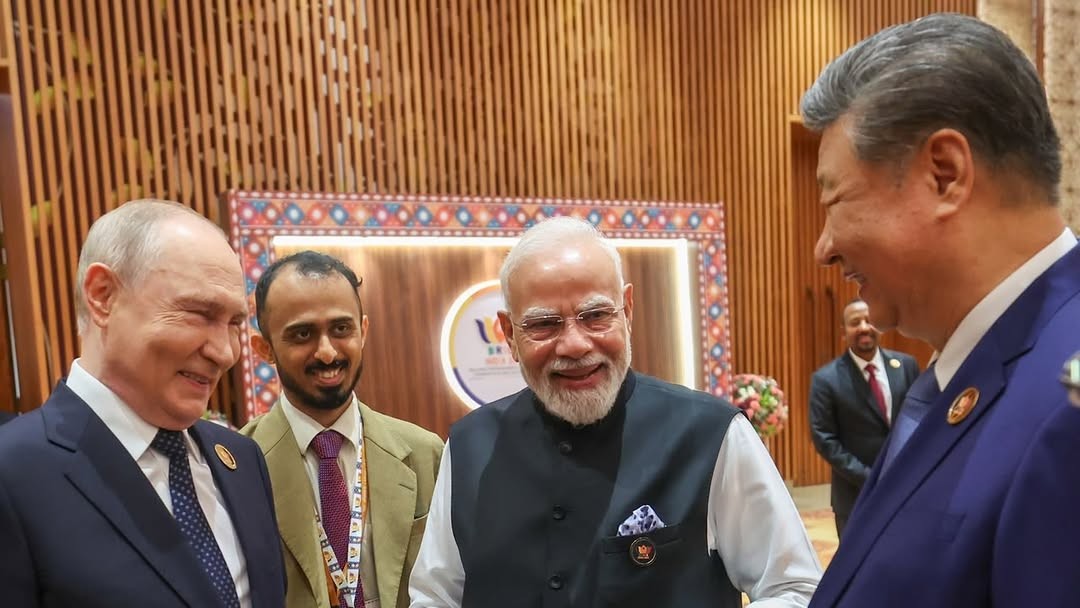
Xi, attending his first Indian visit in seven years after skipping last year’s Rio summit, urged BRICS to “stand on the right side of history,” warned that the Gulf war serves no one’s interests, and proposed an open-source artificial intelligence “special zone” for members. His bilateral with Modi produced a commitment to a “fair, reasonable and mutually acceptable” settlement of the boundary question and an agreement, in Modi’s phrase, that differences should not become disputes — but the two readouts diverged on sequencing, with New Delhi insisting border tranquillity is the precondition for normal ties and Beijing proposing parallel progress. “China and India are partners, not rivals,” Xi said. No new institutional dialogue was announced.
Putin met Modi bilaterally and spoke with Xi on the margins; his spokesman Dmitry Peskov said both leaders asked in detail about efforts to settle Ukraine and offered help. Alexey Maslov of Moscow State University drew the obvious conclusion: “The paradox is that Putin’s policies, however you look at them, have not resulted in Russia’s isolation.” Ashok Malik of the Asia Group read the communiqué as “obvious frustration with Trumpism — unilateralism, the snubbing of the multilateral institutional order, the tariff assault, the neglect of rules,” drafted “so as not to take sides between Iran, Saudi Arabia and the UAE while leaving everyone with something to go home with.”
What’s Next
The immediate test is not the declaration but what follows it. Xi is due in Washington for a state visit with Trump on 24 September, less than a fortnight after telling a Delhi audience that BRICS should pioneer the reform of global governance. The administration has threatened sanctions against any country assisting Iran and has called BRICS anti-American; whether the bloc’s agreed language on navigation and energy flows translates into anything operational in the Gulf is untested.
The structural questions are older and unresolved. Beijing treats BRICS as its premier vehicle for mobilising the Global South; New Delhi treats it as an instrument of strategic autonomy that is non-Western without being anti-Western. Those are not the same project, and a rotating chairship does not reconcile them — which is precisely what Modi’s proposed continuity mechanism is designed to paper over. Alejandro Reyes of the University of Hong Kong framed the standard better than the standard usually gets framed: the real question is not whether BRICS can achieve unity, but whether it can manage disagreement while still pursuing practical cooperation. On that measure, a communiqué agreed at four in the morning between a country at war and two of the country attacking it counts as a pass — narrowly.
Published By | News Editor