Written By | International News Agencies
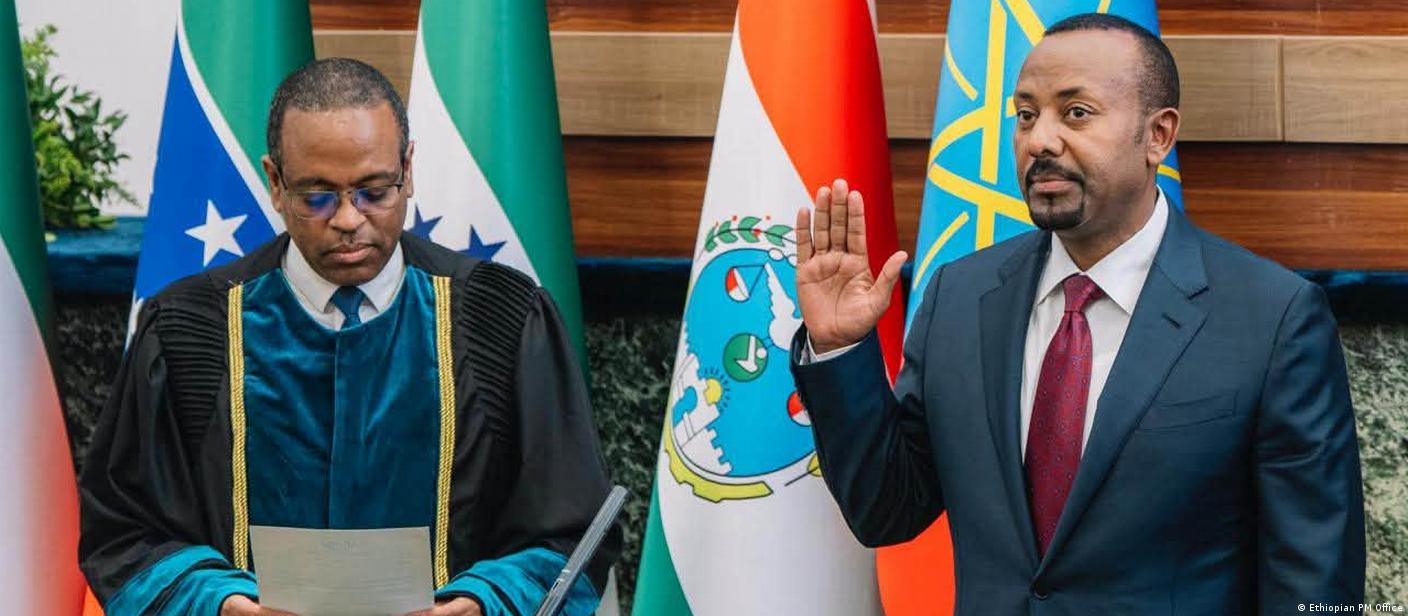
Abiy was sworn in on Monday, October 5, at the inaugural session of the newly elected House of Peoples' Representatives in Addis Ababa, according to reporting by Eastleigh Voice.
ADDIS ABABA, Ethiopia
Prime Minister Abiy Ahmed took the oath for a second five-year term on Monday, but he did so in the middle of the most dangerous crisis of his tenure since the 2020–22 Tigray war. Within the past week, Ethiopian federal forces have retaken Mekelle, the Tigray regional capital, from fighters of the Tigray People's Liberation Front (TPLF). Explosions have shaken Addis Ababa itself, and Ethiopia and Eritrea have severed diplomatic relations. The timing matters because the new government, which Abiy has named the "Medemer Government," inherits both a fresh electoral mandate and a security situation that threatens to unravel the 2022 Pretoria peace agreement.
A mandate with gaps
Abiy was sworn in on Monday, October 5, at the inaugural session of the newly elected House of Peoples' Representatives in Addis Ababa, according to reporting by Eastleigh Voice. President Taye Atske-Selassie opened the session, and Ahmed Shide, a former transport and logistics minister, was elected Speaker of the House. Capital FM reported that "Medemer," an Amharic term often translated as "addition" or "coming together," is the name of the new administration, and that the Prime Minister's Office said Abiy took the oath after being named Prime Minister for a second term.
The mandate rests on a general election held on June 1, 2026. According to the summary of the election compiled on Wikipedia, 486 of the House's 547 seats were decided, with turnout reported at 95.70 percent of 54.06 million registered voters. The ruling Prosperity Party won 438 seats, which is 19 fewer than it held after the previous election. Opposition parties collectively won 40 seats, with the Ethiopian Citizens for Social Justice party (EZEMA) taking the most, at 13, and eight independent candidates were elected. The majority threshold was 274 seats, so the party's margin is overwhelming.
The arithmetic conceals a significant gap. The remaining 61 seats were left unfilled for security reasons, including all 38 seats in the Tigray region, where no vote took place. The National Election Board cited "unfavourable conditions" after the Tigray war and continuing instability involving armed groups such as the Fano militia in Amhara and the Oromo Liberation Army. International observers had also raised concerns before the vote about what they described as government suppression of the opposition. Abiy therefore begins his second term with a supermajority in a parliament that does not include a region that is now at the center of the fighting.
Another item sits on the new government's desk. The Ethiopian National Dialogue Commission submitted its consolidated recommendations across eight thematic areas to parliament and regional governments on October 3, according to Eastleigh Voice. Whether those recommendations survive contact with a deepening war is one of the open questions of the coming months.
The fighting returns
Capital FM reported that renewed fighting began on September 23. The TPLF, according to Capital FM's account of the opposition's structure, joined six other armed groups, among them the Fano militia, in an alliance that seeks to remove Abiy's government. Garowe Online, citing the Ethiopian authorities, identified the grouping as the Ethiopian Peoples' Forces Alliance for Survival. The alliance's claims about its own composition should be treated cautiously, since independent verification from the conflict zone is limited.
The scale of the violence is already considerable. Capital FM reported that fighting in Alamata killed at least 52 civilians over three days. eNCA reported that the federal military launched a counteroffensive toward Mekelle along three axes, and that government-aligned forces pushed TPLF fighters out of Afar state, retaking the towns of Abala, Erebti and Megale. Al Jazeera reported that federal forces and allied Tigray Peace Force fighters took Mekelle, and that the TPLF confirmed its withdrawal. Humanitarian sources cited by Capital FM said at least 17 people died in attacks near Mekelle on the day of the inauguration.
The TPLF has described its withdrawal as "tactical," saying it would "operate from somewhere else" and keep fighting, Al Jazeera reported. That framing is consistent with the group's history. In the earlier war, federal forces captured Mekelle on November 28, 2020, and TPLF forces recaptured it on June 28, 2021, as the Wikipedia entry on the 2020 offensive records. The government's own announcement points to a political track alongside the military one: Al Jazeera said federal authorities plan a new interim administration for Tigray and regional elections "within months." A reader should note that a federally appointed interim administration is the kind of arrangement the TPLF is likely to reject, and it would sit awkwardly with the Pretoria agreement's unresolved questions of disputed territories, the return of displaced people and the disarmament of Tigrayan forces.
The conflict has also reached the capital. Explosions were heard near Addis Ababa's intelligence headquarters on October 1, and eNCA reported that drone strikes hit the Ministry of Defence and an army base. Opposition sources claimed responsibility for a drone attack, while the authorities have not confirmed details, according to Capital FM. For a government that has staked its legitimacy on restoring order, the sight of first-person-view drones over the capital carries symbolic weight well beyond the physical damage.
The Eritrea rupture
The regional dimension sharpened sharply on October 1. Ethiopia's Foreign Ministry said it had decided "to close its Embassy in Asmara, Eritrea, in response to Eritrea's direct and indirect acts of hostility," according to Daily Maverick, and ordered 10 Eritrean diplomats in Addis Ababa to leave within 48 hours. Eritrea's foreign ministry replied that it "has no option but to reciprocate in kind and sever all diplomatic ties with Ethiopia."
Eritrea's information minister rejected the accusation that Asmara backs the alliance, saying the Prosperity Party was blaming neighboring countries to divert attention from internal conflicts, as Capital FM reported. Daily Maverick said Ethiopia has also accused Sudan and Egypt of supporting the alliance, and eNCA reported that Ethiopia expelled an Egyptian diplomat and Cairo reciprocated. Disputes over Ethiopia's Nile mega-dam and its ambitions for Red Sea access run through all of these exchanges.
The reversal is stark. Ethiopia's embassy in Asmara reopened in 2018 as part of the rapprochement that earned Abiy the Nobel Peace Prize. Eritrea fought alongside Ethiopian federal forces in the 2020–22 war but was excluded from the 2022 Pretoria agreement, and relations soured afterward. Daily Maverick reported that there are accounts of Eritrean soldiers joining the opposition offensive in Afar, though such reports remain unverified.
The Red Sea question is central. Yahoo News, in a report on the Prime Minister's comments, said Abiy has insisted on access to the Red Sea despite the threat of regional conflict, and Al Jazeera's Africa page reported that Somalia's president said Ethiopia must negotiate for port access. At the same time, the TPLF leader said, according to eNCA, that "the war is regional and it is a war to control the Red Sea." Both sides, in other words, are describing the conflict in terms that reach far beyond Tigray.
Analysis: three tests for the second term
The first test is whether the federal victory in Mekelle can be converted into a durable political settlement. Capturing a regional capital is a military event; governing a region that did not vote in June is a political one. The 38 vacant Tigray seats mean that any interim administration will lack an electoral mandate from the people it governs, and the earlier war is a reminder of how fragile such gains can be, since Mekelle fell to federal forces in November 2020 and was back in TPLF hands by June 2021.
The second test is the Eritrea front. Cutting diplomatic ties removes the channels through which crises of this kind are normally contained. Both governments now face reputational and strategic incentives to avoid appearing weak. Regional diplomacy is moving quickly in the opposite direction from de-escalation: Al Jazeera reported a joint declaration by four African leaders as the Ethiopian conflict worsened, and Capital FM reported joint meetings among Egypt, Eritrea, Somalia and Sudan, with Garowe Online describing an Egypt-hosted summit, calling for peaceful resolution of disputes, while the African Union and the United Nations urged restraint. From Addis Ababa's perspective, however, that Cairo-centered grouping looks like a coalition of rivals.
The third test is domestic. The Prosperity Party's supermajority gives Abiy legislative freedom, and pre-election observers had worried about proposed constitutional changes toward a presidential system. Nothing in the sources reviewed indicates such a move is imminent, and it would be speculative to predict one. But a government at war with an alliance that includes armed groups from several regions will be tempted to centralize authority, and critics will watch for that. Meanwhile the United Nations has warned that insecurity is disrupting humanitarian operations in northern Ethiopia, which raises the humanitarian stakes for civilians who have already lived through one devastating war.
What to watch next
Several developments will show whether the crisis narrows or widens. The first is where the TPLF fighters regroup and whether the alliance can sustain drone attacks on Addis Ababa. The second is the shape and legitimacy of the promised interim administration and regional elections in Tigray. The third is whether any third party, whether the African Union, the United States or a regional power, can open a channel between Addis Ababa and Asmara now that formal relations have ended. The fourth is the fate of the National Dialogue Commission's recommendations, which could provide a political vehicle for addressing grievances if the guns quiet. Finally, casualty and displacement figures remain thin and are mostly attributed to partisan or humanitarian sources; independent verification will be essential.
For now, the central fact is the contrast between a ceremony in Addis Ababa that celebrated unity and a country whose north, east and capital are all touched by fighting. Abiy's second term has begun with an overwhelming parliamentary majority and very little room for error.



